
रामायण सारांश में
Posted by admin in April 2022, Past issues on April 14, 2022
लेखक: जुगिन्दर लूथरा, वियर्टण, पश्चिम वर्जीनिया
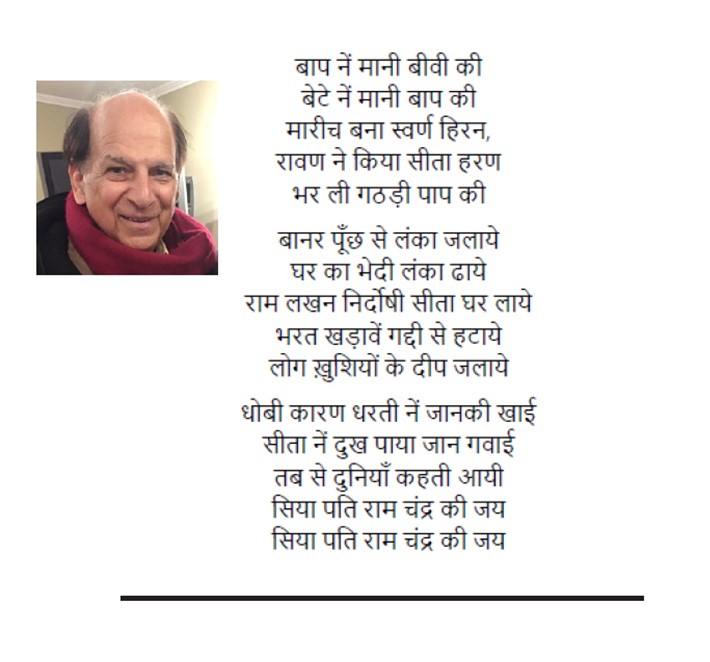
Summary of Ramayan
By Juginder Luthra, Weirton, WV
Father agreed with what wife said
Son agreed with what father said
Marich transformed to a golden deer
Ravan kidnapped Sita
Filled his bag of sins
Monkey burnt Lanka with his tail
Lanka fell by leaked family secret tale
Ram Lakhan brought innocent Sita home
Bharat removed sandals from throne
People joyfully lit lamps in homes
Due to washerman, earth swallowed Janaki
Sita bore sufferings, even lost her life
Since then people keep saying,
“Victory to Sita’s husband, Ram Chandra!”
“Victory to Sita’s husband, Ram Chandra!” .∎
“The Kashmir Files” Portrays the Brutal Genocide and Exodus of the Kashmiri Pandits
Posted by admin in April 2022, Past issues on April 12, 2022
By Bupesh Kaul, Squirrel Hill, PA
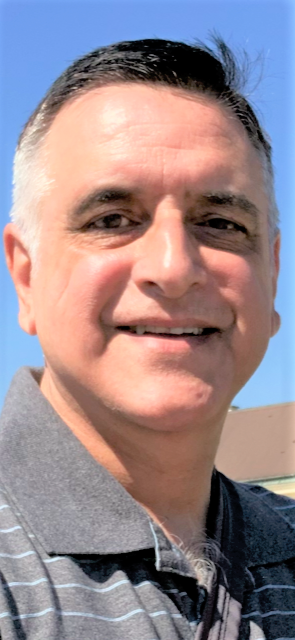
Bupesh Kaul, a resident in our area for over twenty-five years, is a practicing physician, now in semi-retirement. He was an associate professor at the University of Pittsburgh School of Medicine. This is his review of Vivek Agnihotri’s acclaimed film The Kashmir Files.
The release of the movie, The Kashmir Files, has led to a renewed interest in the happenings in the verdant vale of Kashmir over three decades ago. The history of Kashmir is very tangled and complex — as all history usually is.
In the Indian context, Kashmir was an important center for learning — arts, literature, religion, and spiritual quest -— a place where Adi Shankaracharya preached as he revived Hinduism during his travels in the eighth century, CE.
The advent of Islam in the valley in the 14th century, though initially comparatively peaceful, became particularly brutal for the Kashmiri Hindus (Kashmiri Pandits) resulting in mass conversion to Islam, not always by persuasion. At one point, only a small number of Hindu families were left in the valley. Following the Anglo-Sikh war in mid-19th century, Kashmir, which was a part of the Sikh Empire and was mostly Muslim, was “sold” to the Raja of Jammu by the British for a princely sum of 75 lakh Nanakshahi Rupees. The State became Jammu & Kashmir (J&K).
In August 1947, J&K had four distinct regional ethnicities. The Kashmir Valley (Kashmiri), Jammu (Dogri), Ladakh (Ladakhis) & the Northern territories (Gilgit and Baltistan). The Valley had a Hindu minority, about 2-3% of the population. The Kashmiri language was spoken only in the Valley.

It is beyond the remit of this article to trace or debate the political machinations, calculations, and intrigue from 1947 to 1990 that led to the exodus of the minority Kashmiri Pandit community from the Valley in 1990. But what is indisputable is that a premeditated, calculated effort was made to rid the Valley of its Hindu natives. Long before the term “ethnic cleansing” gained currency in the West, it was a reality for the minority Hindu community in the Kashmir Valley. A targeted and carefully orchestrated campaign resulted in a premeditated brutal murder of scores of Pandits that led to the mass exodus of the minority Hindu population from the Valley.
The film also brings into sharp focus the inability/unwillingness of the Indian state and its media to recognize this issue as an Indian issue instead of seeing it as a Kashmir issue. The film does not portray the planning, coordination, and orchestration of the attacks by India’s immediate neighbors. Excepting for this and other minor quibbles, the movie graphically captures what should only be called genocide by terrorism, leading to the exodus of almost all Kashmiri Pandits from the Valley.
Watching the movie at the Waterfront Multiplex, I and other members of the Pandit community had a cathartic release, with many in the audience sobbing through the screening. The makers of The Kashmir Files do not shy away from making bold statements and that is the strength of the movie.

The director, Vivek Agnihotri gives voice to alternate viewpoints for which he needs to be commended. The Pandit community hopes this film will initiate a dialog to bring out the deafening silence by both the media and a spate of weak, corrupt politicians and officials who conspired, perhaps unwittingly, to condemn the whole Pandit community to become refugees in their own land. And bring to justice the perpetrators of the murder, loot, rape, and pillage perpetrated on a peaceful community.
The Pandits believe in the idea of India and in law and order, and not in vigilante justice. Which is why not one Kashmiri Pandit picked up a gun to avenge the murderous wrongs perpetrated on the community. ∎
Coming of Age for Indian Americans in the ‘Burgh
Posted by admin in April 2022, Past issues on April 12, 2022
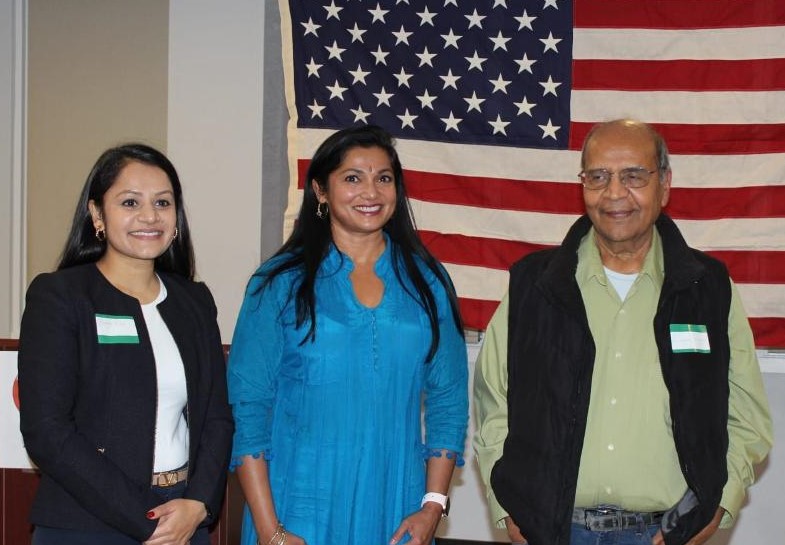
People of Indian origin in our area, while continuing with their careers as professionals and entrepreneurs, are expanding into public life in elected offices in schools and local governments.
Last December, Ravi Balu and his volunteers felicitated three members of our community who made small steps in their public lives by seeking and getting elected to various offices. They are:
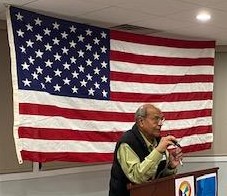
Bhavini Patel (Democrat), the council member of Edgewood Borough; Veena S. Szymkowiak (Republican), Board Member of the North Allegheny School District; and Mandal Singh (Democrat), Director, the Gateway School Board.
Ravi Balu organized a well publicized event open to the public at the Triveni Center in Monroeville. He introduced the three elected officials, giving them the podium to talk about what motivated them to seek elected public offices in the midst of their busy careers and entrepreneurial commitments. There was also a Q/A session at the end. ∎
Snow Leopard Expedition in Ladakh
Posted by admin in April 2022, Past issues on April 12, 2022
By Nitin Madhav, Washington, DC

Nitin Madhav was born and raised in Pittsburgh, graduating from Penn Hills Senior High School and the University of Pittsburgh. After his bachelor’s and two master’s degrees, he began working in public health in several countries around the world. He has traveled extensively and is an avid photographer. His work is on nitin.photography and on Instagram at @nitinmadhav.
I have never packed fourteen pairs of long underwear for a trip to India! When my friend, Behzad Larry, invited me to join him on an expedition to see snow leopards in Ladakh in November — he warned me it would be cold — I jumped at the opportunity since this was not the usual thing a guy from Pittsburgh does. I have been to India many, many times to visit family or for religious festivals, but never had to pack for the cold. This was a first — a snow leopard safari in the high mountains of the Himalayas.
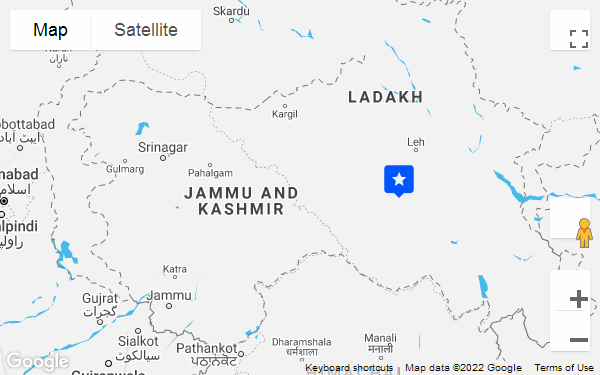
Behzad worked with his Ladakhi partners, Abdul Rashid and Dorjay Stanzin, to set up a camp for snow leopard safaris near Hemis National Park (32 miles from Leh at 16,000 ft elevation), which has only about 70-80 of these cats, out of a worldwide population of about 3500.
Behzad, who is from Indore, India and an accomplished wildlife photographer-turned-conservationist, saw a void in the tourism experience that Ladakh offered. While most people came to Ladakh to trek, there is an incredible story for these visitors to share with people interested in wildlife, especially the critically endangered snow leopards.
Conservation in India has seen a positive change in the last few decades. While there is still human/animal conflict where man is encroaching on wildlife habitat, there is a renewed urgency in maintaining the biodiversity of India. There are several national parks where one can see tigers, but few with the world’s most elusive big cat — snow leopards. Ladakh happens to be the place with the highest concentration of snow leopards in India.
The altitude is important to factor into travel plans in Ladakh. I flew from Delhi to Leh, the capital, and spent two days acclimatizing to the high altitude. I am pretty fit, but still found simple tasks like putting on my shoes left me gasping for breath. Behzad told me that this was normal, and I would acclimatize in a few days, which I did.
Since I have been on many safaris across Africa, the Ladakhi experience is not significantly different… just miserably colder. Behzad works with highly skilled spotters who can identify snow leopards on high mountain ridges from great distances, sometimes up to seven kilometers away. They depart early in the morning, radioing back to camp when a cat has been spotted. Then, we bundle up, grab our cameras, and hop into the jeep.
Snow leopards are most active at dawn and twilight, so it is key to make the most of this time. The spotters look for blue sheep, known as bharal in the local language. A hungry snow leopard will often target blue sheep in its hunt; so, if these local experts spot these sheep, it is most likely that a cat is somewhere around.
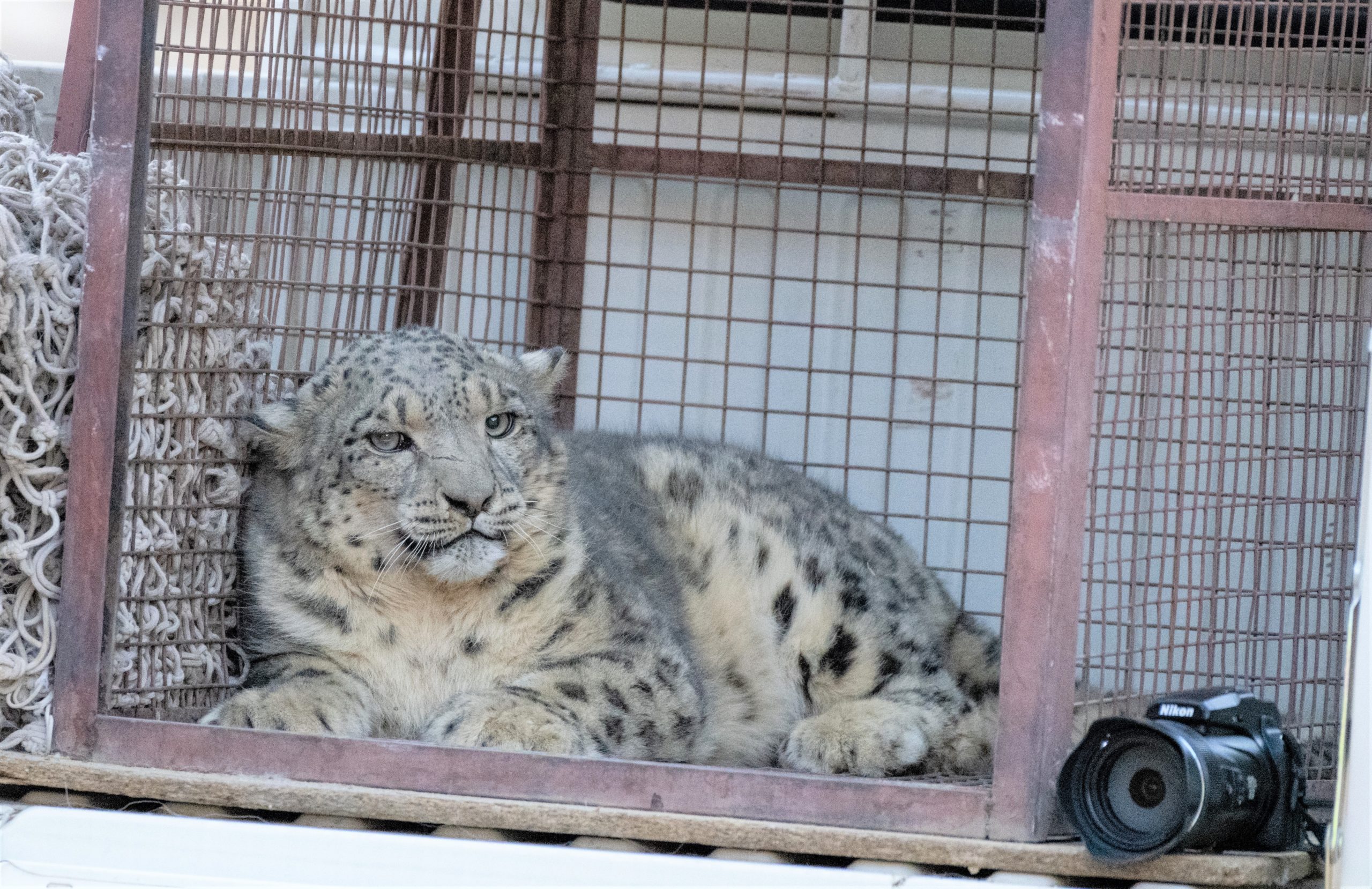
Snow leopards camouflage themselves in the rocky terrain. They roll around in the dirt before stalking bharal, covering their coats in soil. Their spots make them blend in with rock formations, making them difficult to spot. Thus, it is important to work with trained spotters who know what to look for. Sometimes, the spotters will see a cat and will try to track it; however, the cat will disappear over a mountain ridge. They carefully scan the mountains paying attention to the bharal and the condition they are in. If they are agitated or seem on edge, a snow leopard could be nearby. Sometimes the wait can take all day in the cold, which is why I made sure to pack all those long johns!
While there are others that offer snow leopard tours, it is vital to ensure that these are done ethically, without baiting the cats. When snow leopards are baited, it creates the expectation that domestic livestock are easy prey for the cat — which leads to ongoing human/animal conflict as herders can lose their entire herd to a snow leopard, and they, in turn, would prefer to kill the snow leopard to avoid future losses.
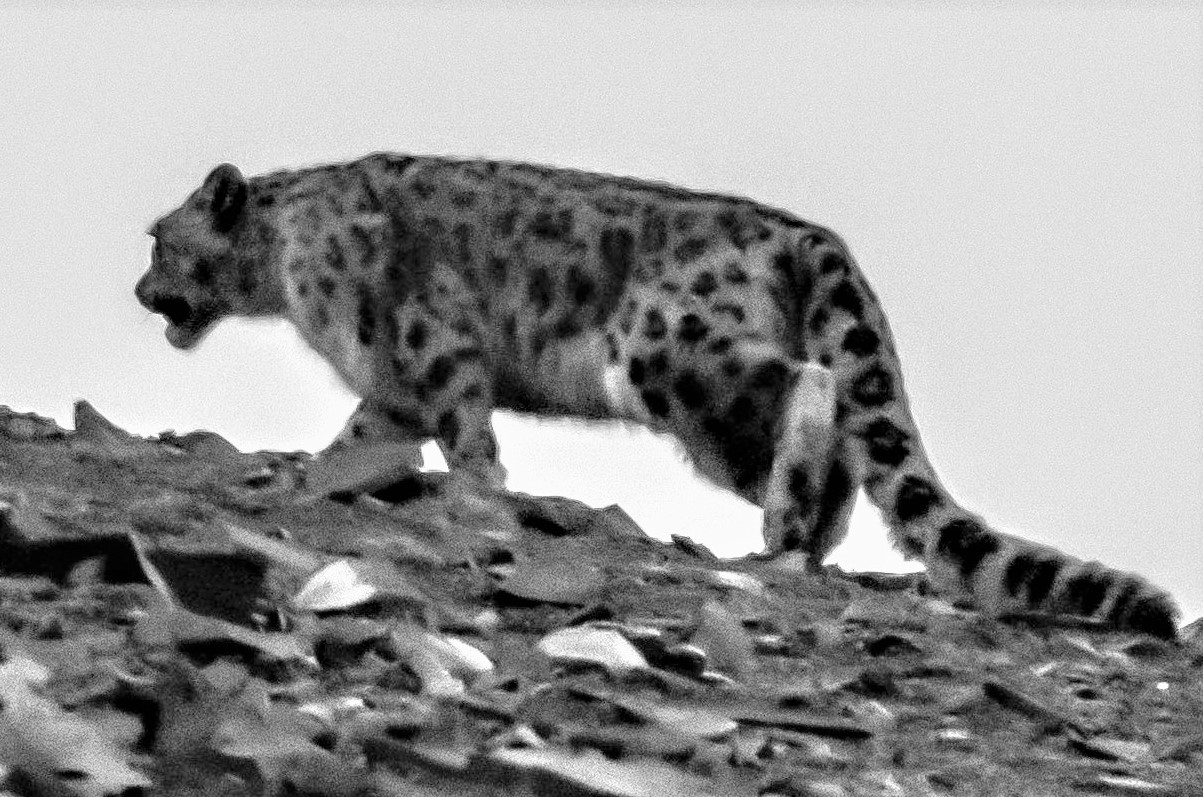
The first time I saw a snow leopard, I mistook a group of bharal for bushes, and I asked Behzad to stop for a second, when one of our trackers hollered “Snow leopard!” and indeed, it was. It was a scruffy beast, not at all like the supermodel snow leopards I had seen in photos. This was a beast who had worked hard to find every meal — and he slowly approached the bharal which fled in fear — but not before Behzad got a few shots of the snow leopard close to the bharal.
The next day, we got a call telling us that a snow leopard had gotten trapped overnight in a shepherd’s corral in a village about an hour away, and were invited us to take part in its rescue. The snow leopard snuck into a corral at night. The shepherd heard the commotion of the cat attacking the sheep, and let the other sheep out and locked the gate with the snow leopard captive inside.
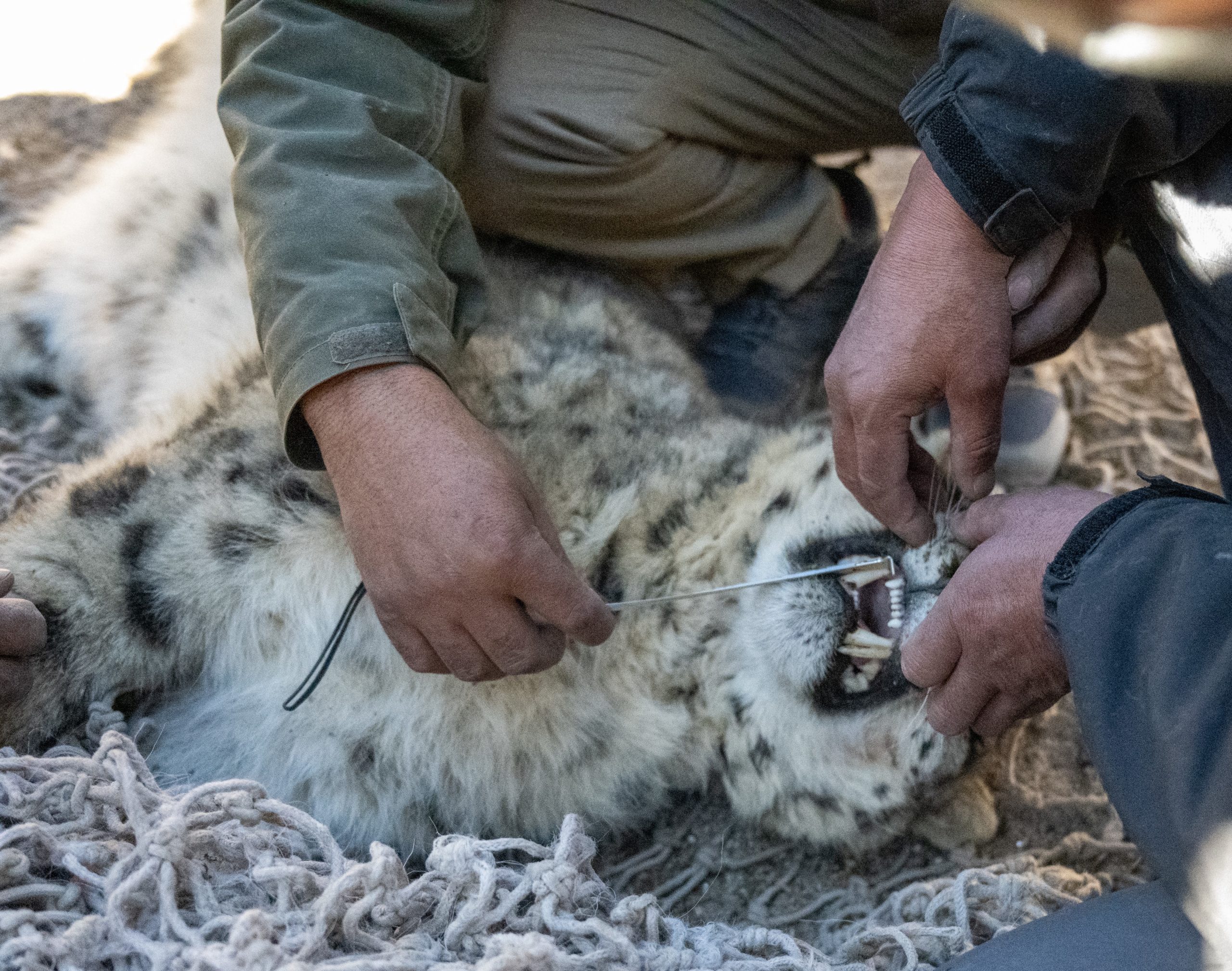
The Indian Wildlife Service rangers came by, tranquilized the snow leopard and after it was sedated, brought it out of the corral and took some biometric data before releasing it into the wild.
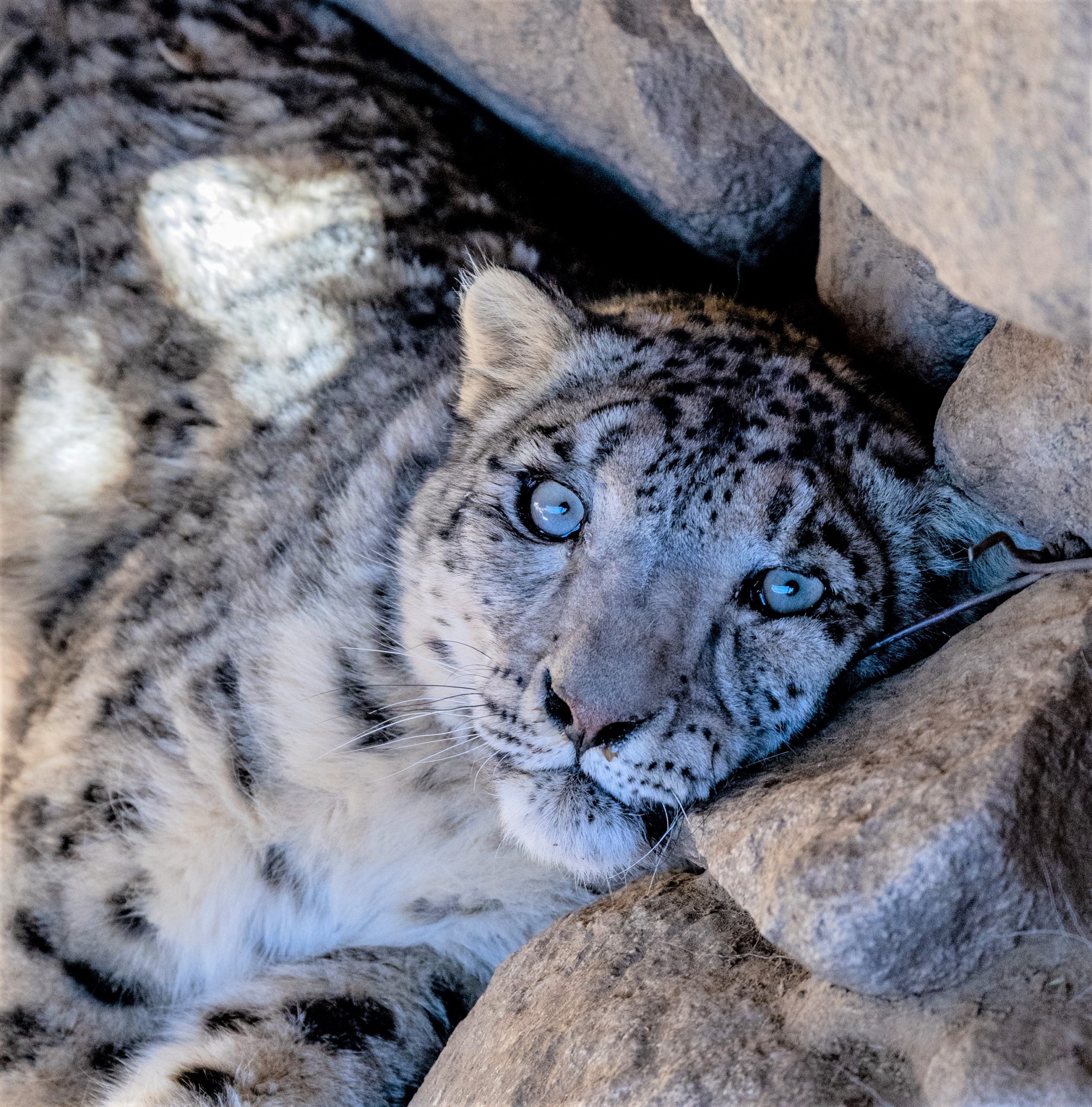
While it was sedated, I got to pet it and be a part of the biometric measuring. It was a beautiful male cat about five years old. I have been told many times that that is an unusual occurrence — I am the only one who has had a chance to do that, of the several hundred people who have gone on Behzad’s expeditions. It was an experience I will never forget — which made the trip so much more worthwhile.
Behzad kept saying he didn’t know if he could top that experience, and to be honest, nothing quite as interesting happened the rest of the trip. But this was the thrill of a lifetime.
If you are interested in a snow leopard expedition in either Ladakh or Kyrgyzstan, Behzad is offering a discount to readers of the Pittsburgh Patrika — mention that when you contact him on his website: https://voygr.com/ ∎
Obituary: Parvathi Gutti (1944 – Dec 17, 2021) Anesthesiologist, Affable & Anchor to Her Husband
Posted by admin in April 2022, Past issues on April 12, 2022
By Nangali S Srinivasa, Murrysville, PA
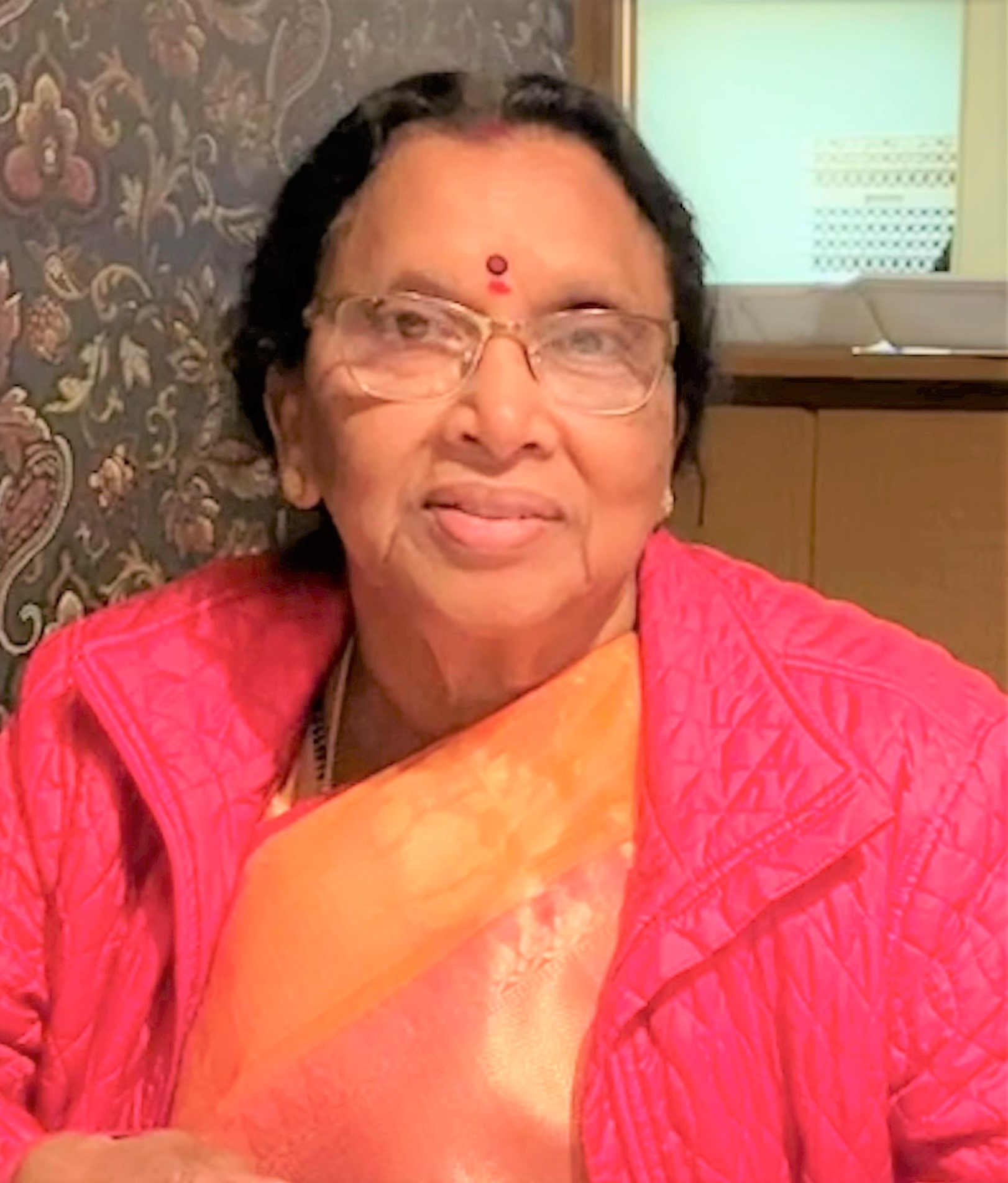
Parvathi Gutti, a long-time resident of Jeannette, Pennsylvania passed away surrounded by her family on Friday December 17, 2021, after an abdominal surgery needed for a complicated medical condition.
She was born on January 12, 1944 in Brahmapura, a small village in Krishna District, Andhra Pradesh, India. Her father Perrysetti Subbiah and mother Mahalakshamma were traditional weavers. Parvathi was the last of sixteen siblings. Born of humble beginnings, she was the first girl in her village to get a formal education, which led her to earn a medical degree from the Andhra Medical College, Vishakhapatnam, the oldest and a top-ranked medical college in Andhra Pradesh.
Losing her parents when she was very young, Parvathi was raised by her elder brother. Being the youngest of sixteen children, she was content with household chores. She started school when she was nine, on the recommendation of her home-school teacher, who recognized her intelligence. In small villages in those days, girls were not sent to school. During her school days she was acquainted with a Kuchipudi dance student, who was the younger sister of Varaprasad Gutti Rao, whom she would later marry. With financial support from others, Parvathi went to Hindu College in Machilipatnam, a nearby coastal town. Later, she earned a scholarship to go to Andhra Medical College, Visakhapatnam.
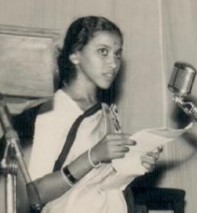
Soon after graduation, she married Varaprasad in 1968 before he went to Rensselaer Polytechnic Institute in Troy, NY, for his PhD in Nuclear Engineering on a NASA fellowship. Parvathi joined him, pursuing her studies in anesthesiology at Albany Medical Center, later completing a 6-month Fellowship in Gyne-Anesthesia at the Yale University hospital.
The Guttis moved to Latrobe in 1974 where she joined the Latrobe Area Hospital, which later became part of the Excela Health System and worked as a staff anesthesiologist for nearly 48 years. She started the first Pain Clinic in Westmoreland County, becoming the chairman of the Department of Anesthesiology at the hospital. She was an early donor for the expansion of the Latrobe Area Hospital in the 1990s and was the Co-Medical Director of the Westmoreland Latrobe School of Anesthesia during 1981 and 1986. She set up an annual award for outstanding nurse anesthetist. After retirement, she continued to work part-time. She was well liked by the physicians, nurses, and support staff who worked with her.
She loved the performing arts, especially Indian classical music, dance, and theater. She took keen interest in training her children from a very young age and developing them into mature artists. She served as a secretary of SPIFPA Foundation for performing arts, affiliated with the Pittsburgh Foundation and Community Trust.
A sheet anchor for her family and a strong supporter of her husband in many of his endeavors, Parvathi was quite stoic in accepting personal losses. In the early days of S.V.Temple in the 1970s, when people were not even sure of a need for the very idea of a Hindu place of worship here, Parvathi and her husband supported the concept by donating his very first month paycheck to the temple project. The Gutti family has generously supported the growth of the temple in many ways to this day.
Parvathi was well liked by members of the temple community for her simplicity, mild nature, loving spirit, and above all, her warm hospitality. She leaves behind her husband of fifty-four years of marriage, her daughter Bindu Madhavi, son-in-law Kumar Rachuri, and two granddaughters Krishnaa and Siri. A large number of her extended family and friends virtually attended the funeral at the Frederick Funeral Home, Latrobe. She was given a Hindu burial, with Shri Samudrala Venkatachayulu from the S.V.Temple helping the Gutti family with the religious rites.
From the Gutti Family: Thanks for Your Support in Our Time of Grief
Dear Friends: We thank you very much for all your help and support during our time of grief. So many of you offered your condolences, came to pay your respects and share in our grief, provided us with nourishment (both physical and emotional), gave us your shoulder to lean on, helped us with all the funeral logistics that we did not have the presence of mind to deal with and in so many other countless ways, big and small. Your thoughts, words and actions mean more to us than what you will ever know.
We owe our thanks to the S.V.Temple staff, Officers and the Board, including the temple community, as well as to the entire Pittsburgh Indian Community and the entire Excela Health Medical community.
So many of our personal friends went out of their way to care for us. Thank you all.
The Gutti Family and the Rachuri Family
Varaprasada Rao, Bindu, Krishna, Kumar, and Siri ∎
In the Globalized World, Even Internationally, All Politics is Local & Personal
Posted by admin in April 2022, Past issues on April 12, 2022
I read with anxiety Canadian prime minister Justin Trudeau’s warnings to the Canadian truck drivers’ mostly peaceful protest against the Covid vaccination, blocking truck traffic between the 2000-mile-long US and Canada border. These trucks provide smooth supply chains and logistical support between Canada, US, and even Mexico. They deliver parts for factories and move finished goods, industrial machinery, large volumes of agri and animal products, pharmaceuticals, medical supplies, and vital components for the auto and aerospace industries. Delivery delays from this protest were choking the already snarled post-Covid global supply chain costing billions of dollars to the economy. Consider this: In 2020 Canadian merchandise export to the US was $375 billion (70% of its total exports) and import from the US was $349 billion (62% of its total imports). And over 55% of US-Canadian merchandise moves in trucks.
So, Justin Trudeau, the Liberal Party Canadian Prime minister, with the truckers only a few days into their protest, assumed emergency powers to manage the strike. The last time this happened was when his father Pierre Trudeau declared an emergency fifty years ago during the violent protests (“terrorism”) by Quebecois.
Justin Trudeau’s warnings to the weeks-long truckers protest was stern. “It’s high time that these [striking truckers] illegal and dangerous activities stop… … They are a threat to our economy and our relationship with trading partners. They are a threat to public safety.” His other words of warning: “Blockages, illegal demonstrations are unacceptable, and are negatively impacting businesses and manufacturers. We must do everything to bring them to an end.”
“If you joined the protests because you’re tired of COVID, you now need to understand that you’re breaking laws. The consequences are becoming more and more severe. You don’t want to end up losing your license, end up with a criminal record, which will impact your job, your livelihood, even your ability to travel internationally, including to the U.S.”
Then, he leaned on President Joe Biden for support: “President Biden and I both agree that for the security of people and the economy, these blockades cannot continue,” Trudeau said. “So make no mistake, the border cannot and will not remain closed… Canada’s banks are governed by laws … that ensure funds cannot be used for criminal or illegal activity, and these blockades are illegal…” Trudeau said he updated U.S. President Joe Biden on the situation, including discussing the influences of U.S. right-wing citizens and foreign money funding this illegal activity.
The same Trudeau, last year, when farmers’ protests in New Delhi went on for over a year led mostly by Punjabi farmers with financial and political support from the active Canadian Punjabi diaspora, addressed the Sikhs on the Guru Poornima day with these words:
“I would be remiss if I didn’t start by recognizing the news coming from India about the protest by farmers. The situation is concerning. We are all very worried about family and friends… Let me remind you, Canada will always be there to defend the rights of peaceful protesters. We believe in the process of dialogue. We’ve reached out through multiple means to the Indian authorities to highlight our concerns. This is a moment for all of us to pull together.”
The Indian farmers protest was against the Modi government’s efforts to bring market reforms in the farming sector by giving additional options for farmers to sell their produce to whomever they want to sell, while a) preserving the minimum support price for their products guaranteed by the government, and b) retaining their option to sell their products to existing cartels in Punjab now controlling the grain market for over 60 years.
The Trudeauvian hypocrisy of supporting the year-long Indian farmers’ agitation blocking national highways around New Delhi in the middle of the Covid pandemic led by the Punjabi farm lobby on the one hand, while assuming emergency powers to quell the mostly peaceful just week-long protest of Canadian truckers is astounding. Remember, Justin, like his father, Pierre Trudeau, is the leader of the Liberal Party in Canada.
Trudeau’s political address to the Sikh’s in Canada on a religious festival (Guru Poornima Day), was not just out of political compulsion, with 17 MPs of Indian origin (many of them Sikhs) in his parliament, and four Indian-origin ministers (three of them Sikhs) in his cabinet.
Trudeau’s support for the farmers protest in India orchestrated by farmers from Punjab has a larger Canadian context. Today, of the over 300,000 truck drivers in Canada, nearly 20% are of Indian origin, more specifically, Sikhs. By comparison, in 1995, only 2% of the truck drivers in Canada were from the Indian sub-continent. In and around Toronto, Ontario and Vancouver, British Columbia, Sikhs account for nearly 50% of truck drivers.
And trucking being a lifeline for trade between Canada and the US, it is no wonder that Trudeau was trying to please not only the Sikh members in his cabinet and in the parliament, but also the nearly 60,000 Sikh truck drivers and many Sikh owners of trucking companies. The Sikhs are a vital link sustaining the Canadian economy. Incidentally, Punjabi-style dhabas are coming up in many truck stops across Canada and the US.
Trudeau was also trying to placate the 500,000 Canadian Sikhs, who are 50% of the Canada’s 1,000,000 people of Indian origin. In Canada’s population of 35 million, Indians are 3%, with Sikhs comprising of 1.5%. Remember, the population of Mumbai Metro area is over 20 million.
Pandering to his domestic Sikh constituency aside, there is no political or economic consequence for Trudeau in supporting the Indian farmers strike internationally. In the big scheme of things, Canada is a small potato for India. India’s foreign trade in 2019 is over $320 billion exports and $420 billion in imports, of which trade with Canada is paltry. Exports to Canada is only $2.9 billion and imports from Canada, $3.9 billion. For Canada too, trade with India is a small. The total volume of Canadian exports is $390 billion, and imports, $420 billion. Besides, Canada has no political gravitas internationally, being a weak second-tier partner in the Western alliance. In North America, the behemoth US dwarfs Canada in every measure.
This is perhaps why India’s foreign policy establishment ignored Justin Trudeau’s hifalutin support of the Indian farmers strike as his pandering to his Canadian Sikh constituency, purely for his domestic consumption. However, for Indians, Trudeau’s iron-fist way of managing the Canadian truckers’ strike brought his hypocrisy into sharp relief.
In 1996, Ralph Wright authored the book All Politics is Personal, and in 1997, Tip O’Neill, the famous Speaker of the US House of Representatives authored the book, All Politics is Local in the “local” US context. These books came out before the advent of social media. But with social media bringing everything into the open globally, seeing Justin’s Trudeau’s hypocrisy, one can say, even in international politics, All politics is personal & all politics is local as well.
An ironic end note: Many writers bearing Indian names were berating the Modi government in the American media for not negotiating with the farmers strike leaders last year. However, not one of them, to the best of my knowledge, had anything to say on Liberal Party Trudeau’s iron-fist tactics to break the mostly peaceful truckers strike in Canada. That is a fine example of the hypocrisy of left-leaning Indian and Indian-origin intellectuals among social and political scientists. ∎
Provoking Russian Invasion of Ukraine
Posted by admin in April 2022, Past issues on April 12, 2022
Henry Kissinger, in his Washington Post article (March 5, 2014) titled To Settle the Ukraine Crisis, Start at the End, didactically traced Ukraine’s convoluted political, cultural and religious history, and why Russia — not just Vladimir Putin — is obsessed with Ukraine. Kissinger’s advice was unambiguous: Ukraine “should not join NATO” while it “should have the right to choose freely its economic and political associations, including with Europe.” Kissinger is not alone on this. Among many other experts, George F. Kennan was the architect of American post-World War II strategy for containing the Soviet Union. In the late 1990s after the USSR imploded, Kennan called the expansion of NATO into Central Europe “the most fateful error of American policy in the entire post-Cold War era.” But US foreign policy machine and bipartisan Congressional leaders in the Obama, Trump, and Biden presidencies have been heedless.
President Biden, so soon after ending the longest (20 years) and the costliest ($2 trillion) American war in Afghanistan, knows that Americans are not ready for another military adventure thousands of miles away in Russia. Further, the US military and foreign policy advisors to Biden recognize that Russia is no Afghanistan or Iraq. And EU nations are not ready to spill their blood and draining their treasury in a military confrontation with Russia over Ukraine. Besides, 40% of EU’s natural gas comes from Russia, with which EU is historically interlinked in complex ways.
No wonder, other than sanctions — including sanctions on individuals in Russia — there is nothing the US can do for now. So, Russia is militarily overpowering Ukraine and prolonging the conflict. No matter how this ends, we are in for a long Cold War II.
Media in the US talk in moral tones about Russia’s military ambition and penchant for interfering in US domestic politics. But then, since WW-II, the US has deposed democratically elected leaders, propped up despots, and made the USSR implode, not to speak of countless asymmetric wars, big and small, in many parts of the world killing and maiming civilians in the thousands and destroying their physical infrastructure.
Russia is not, by any stretch of the imagination, an economic or technological threat to the US. Militarily, maybe. And yet, after dismantling the USSR, the US added fifteen new members to NATO, all encircling Russia, Wanting to admit Ukraine into NATO only provoked Russia. The American focus should be on China, a more menacing threat economically, politically, militarily, even culturally, and with deep pockets. ∎
“It’s a Mad, Mad, Mad, Mad, World!”
Posted by admin in January 2022, Past issues on December 7, 2021
On November 6, Air Arabia Maroc’s flight 3O437 from Casablanca, Morocco (departure 5:00 PM local time), was headed to Istanbul, Turkey, a 4½ hour flight. Over one hour into the flight, the plane declared a medical emergency and was diverted to land on the island of Palma belonging to Spain because a passenger was asking for medical assistance.
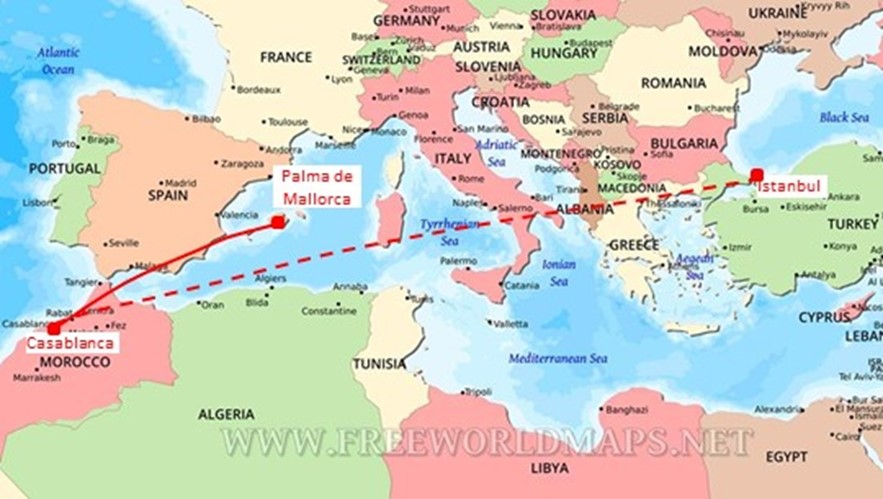
On landing at Palma de Mallorca, the Spanish police said the patient appeared to be in a diabetic coma and was rushed to the local hospital with his companion. The Moroccan air traveler, it appears, feigned the medical emergency to divert the flight, ostensibly to enter Europe, because, at the hospital, doctors found the man to be in normal health. Besides, the police said, the person accompanying the patient fled as soon as they arrived at the hospital.
Meanwhile, as the plane was parked on the tarmac, after some time, twenty-one passengers jumped out of the plane trying to flee the airport. Twelve of them, who spoke French, were arrested, and the others escaped. The supposedly “sick” man was later arrested for “helping with illegal immigration and violating Spanish immigration laws.” All except one among the 20-plus people in this episode were Moroccans.
Police suspect this was a novel and “unprecedented” way for people wanting to enter Europe illegally. They are investigating whether “the whole episode was an orchestrated event or an isolated freak incident.” The investigation is continuing.
A Spanish law enforcement official said, “Those who fled will be prosecuted for non-compliance with aviation safety rules and illegal entry into Spanish territory, and will be deported to their country of origin.” None of them applied for political asylum. Details here: www.tinyurl.com/Ppl-Flee-MedEmrgncy. ∎ — END

Cynically Sublime — The Power of Wealth
Posted by admin in January 2022, Past issues on December 7, 2021
Almost instinctively, people in all societies at all times throughout history have pursued wealth, often single-mindedly. We cannot blame them, for this is how some of the great minds cynically looked at wealth:
1. He who has wealth is deemed noble, a scholar, proficient in the scriptures, discerner of tastes, an eloquent speaker, and attractive to even look at. All qualities are dependent on wealth.
2. Wealth is class, wealth is beauty, wealth is learning, wealth is fame, What can those deprived of wealth aspire to?
3. Good qualities are attained by wealth, not wealth by good qualities. The wealthy ones are served by the ones with good qualities, not the other way around.
4. The old, the famous, the learned, the skilled, the valorous, the ones well-versed in the scriptures, poets, noble men, all look at the wealthy and declare, “May you be victorious. May you live long!”
5. The poor are loathed in their own homes. The rich have affectionate relatives even in the other worlds.
Can you guess who is the author for each of the above? E-mail thepatrika@aol.com for the answer. — By K S Venkataraman ∎ END
On Saturday February 19, 2022 — By the Students of Pitt A Competitive Indian Classical Dance Program Raising Funds for A Good Cause
Posted by admin in January 2022, Past issues on December 7, 2021
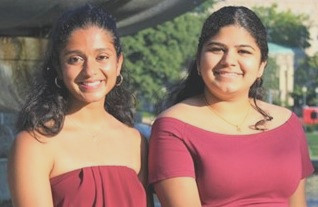
By Stuthi Iyer and Roma Usgoankar, Dhirana, Pittsburgh
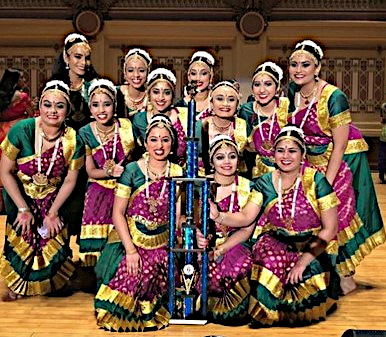
Dhirana is Pittsburgh’s premier competitive Indian classical dance event, hosted annually by students from the University of Pittsburgh. It is the only nationally recognized competitive program featuring Indian classical dance styles such as Bharatanatyam, Kuchipudi, Kathak, and Odissi. Every year, eight collegiate Indian classical dance teams from across the nation are invited to compete in the Dhirana event. World-renowned judges, who are dance teachers or practicing artistes (often both) and committed to preserving the tradition of these ancient art forms, evaluate the teams on nritta (intricate footwork), mudras (hand gestures), abhinaya (facial expressions), and other aspects of the dance. Every year, hundreds of people come and enjoy this spectacular program, immersing themselves in the ancient Indian story-telling tradition.
After hosting Laasya 2012, Nrityamala, the host team, created Dhirana with your support and the enthusiastic involvement of students to foster interest in Indian classical dances and raise funds for a Pittsburgh charity. All proceeds from ticket and food sales at Dhirana go to the Birmingham Free Clinic located in the South Side in Pittsburgh.
The Birmingham Free Clinic provides for the uninsured community-based collaborative critical medical care with compassion and dignity. The services offered at the clinic include cardiology, free eye care through Guerrilla Eye Service, ear nose and throat, dermatology, pediatrics, smoking cessation, diabetes, and gynecology. The clinic depends on volunteer teams of physicians, pharmacists, and nurses. In a single year, the clinic provides treatment to more than 3,000 patients, and the number is only increasing, and they need all the help they can get.
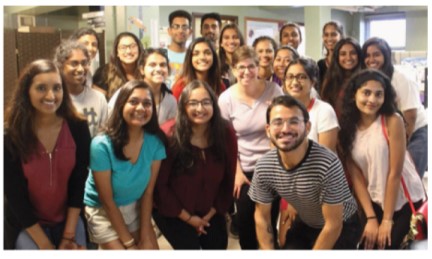
During the COVID-19 pandemic, with increased job insecurity and unemployment, more and more people depend on the clinic for their medical care. Dhirana is pleased to announce that over the past TEN years, we have donated $105,000 to the Birmingham Free Clinic, which has funded a 12-lead EKG device for the clinic, covered medication costs for patients, provided a consistent source of income for the Clinic’s annual budget, and most importantly, positively impacted the lives of thousands in the Pittsburgh area.
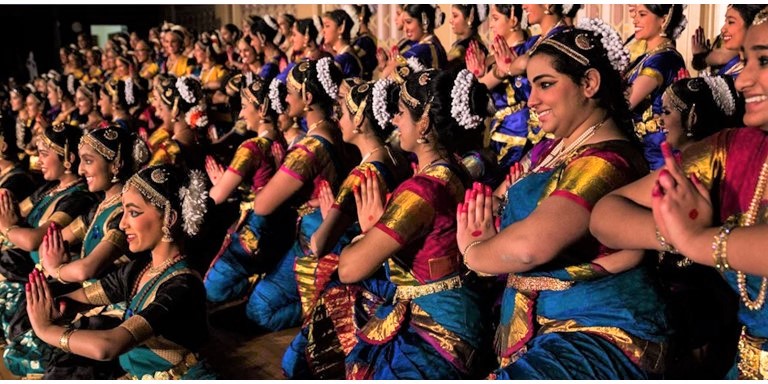
This year, we are striving to make our show bigger and better than ever. To put on a show of this magnitude, we depend on your generosity and support to cover the $16,500 expenses. We have been supported for the past decade by the Srinivasa Prasad International Foundation for the Performing Arts (SPIFPA).
Please support our efforts by reaching out to Dhirana’s Sponsorship Chairs, Stuthi Iyer and Roma Usgoankar, at dhirana.sponsorship@gmail.com, and take a look at our Sponsorship Packet at shorturl.at/pzMW2. We hope that you will join us on Saturday February 19th, 2022, at Soldiers and Sailors Memorial Hall. Please follow us on Facebook or stay updated at dhirana.com for ticket sales and updates! ∎ — END
Recalling My Own Aquatic Skills Growing Up in My Village in Gujarat
Posted by admin in January 2022, Past issues on December 7, 2021
By Harilal Patel, Monroeville, PA
Editor’s note: Mr. Harilal Patel, a long-time and successful entrepreneur in our area, is also active in the Pittsburgh Gujarati Samaj and the Hindu-Jain Temple. In 1978 he displayed his aquatic skills at the Three River Regatta by swimming across the Allegheny River from the North Side to Point State Park.
The story in the last issue on our instincts to display our skills in front of the public brought memories of my own younger days. Like Todittalai Vizhuttandinaar recalling the aquatic skills of his young days in his 2000-year old Tamil poem, I too remember my own younger days growing up in Valam, a large village with a long history, in Mehsana District, 50 miles north of Ahmedabad, Gujarat.
We had — and still have — a large talaab (lake) approximately 0.7 mile wide when it is full after the monsoon, with water 50 feet deep at several spots. One side of the lake had four large ghats for people to bathe. The opposite side was for buffaloes, cows, goats, and camels for their water needs. Around the talaab, we had a hospital, and rows of jamun, mango, and tamarind trees. And three temples.
Summertime drew us to the talaab, not just for bathing, but also for displaying our swimming skills. Competition among us was keen. Holding our breath and staying under water for the longest period was a game we reveled in. The daring among us swam to the deepest spots. Like the Tamil poet Vizhuttandinaar, we would reach the bottom of the talaab and come out with a fistful of gravel as proof that we had reached the bottom.
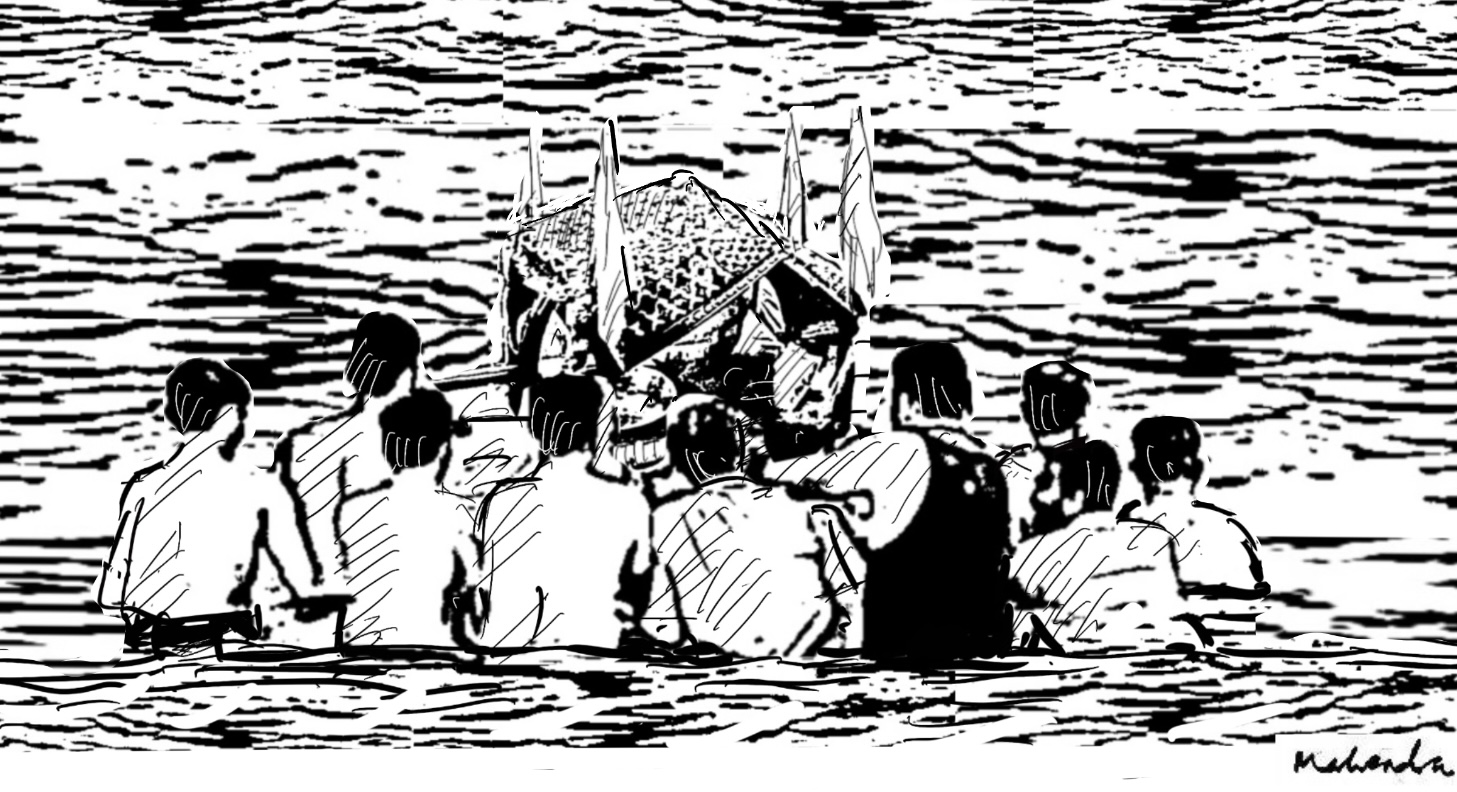
During August-September the village celebrated a festival with over 100 skilled swimmers carrying, while swimming, a palki (palanquin) with the deity (Krishna) across the talaab, with hundreds of villagers admiringly watching from the banks. The event ended with people carrying the palki in a procession into the village while chanting Bhajans. ∎ — END
From Wall Street to Onesies: Pallavi Golla’s Entrepreneurial Journey
Posted by admin in January 2022, Past issues on December 7, 2021
By Aire Reese, Pittsburgh, PA
When Pallavi Golla had her first son, Vyan, in 2015 she never thought her own problems as a first-time mother would be the start of a business venture. Pallavi was born and raised in the Franklin Park neighborhood of Pittsburgh. After graduating from Sewickley Academy, she attended NYU Stern School of Business majoring in Finance and went on to work in hedge funds for many years before attending business school in California.

After returning to Pittsburgh, Pallavi and her husband Mukul Patil started their family with their first son. She enjoyed taking Vyan on walks in a stroller but noticed that while she stayed dry in her activewear leggings and T-shirts, he would get hot and sweaty in cotton baby clothes. Their time was cut short because he would get heat rash. At night, traditional sleepwear would make him sweaty and fussy.
Pallavi started to wonder whether the same fabric used in adult active-wear could be used to make better baby clothing. She quickly realized that technical synthetic fabrics for adults were laced with harmful chemicals that would not be safe for small children. “There were adult companies pushing the limits on fabric technology,” says Pallavi. “But for children, there wasn’t anything new or innovative.”
Today, Golla is the founder of Lark Adventurewear, a premium e-commerce brand that makes clothes for children, and also for adults now, from a proprietary and sustainable Softek bamboo knit. The touch & feel of this fabric is something you must experience personally. It is buttery soft, temperature-regulating, UPF 50 sun-safe, and made to last.
Every product Pallavi and her team design is laser-focused on the following: functionality that makes life easier for parents and more comfortable for kids. And her customers have taken notice.

Since its founding in 2017, Lark Adventurewear has gained a loyal following on social media with over 60,000 followers and a passionate customer base extending from size 3-months through adult 3XL. Her company was featured in Vogue India, Inc Magazine and Forbes. But Golla is more interested in what her customers say. Hearing stories about a child having less eczema symptoms, a 6-year-old sleeping better through nights in Lark PJs, or providing the “best joggers I’ve ever had” to a tired mother is the feedback that keeps her working harder.
What once started in the spare bedroom of her home as she packed orders with her two small children has blossomed into a fast-growing e-commerce business with a warehouse in Central PA. Lark is on track to triple its year-over-year sales in 2021. While the road to success hasn’t been smooth, Pallavi says “I’m continually learning and trying to make better products for my customers. The best advice I can give anyone interested in pursuing a business idea or creating something new is to enjoy trying, failing, growing, and experimenting to learn what works.” ∎ — END
Dr. Raman Venkataramanan: A Portrait in Humility
Posted by admin in January 2022, Past issues on December 7, 2021
By Manjari Kulkarni, Upper St Clair, PA

Note: Manjari Kulkarni was born and raised in Pittsburgh. She practices orthodontics in the South Hills and lives with her family in Upper St Clair.
Almost daily, the mild-mannered professor of Tamil origin crossed my path as we began our days at the University of Pittsburgh’s Salk Hall, the location of the Pharmacy and Dental Schools. On several occasions, as we rode the elevator, Dr. Venkat (whom my parents endearingly call “the Pharmacy Venkat”) shared with me several life lessons, as he would with his own pharmacy students. Little did I know that this quiet professor who I would often see smiling behind the lens of a camera at big parties in social gatherings, is a hero among us.
Dr. Raman Venkataramanan is Professor of Pharmaceutical Sciences at the University of Pittsburgh School of Pharmacy. He received his B.Pharm from the University of Madras and M.Pharm from BITS, Pilani, India; and Ph.D. from the University of British Columbia, Vancouver, Canada.
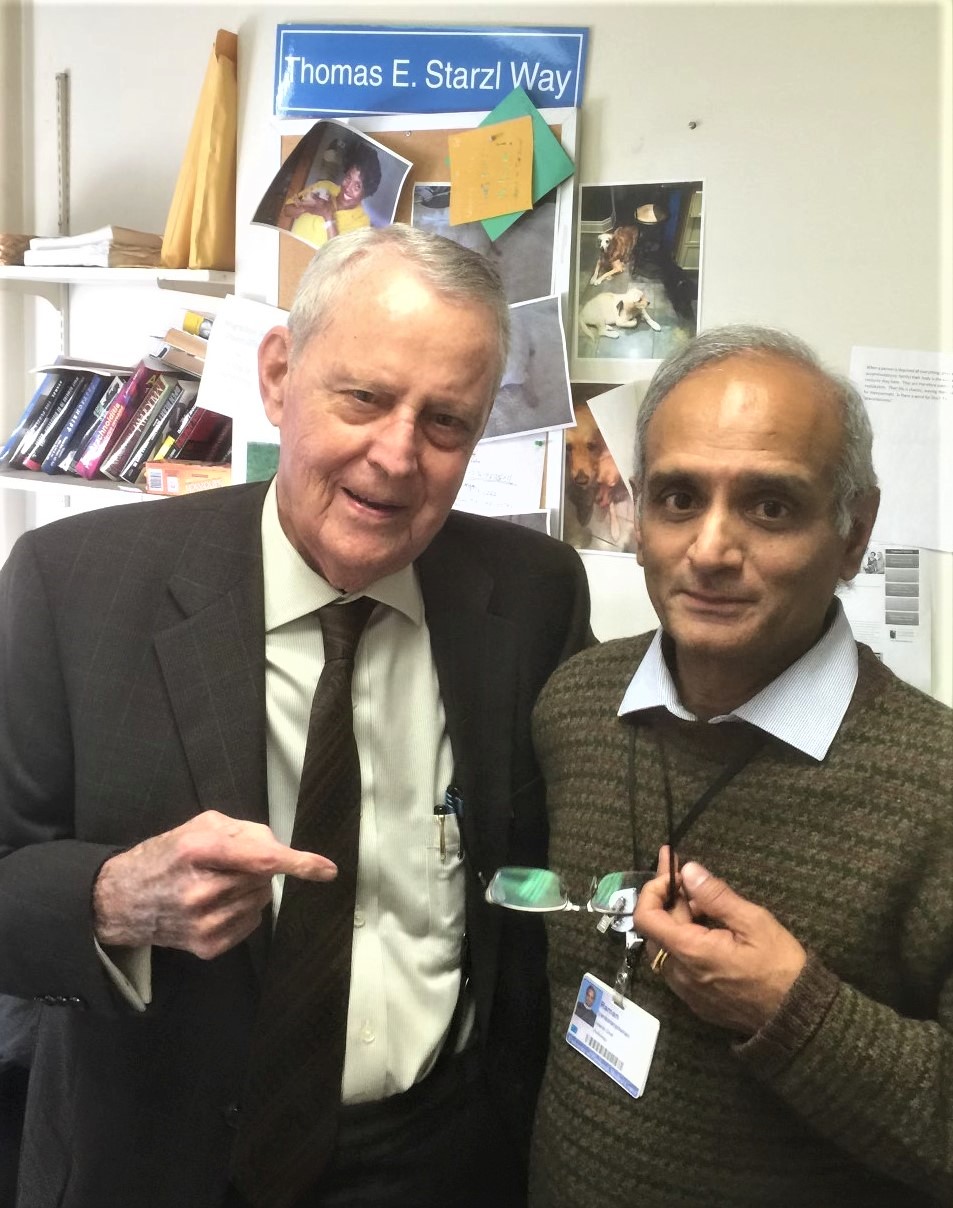
After a postdoctoral fellowship at the University of Washington, he joined the University of Pittsburgh in 1980 as faculty. The adage “Luck favors the prepared,” applies to Dr. Venkat perfectly. In 1982 he was approached to work with the world-renowned transplant surgeon, Dr. Thomas Starzl, to conduct clinical research on anti-rejection drugs for liver transplants. Cyclosporine was the most researched drug for anti-rejection then, and the biggest challenge in organ transplants was solving the problem of the rejection of the transplanted organ by the recipient’s body.
Dr. Venkat vividly recalls Dr. Starzl visiting him in his office, holding a small bottle of a chemical he had learned about at a conference in Japan. He asked Dr. Venkat if he knew what this bottle held. Dr. Venkat knew this was a preliminary chemical studied as a possible anti-rejection drug for liver transplants. After this meeting, Dr. Starzl recruited Dr. Venkat to be a lead researcher on this product. The chemical, at that time, was called FK-900506. Dr. Venkat and his colleagues studied its use in small and large animal transplant models.
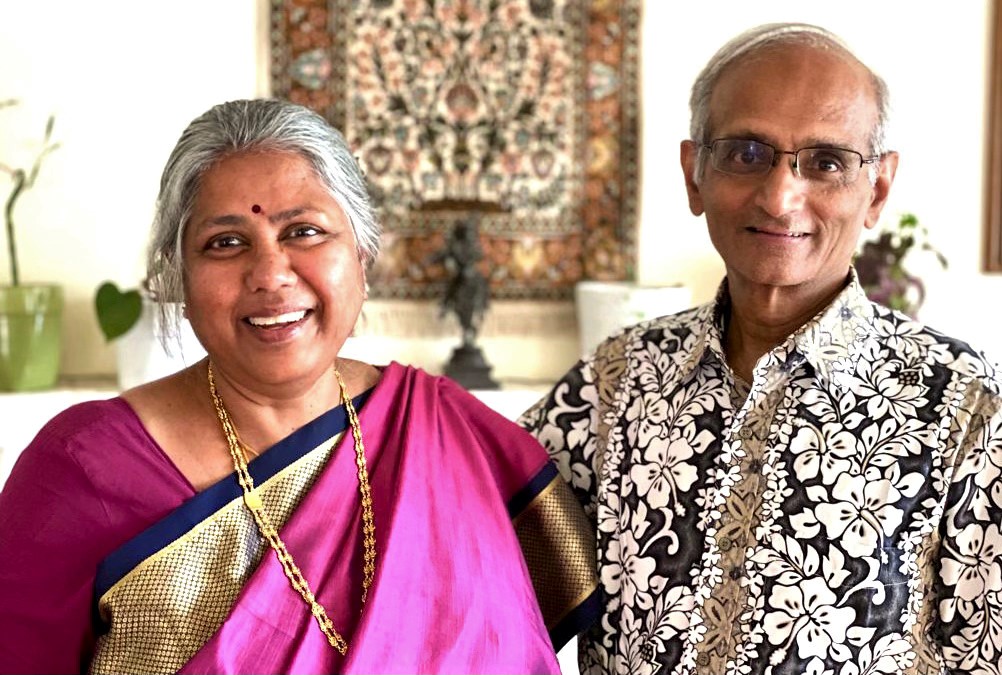
Eventually, the chemical, called FK-506, became known as Tacrolimus, the primary immunosuppressive drug currently used in liver as well as other transplants. This was one of the few drugs to get the quickest FDA approval due to the efforts of Dr. Venkat and his colleagues. This work made Pittsburgh a leader in organ transplants. Dr. Venkat considers himself blessed that he directly worked with patients to see how his efforts were helping transplant patients. Along the way, Dr. Venkat also published nearly 400 research papers.
In October 2021, the American Association of Pharmaceutical Scientists (AAPS) honored Dr Venkat with its prestigious Distinguished Service Award, appreciating his lifetime service as a member of AAPS. This was for him the culmination of a string of recognition he received from his peers. Details here: www.tinyurl.com/VenkataramananPeerRecognition
Inspired by his grandparents, Dr. Venkat chose healthcare as his career calling. Unable get into medical college in Tamil Nadu, India despite his academic excellence, he chose pharmacy as an alternative. His greatest interest has been teaching and he is passionate about sharing what he has learned from his countless mentors and personal heroes.
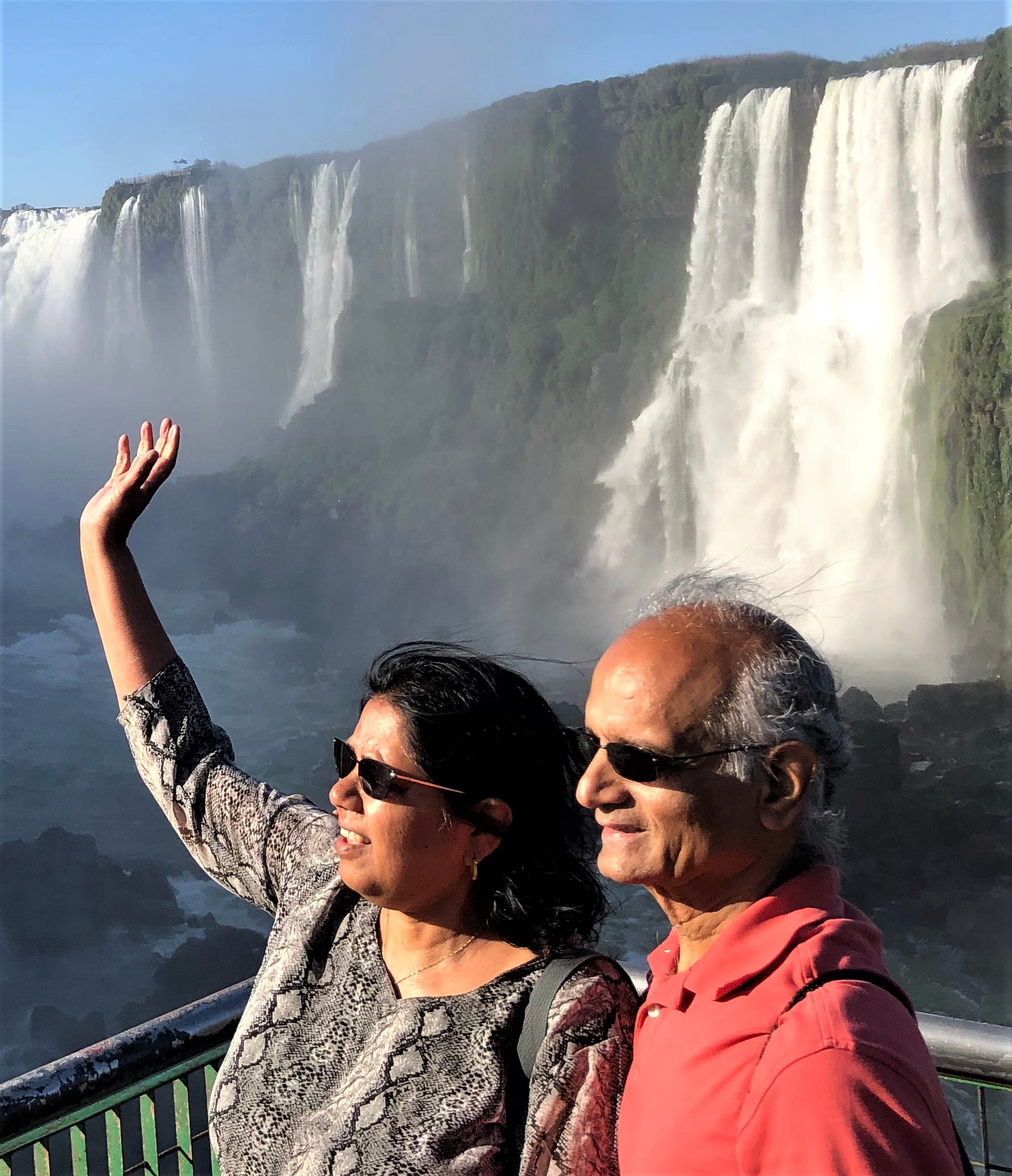
Outside of pharmacy teaching and research, Dr. Venkat teaches Sanskrit he learned from Shri Rajagopala Iyer in India (and later getting it refreshed in Jyotsna Kalavar’s classes here) to kids at the Chinmaya Mission,
Dr. Venkat, again with humility, describes his wife Padma as “the brainy one,” who is always learning and changing to keep herself sharp. He says, “I never could have had any success without Padma’s support.” Dr. Venkat, reflecting on turning 70 recently, quotes from Vivekachoodamani attributed to Adi Sankara, “जन्तूनां नरजन्म दुर्लभम्,” Jantunaam narajanma durlabham, “Being born as a human among the living is rare.” And he adds with a smile. “And then, being able to do what we are passionate about is a bonus.” Who can disagree with that? ∎ — END
Pittsburgh Airport Breaks Ground for $1.4 Billion New Airport Terminal
Posted by admin in January 2022, Past issues on December 7, 2021
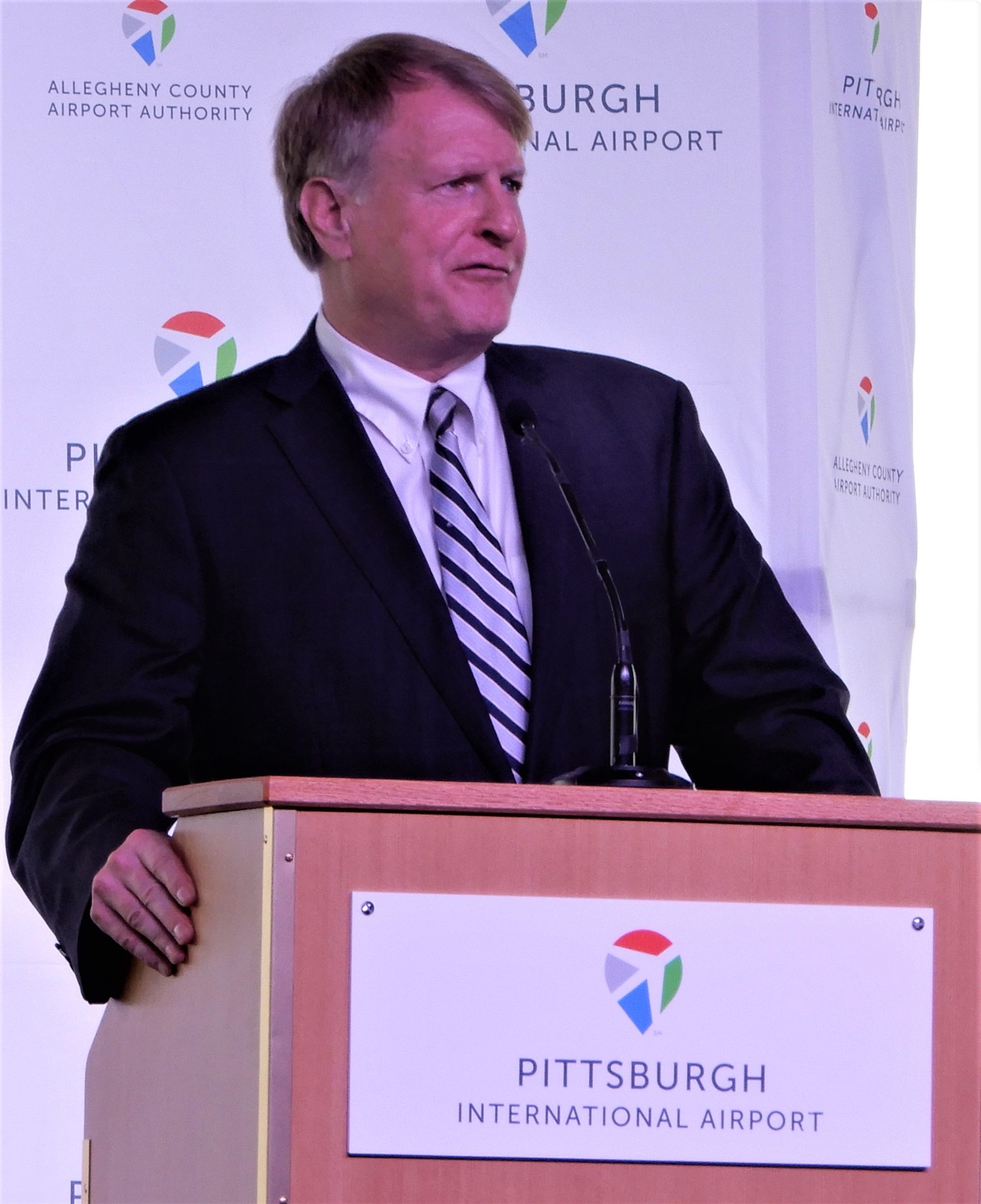
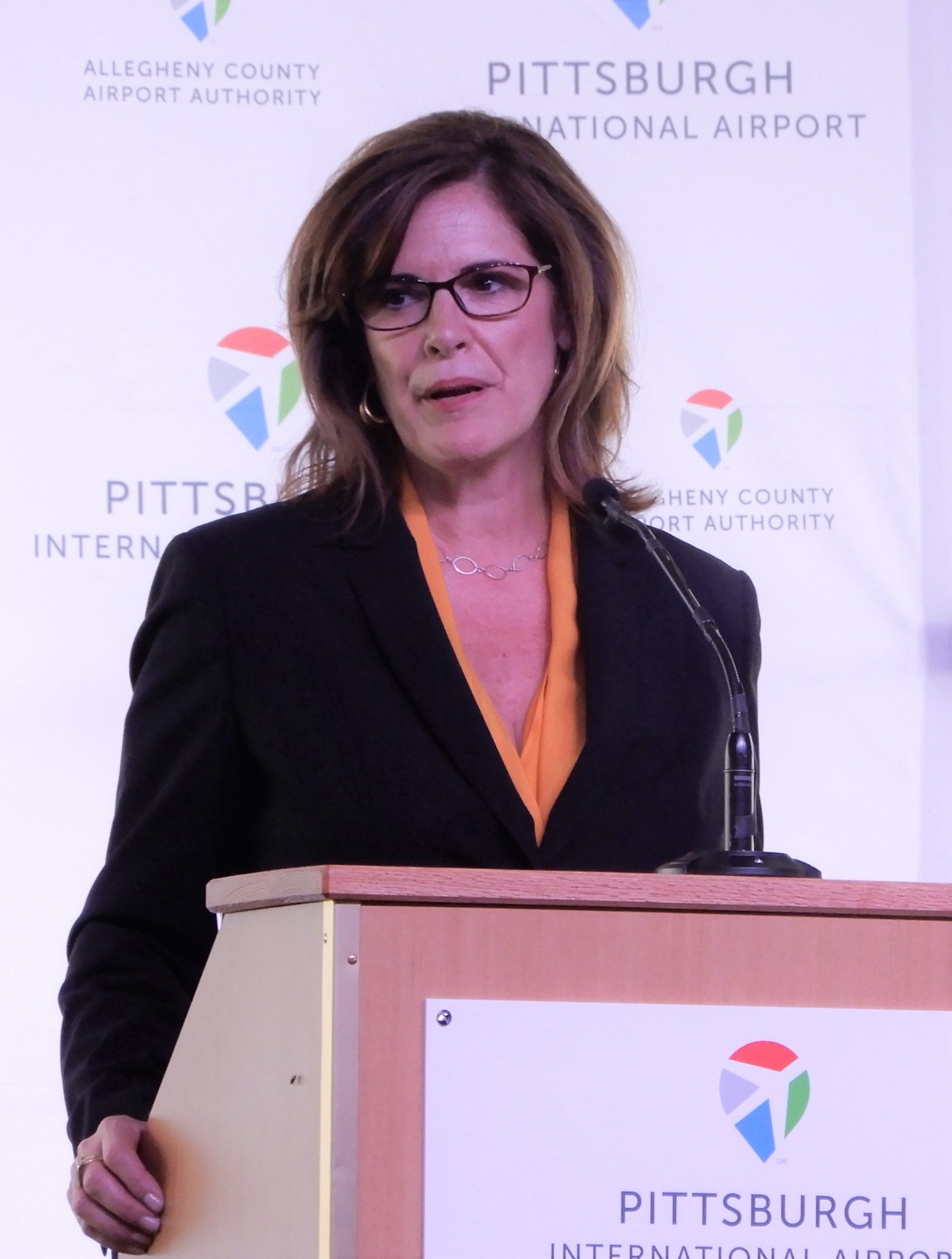
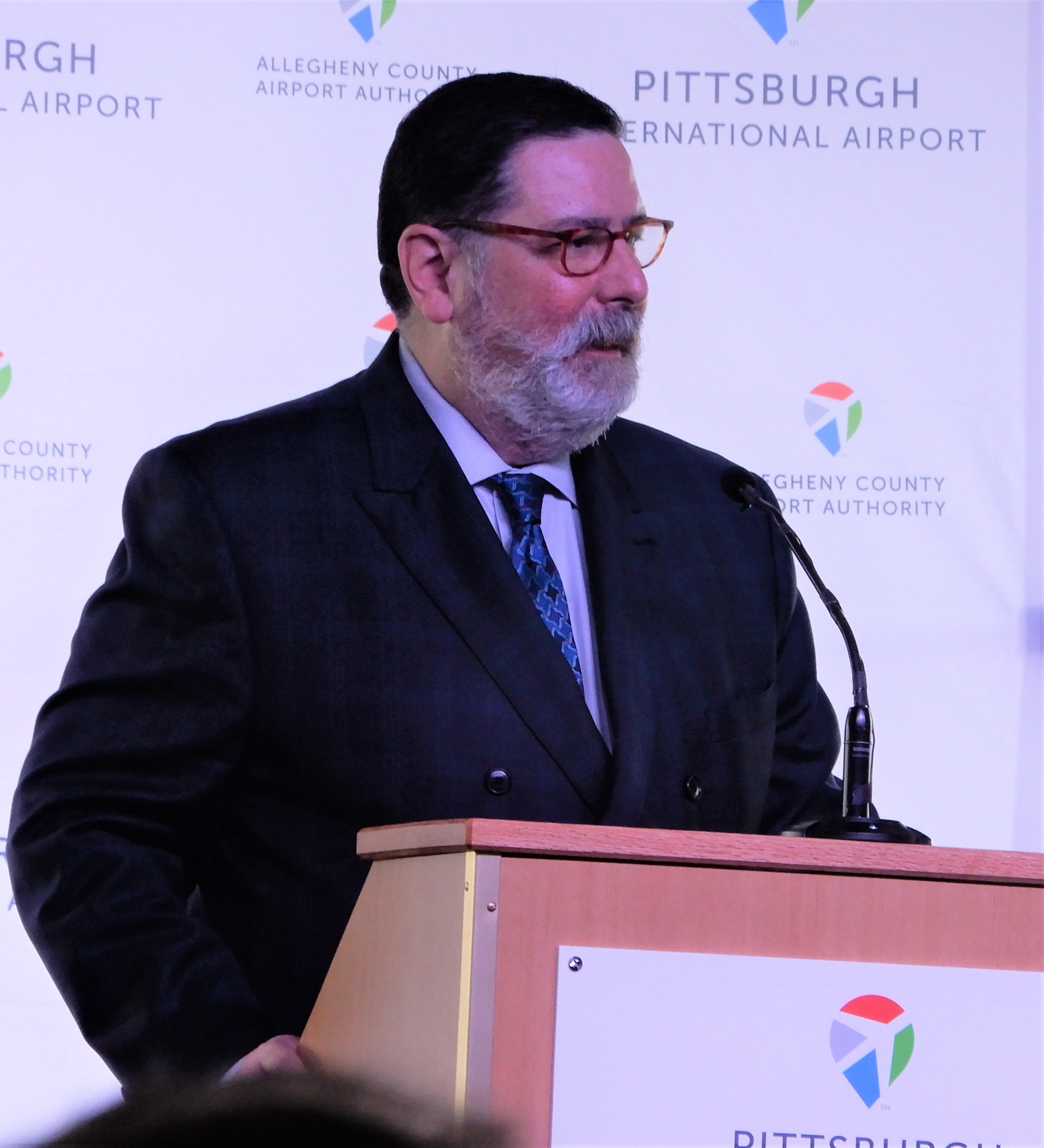
The Pittsburgh International Airport, owned and managed by the Allegheny County Airport Authority (ACAA), is getting a much-needed modernization. On Thursday October 14, 2021, ACAA formally broke ground at the construction site for a new terminal. County Executive Rich Fitzgerald, the ACAA’s CEO Christina Cassotis, its chairman David Minnotte, and Pittsburgh’s Mayor Bill Peduto, among others, addressed a gathering of over 300 people — the region’s elected officials, business and labor leaders, contractors, and invited guests.
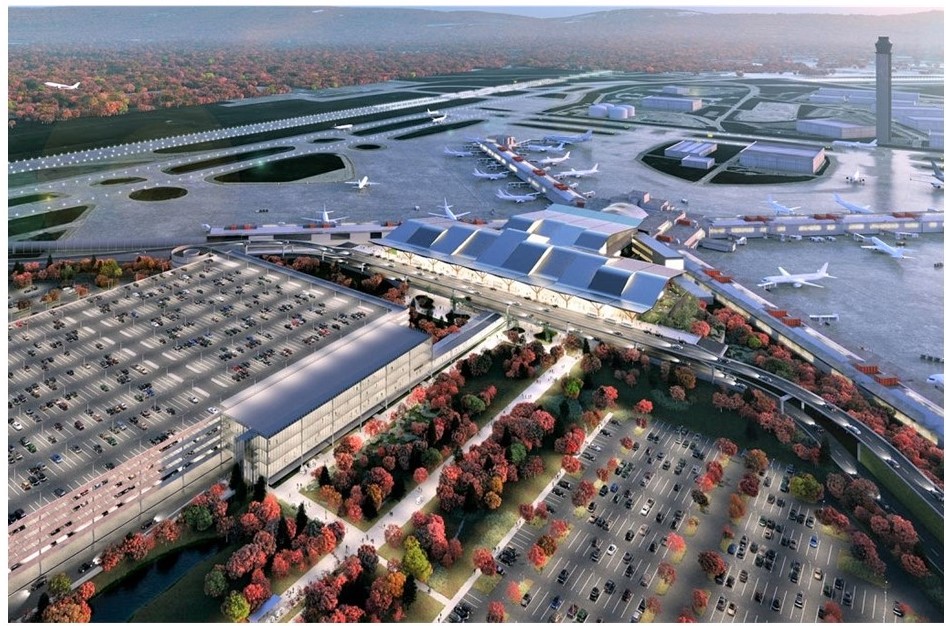
One point in Fitzgerald’s speech was encouraging: after losing population for the last six decades, Allegheny County’s population increased in the 2020 census. It is now 1,250,000, up by 2.2% (or 27,000), compared to the 2010 census. And the county population is more diverse (24% in 2020 compared to 18% in 2010), and younger, the features recognized as catalysts for growth.
The current layout of Land- and Air-side Terminals with 75 gates in four concourses, and a 0.5 mile-long connecting train, is too unwieldy, too old (opened in 1992) and too costly for upkeep for the 170-plus daily flights today. At its peak two decades ago, the airport handled nearly 700 daily flights with 20 million passengers/year passing through its gates.
The new terminal will meet its current and future needs; will reduce operating costs and carbon footprints; will give better ambience for departing passengers from check-in, security through boarding; and for arriving passengers from landing, baggage claim through leaving the airport.
How we ended up with 75 gates in four concourses: In the 1980s, with US Airways’ hub expanding at the Pittsburgh airport, the number of passengers passing through its gates increased rapidly. Most were transit passengers changing flights to reach their final destinations. So, the then state-of-the-art terminal with 75 gates in four concourses was built in 1992 to meet the airline’s demands.
Then the 9/11 disaster in 2001 devastated the airline industry. Meanwhile, US Airways was expanding its presence in Philadelphia. When US Airways closed its PIT hub (and moved to Philadelphia), the volume of passengers at the Pittsburgh airport plummeted to just over 6 million per year. Over 15,000 jobs vanished in the region. This devastated the airport’s operations and the region’s image, even as we were struggling to recover from the steel industry’s death here in the 1970s.
Ironically, we learned the same bitter lesson twice: overdependence on steel devastated the region when the Mighty Steel died in the 1970s, and over dependence on US Airways (accounting for over 85% of flights at its peak at PIT) devastated the airport when it closed its hub here.
Besides, before shutting down its hub, the bad faith in which US Airways had negotiated with our region’s elected officials and airport officials left deep scars. So, not many at ACAA and among our elected officials wanted the airport again to become a big hub for another air carrier. Twice bitten, thrice shy. So, seeking regional taxes to fund airport modernization was just out of question.
Then came Nature’s boon in the form of Marcellus shale found in abundance in Pennsylvania, West Virginia and eastern Ohio. The shale lying between 5000 to 8000 feet underground is a source for natural gas, a clean energy fuel for domestic & industrial use and electric power generation — it has the smallest carbon footprint and no solid waste products such as fly ash, as with coal. Radio talk show hosts boast that natural gas for Pennsylvania is what is petroleum is for Saudi Arabia.
Over 9000 acres of land around the airport belong to ACAA. The airport allowed a local gas company to drill 45 gas wells in its land to generate revenue for the next several decades. With the natural gas running five generators and 10,000 solar panels already installed, the airport’s microgrid generates 20 MW of power while its needs are only 14 MW. (source: www.tinyurl.com/Microgrid-at-PIT).
Meanwhile, the Pittsburgh region slowly has redefined itself in terms of financial service companies, higher education, innovative technologies (robotics and AI), as an incubator for startups, and healthcare industries. Along the way, the Pittsburgh airport too grew. From barely 70 daily flights after the US Airways shut down to over 170 daily flights today; from just over 6 million passengers/year at its nadir to over 9 million passengers/year now; from just under 10 air carriers to 17 air carriers at PIT now with more nonstop flights to more cities. The airport’s freight handling too has increased over the years.
Deciding not to seek funds from local taxes, ACAA took the plunge to modernize the airport terminal with its own resources. The work started as early as 2017, but the 2020 Covid pandemic stalled the work.
With the fear of the Covid-19 receding, the 4-year, $1.4 billion modernization project has started. Its main features as detailed by Messrs. Fitzgerald, Cassottis, and Minnotte in their speeches are:
1. The project is funded without local taxes. The businesses that use the airport — the airlines who use the airport (landing fees and gate rentals), the concession shops at the terminal, and passengers using the facility will bear the cost. The funds will be raised through bonds issued by ACAA on its own strength. (Note: For the same reason, if the modernization results in a resurgence of the airport’s fortunes generating good net incomes year after year, one wonders whether ACAA will be obligated to fund projects outside the airport — such as a light rail transit from the airport to the city. And passengers will see increases in parking fees and charges for food and drinks at the airport — as in airports in New York, Chicago…)
2. The land-side terminal and the People Mover train will be gone (see the picture on the cover page), and the air-side terminal will be refurbished with new check-in counters and a baggage handling facility and passenger pick-up systems.
3. The modernization is for the region’s current and future travel needs, and not for making the airport a big hub for another air carrier. (Bad experience with US Airways and the good olde grandmotherly advice not to put all your eggs in one basket).
4. The existing concourses will be retained and refurbished, but with fewer gates with better ambience. More concession stands and shorter times for passengers to reach departure gates and retrieving baggage on arrival.
5. A multilevel parking lot walkable from the baggage claim area.
6. State-of-the-art design using natural light, fresh air, attractive ambience, open space, and for mass transit, taxis and passenger pickup… …

7. Recycling 75% of the demolition debris from the existing structures (such as concrete slabs) and re-using them for construction.
8. Childcare services during construction on site for the hundreds of men and women working there. Workplace safety from the get-go.
9. Over 14,000 direct/indirect jobs created by contractors and subcontractors with taxes in millions of dollars feeding into local governments.
In 2025, we will be in for a grand dedication ceremony for a stunningly ultramodern reincarnated airport terminal. And also be ready for higher charges for all services such as parking fees, baggage carts, and all concessionaires at the airport terminal. ∎ END
Dr. Raman Venkataramaman’s Peer Recognitions
Posted by admin in January 2022, Past issues on December 4, 2021
1. Distinguished Scientist Award AAiPS (2016)
2. Honored/invited speaker at Agents for change – Alumni recognition Symposium organized by the University of British Columbia Vancouver Canada
3. APhA Tyler Award for Stimulation of Research (2011)
4. University of Pittsburgh- Provost’s Award for Excellence in Mentoring (2009)
5. ACCP BMS Award for Mentoring in Clinical Pharmacology (2009)
6. Ranbaxy Research Award in Pharmaceutical Sciences, India (1998)
7. Distinguished Research Scientist Award by The Institute of Kidney Diseases and Research center and the Institute of Transplantation, Ahmadabad, India (1998)
8. Fellow of the American Association of Pharmaceutical Scientists (1996)
9. Fellow of the American College of Clinical Pharmacology (1989) ∎ — END
Did You Know We Have A Second Fully Functioning Civil Airport in Pittsburgh?
Posted by admin in October 2021, Past issues on October 4, 2021
Did you know that we have a fully functioning airport on 24x7x365 basis — it even has its own airport code AGC — in West Mifflin, an eastern suburb?
Did you know that till 1954 when PIT came into being, AGC, built in 1931, was the commercial airport for our region’s burgeoning travel needs with the growth of the steel industry?
Did you know that ACG was one of the first three airports in the nation, and also the first airport with hard-surface runways?
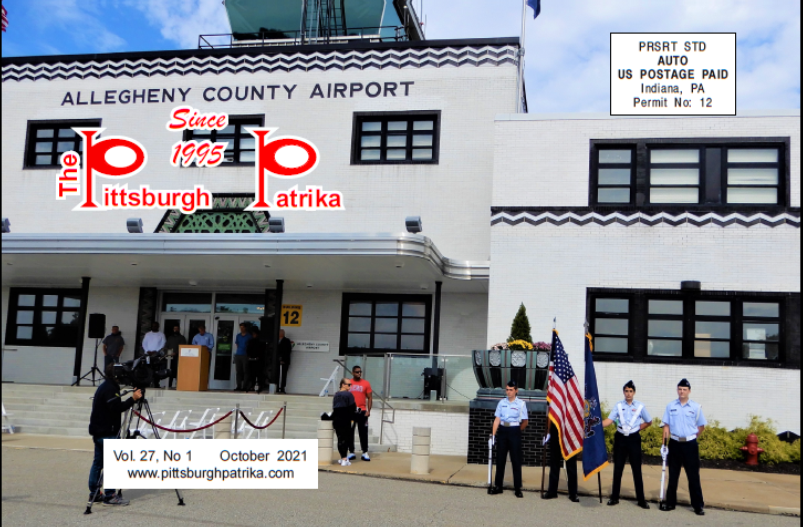
I too didn’t know these facts till I attended the 90th anniversary of the airport in September. This is one reason why we all should take an interest in our region’s rich history and what is happening around us right here.

After completing a $2.5 million project refurbishing the airport’s passenger facilities, on Saturday, September 25, organizers celebrated the 90th year of the airport. Elected officials and the people who run the airport addressed a gathering on the highlights of the airport.
County Chief Executive Rich Fitzgerald in his brief address informed the audience that the airport brings over $2 billion in business to the region with over 60,000 arrivals and departures annually — mostly charter flights and privately owned planes. The airport also serves other functions, such as medical emergencies, disaster emergencies, and also for training for new pilots.
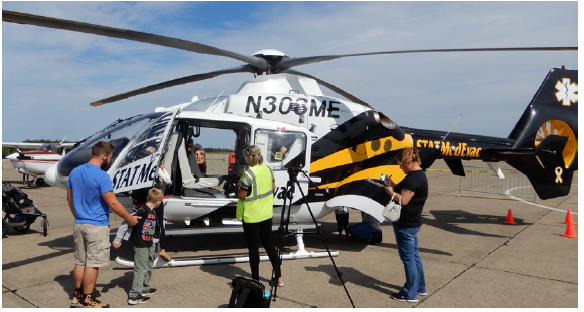
The Civil Air Patrol (CAP) also operates from this facility. CAP, the official US Air Force auxiliary, is a nonprofit organization tasked by the US Air Force to help in inland search-and-rescue operations and assist in other security-related activities.
A more detailed story on these will be in the next issue. — END
कन्यादानं in Vedic Weddings — Receiving the Bride is As Important
Posted by admin in October 2021, Past issues on October 4, 2021
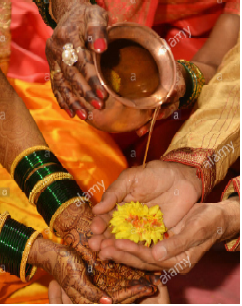
In Vedic and Christian weddings all over the world, the giving away of the bride is an poignant, emotional part of the ceremony. While the details vary widely, the tradition of the father handing over his daughter to the groom is common in both. I am sure, some anthropologist somewhere has studied how this ritual is common in both cultures even though separated by thousands of miles, and irreconcilably differing in theology — salvation (Christians) vs. liberation (Hindus); obedience & sin (Christians) vs. karma & avidya (Hindus).
In August, I attended a cross-cultural Hindu Vedic wedding on the West Coast. Shri Sashidhara Somayaji (contact number 408 800 5444), one of the pandits conducting the wedding, said this in facile English before kanyaadaanam, widely understood as the parents of the bride giving away their daughter: “We understand कन्यादानं (kanyaadaanam) by splitting the phrase using Sanskrit Sandhi rules into कन्या + दानं with कन्या (kanya) meaning bride; and दानं (daanam) contextually meaning “gift.â” Incidentally, Pandit Somayaji, who is from Udupi in Karnataka, is facile in Kannada, Telugu, Tamil, Malayalam, Tulu, Hindi, Sanskrit and English.
He continued: “Understanding कन्यादानं exclusively as parents giving away their daughter is incomplete. Following Sanskrit’a sandhi rules, कन्यादानं also splits into कन्या + आदानं (aadaanam). आदानं (aadaanam) means receipt or receiving. So, कन्यादानं should be correctly understood with emphasis on both parents giving their daughter away and the groom accepting her in the ceremony.” After all, when someone gives, someone else has to receive. Without some one to receive, the “gifting” part has no meaning.
The आदानं part gives an entirely different flavor to the ceremony with the obligation on the groom to live compatibly with his new bride, with the implied responsibility on the bride also in their journey together. — END
Human Instincts to Display One’s Prowess
Posted by admin in October 2021, Past issues on October 4, 2021
From Olympics to college and school sports, we see the natural instincts of youth to compete with each other and display their prowess to an admiring audience. It is an absolute delight to see six- and seven-year-olds running on soccer fields screaming and chasing after each other to snatch the ball and move it towards their opponents’ goal post. This instinct to display physical skills is not only in competitive sports, but also in simple family gatherings, as I found out recently.
We were in California in August for a family wedding, when our daughters also added a few vacation days for us and our grandkids to stay in a rented place. The place had an indoor pool with an 8′ deep diving end. Our nine-year-old grandson, barely 4′ tall, knows swimming and was trying to learn diving from his dad. After a few trials and some serious struggle, he did get the hang of how to dive deep into the pool.

No sooner had he got the hang of it than he wanted to show his prowess to his grandfather, who, growing up in India in the 1960s, was a stereotypical urban kid, not even SEEING a swimming pool. My grandson told me, “Thatha, toss a coin at the deep end. I will dive and get it for you.†I was nervous, not knowing whether he had the lung capacity to dive deep in the pool, search for the coin, reach the bottom, pick it up and come out. He pestered me. I looked at his father, and he said, “Go ahead.”
With hesitation, I tossed a quarter into the deep end of the pool. The kid dived confidently into the deep end, looking for the coin. Then, picking up the coin, and with a great sense of accomplishment, he soared out of the pool like a dolphin with a beaming smile, showing me the coin in his hand. He asked me to do this again and again.
Seeing my grandson trying to impress me with his aquatic skills, I recalled an old Tamil poem I had read decades ago. This poem is in the 2000-plus year-old Tamil classic Puranaanooru.
Puranaanooru is an anthology in the Tamil literature, written by both men and women poets 1800 to 2200 years before our time. The 398 verses are in classical Tamil with very few Sanskrit words interwoven, indicating that Tamil’s history is parallel to Sanskrit’s.
The Puranaanooru verses describe the valor, pride, pettiness, generosity, and even philandering of kings; admonish them to be loyal to their wives; advise kings not to let bureaucrats harass citizens; describe the grinding poverty of citizens during wars, thus trying to dissuade kings from going to adventurous wars.
But the poem I recalled is quite different. In this, the poet, Todittalai Vizhuttandinaar, in his very old age, recalls with vivid imagery the innocent days of his youth long gone, very much like my own. He describes the prowess he and his buddies showed in their swimming skills to the admiring onlookers on the banks of a large, deep village pond after the rains. The sentiment the poet expresses is universal transcending time, place, and culture that separate humanity into distinct linguistic, religious, and cultural groups. Here is a free style English translation of the verse:
It feels sad to think about it now.
On the sandy edges of the pond with cool water,
we played with girls who made dolls with the clayey soil,
decorating them with flowers plucked from trees nearby.
Holding hands in the innocence of youth,
we hugged each other, swaying this way and that.
Climbing the Marutha (Arjuna) tree on the bank
with its branches sagging towards the pond,
we dived into the deep pond with a thud and a splash.
Reaching the bottom, we returned showing to the
amazed onlookers on the shore the fistful of sand
we grabbed from the pond’s floor.
Where did that innocent youth go?
Isn’t it pitiful that having become old now, tremblingly
I walk holding a metal-capped stick while coughing,
barely uttering a few words in between?
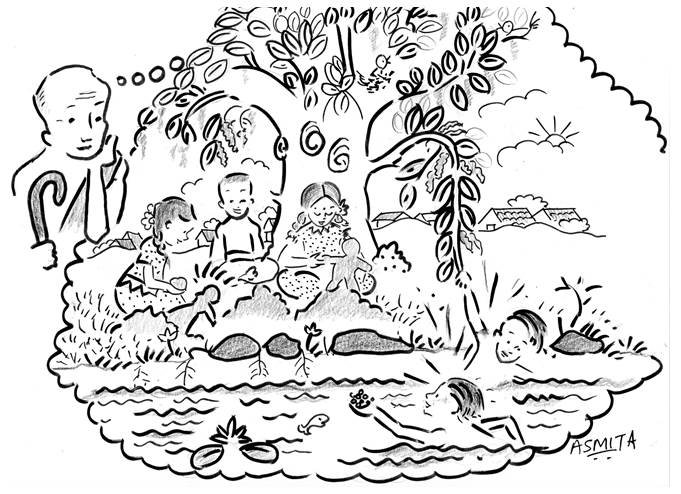
Sitting on the poolside in balmy California, I was amused to see similarities between my nine-year-old grandson trying to impress me with his aquatic skills and what Todittalai Vizhuttandinaar, the senile Tamil poet, recalled in a 2000-year-old poem on his youth long gone. The Tamil poem in Puranaanooru in its original is available here: www.tinyurl.com/Puranaanooru-Swimming — END
Obituary: Vijay Kapoor (1937 to August 21, 2021) — A Well-Liked Long-Time Resident & Music Lover
Posted by admin in October 2021, Past issues on October 4, 2021
By Shambhavi Desai, Bridgeville, PA
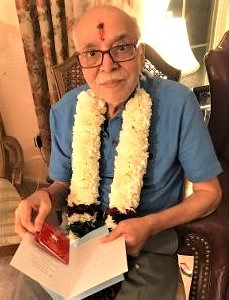
Vijay Kapoor of Mt. Lebanon, Pennsylvania, a long-time resident in our area, well-known and well-liked by all who interacted with him, passed away in his sleep at St. Clair Hospital on August 21, 2021. He was 84.
He was born on April 28, 1937, in Hyderabad, India, to Shadi Ram and Krishen Kaur Kapur, as the youngest of nine siblings. He got his bachelor’s degree in arts. In 1975, Mr. Kapoor came to the U.S. with his two children and lived with his older sister, Shakuntala Prabhu, with whom he was very close. His wife, Sulochana, joined him later. Before coming to the United States, he was in the Indian military, lived in Zambia, and Ottawa where he worked for the Indian High Commission. He was with Allstate Insurance since 1977, till he retired in 2009.
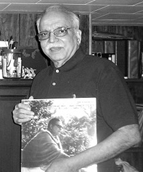
Many in Pittsburgh knew Vijay Kapoor as a soft-spoken gentleman with a polite disposition. His passion was music, a trait he got from his mother and brother. He told me in an interview years back, “I listened to Bengali and Hindi songs on the radio growing up.†An ardent fan of legendary singers like Pankaj Mullick and Hemant Kumar, he sang Hindi and Bengali songs at community gatherings in his melodious voice. He was facile in Telugu and Urdu as well. Mr. Kapoor was with the Bengali Association of Pittsburgh. He chuckled and told me once, “I am a Bengali soul in a Punjabi body!â€
Kapoor had a large personal collection of Indian gramophone records from the 1930s, 40s and 50s, well-kept and cataloged in his basement where he spent his time in retirement, lost in his world of music. Some of his music collections are on this link: www.tinyurl.com/Kapoor-Music-Albums.
He is survived by his wife of 56 years, Sulochana; his children, two sons (Hemanth Kapoor and Vikram Kapoor; and daughter Krishna Kapoor Johnston) and their spouses; and his grandchildren.
Vijay Kapoor’s Hindu cremation was at the Beinhauer Funeral Home with Pandit Sureshchandra Joshi from the Hindu-Jain Temple helping the Kapoor family with the last rites.
A grateful note from the editor: Vijay Kapoor (and his son Hemanth) supported the magazine with ads in its early crucial days, the ads that they perhaps did not need for their business, just to help the magazine survive. — Kollengode S Venkataraman — END
Monroeville’s Peace Pole Installation Ceremony
Posted by admin in October 2021, Past issues on October 4, 2021
By Praveen and Pratheema Kumar, Monroeville, PA


Note: Praveen, with his background in computer science, is pursuing his PhD program in machine learning while working in the same field. His passion are sports car and coffee. Pratheema, an electrical engineer, works for a semiconductor company. She loves cooking, baking and dancing. She has learned Bharatanatyam. They live in Monroeville.
If anyone wanted to have an outdoor event in our area, July 31st, 2021 was the day — azure sky with patches of white clouds slowly drifting, temperatures in the 70s and gentle breeze. The Rotary Club of Monroeville could not have chosen a better day for dedicating their Peace Pole, reminding us of the importance of peace in this world! Around 150 people from diverse backgrounds joined in the celebrations.
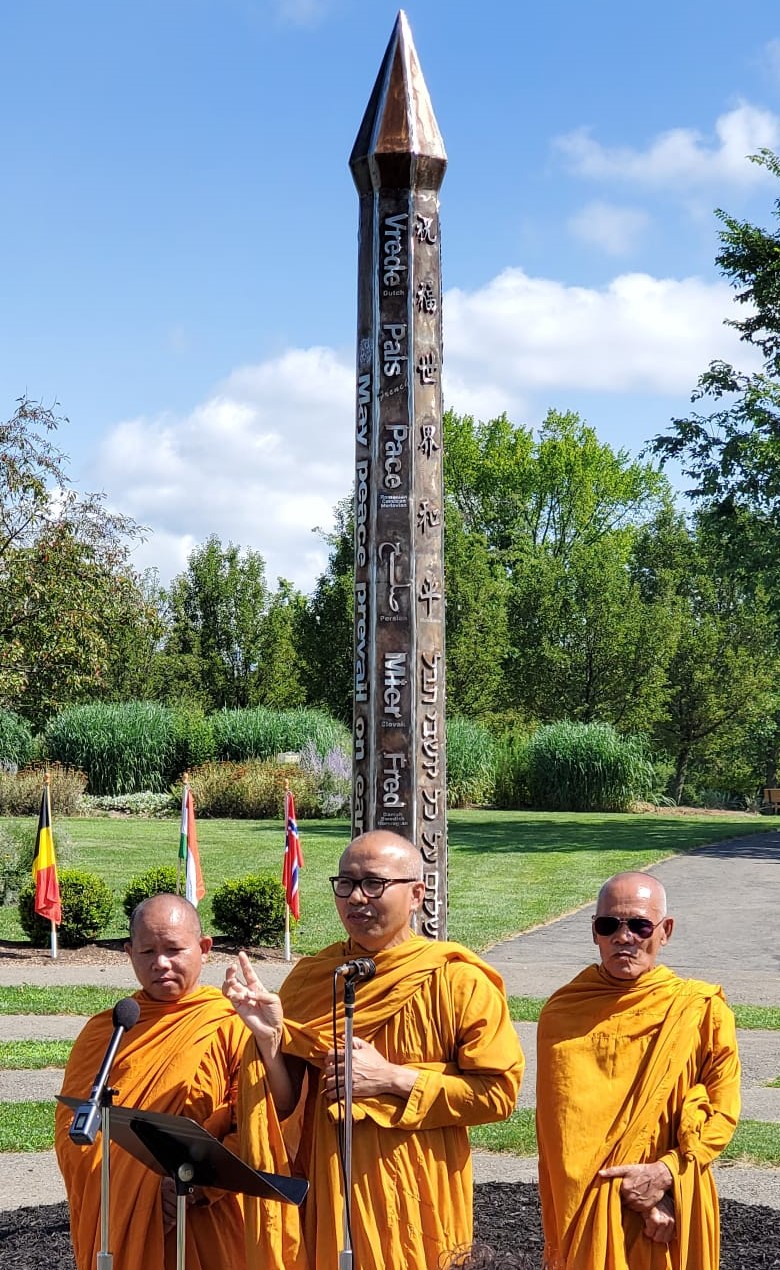
Peace Poles, fabricated with different materials, are internationally recognized symbols of the hopes and dreams of humanity, standing vigil in silent prayer for peace on earth.
In the wake of the Second World War, Masahisa Goi of Japan 1955 in Japan, came up with the idea of installing Peace Poles. The first few Peace Poles outside Japan came in 1983. Since then, more than 250,000 Peace Poles are in over 190 countries. The central theme in the monument is the message “May Peace Prevail on Earth.â€
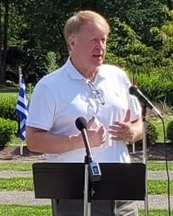
Rich Fitzgerald, County Executive of Allegheny County, was the special guest for the event. Mr. Fitzgerald said Pittsburgh is a city that is very diverse and has been welcoming people of all backgrounds and nationalities for several decades and will continue to do so in the future. Moments like these give us time to pause, he said, to reflect and respect the journey we have come through as a country, and events like these make us think forward on ways to strengthen our cultural diversities even more by respecting everyone and treating everyone equally.

Earlier, Brandon Markosek, the Democratic State Representative in Harrisburg (from District 25 covering Monroeville) stressed that it is paramount that we all come together as one, we treat everyone fairly and equally and for all to feel part of the community. The Peace Pole, Markosek declared, “conveys the fact that we are one country, and we are one people.â€
Setting the stage for the event, earlier, the president of Monroeville’s Rotary Club, Gerry Maynard, welcomed the invited guests and the gathering. He highlighted the significance of installing a Peace Pole as a symbol for welcoming and nurturing diverse cultures among people of different national origins, ethnicity, and religions. He exhorted everyone in the audience to extend diversity, equality, and inclusion in simple everyday tasks by making them a priority.
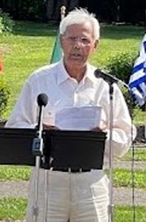
SOm Sharma, the previous president of the club, detailed the tremendous efforts that went into the Peace Pole project. Peace, he said, is at the very top of Rotary’s Seven Areas of Focus, and that Rotary’s motto, namely, “Service above Self†continues to motivate fellow Rotarians all over the globe. Hundreds of thousands of Rotarians in more than 35,000 clubs worldwide continue to spread peace around the world.
There are plans to add “Hiroshima Trees,†to send a strong message of human resilience. The Hiroshima trees survived the US dropping of the nuclear bomb in Hiroshima in Japan in August in 1945. The Peace Pole will only be a beginning inspiration for all to create programs nurturing peace and harmony in the community.

The Monroeville Rotary Club, a year ago, decided to have a Peace Pole in the community. A team of enthusiastic Rotarians did their research and engaged the services of a reputed sculptor, Joel Selmeier, of Cincinnati, Ohio. The Rotarians also identified the different languages spoken in and around Monroeville, an astounding number of forty languages to be cast on the pole. Stainless steel was the choice of the material – we are after all, the Steel City — based on our location, weather patterns and durability (expected life span of 400 years). The $15,000 project, funded mostly by the club’s own funds, took ten months to complete.
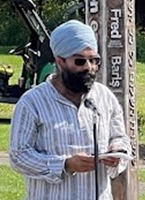
Through the program, Mr. Maynard randomly picked one of the 40 languages and invited people from the audience who could speak that language. He asked them to translate the phrase “May Peace Prevail on Earth,†and the phrase was translated into Hindi, Punjabi, Japanese, Hebrew, Urdu, Thai, French and Bahasa (Indonesia).
The event ended with a closing song “Let There be Peace on Earth†by Diane Milowicki while the audience stood up and joined Diane in the singing, followed by the release of seven doves symbolizing the seven continents.
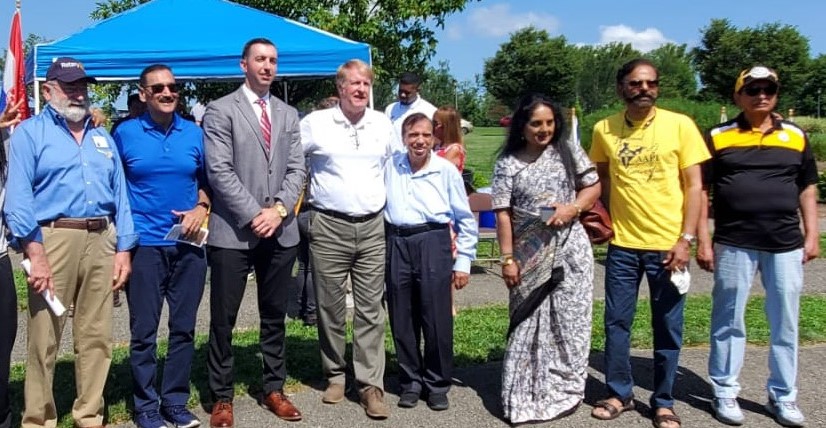
It was a great event, where people of different cultures, color and ethnic backgrounds were present unitedly to show their support to the “Peace Pole Inauguration Ceremonyâ€.
Suzan DeLaney, member of the Murrysville Rotary Club emceed the program, with Diane Milowicki giving the national anthem in the ceremony. — END