
Archive for category January 2015
Women and Managing Assets
Posted by KOLLENGODE VENKATARAMAN in January 2015 on August 4, 2026
Kollengode S Venkataraman Written in 2003
While many early Indian immigrants are evaluating their retirement options, others are staring at it uncomfortably, looking at ways to manage their nest eggs. This topic is important to Indian women as well. Particularly those who were mostly homemakers or hold jobs that were not highly paying or pay no benefits at all. Consider these.
- Most of the early immigrants from the Indian subcontinent have had arranged marriages in which grooms are typically older than their brides by 6 to 10 years.
- Empirically, in the West, women live longer than men. Among Indians, women may live even longer than men by a few more years.
Putting these observations together, one can readily infer that Indian women are likely to outlive their husbands by 10 to 15 years. Want proof? Next time in any indian gathering, empirically you will see more women who have lost their husbands, than senior Indian men without their wives. In the US, these women are likely to inherit their husbands’ sizable estates.
In our desi Yankee hybrid marriage, our seniors want independence, while our married children want privacy. So, our women in their golden years will often be living by themselves, close to, but not with their sons and daughters, with sizable amount of money kept in different accounts.. So, it is important that Indian women learn the basics of how to manage their assets. This is the burden that comes with independence and wealth.
It is one thing to carefully manage take-home pays of yourself and your husband in running your homes. Even in this some women are constrained by their husbands. But an entirely another beast to manage a large volume of money in mutual funds, stocks, and bond, CDs, and IRAs… … You need to make informed decisions even if you have a well-meaning financial planner. You need to be aware of all options. And the risks associated with each of them. This should help you can intelligently work with your financial planner. It is not for nothing that the Panchatantra says.
Money causes pain in getting.
In keeping pain and fitting.
Pain in loss and pain in spending.
Damn, the pain never ending.
So, Indian immigrants must let their spouses know the basics of managing money and assets. Men only help themselves by doing this. The time is ripe for early Indian immigrants to organize or at least attend seminars for letting their spouses, particularly traditional women, understand the taxation issues and the risks involved in many investment options, et cetera. So that they can spend their golden years with independence, confidence and peace of mind.
After diligently saving for retirement, not preparing people on how to manage one’s life and one’s estate is a crime. END
A Worm’s Eye View of A Vibrant India.
Posted by KOLLENGODE VENKATARAMAN in January 2015 on August 3, 2026
By Kollengode S Venkataraman (written in 2004)
India’s rapid growth and the accompanying expansion of the Indian middle class — 300 million and growing — the success stories of Infosys, Wipro, Ranbaxy, and other ventures, and the shrinking number of people living below the poverty line are regular features in the global media. The Wall Street Journal and The New York Times have written tongue-in-cheek stories on India-based call centers servicing English-speaking customers all over the globe.
As India is trying to move up the technology chain, fast-food joints are proliferating. One recent story contrasted Delhi suburbanites splurging on French fries in shopping mall food-courts on the national holiday marking the birthday of Mahatma Gandhi, who preached and practiced frugality and simplicity.
India’s exports show steady increases, now over $45 billion, with around $10 billion in IT alone, and foreign exchange reserves are over $90 billion and growing. Goldman Sachs recently reported that by 2050, the BRIC countries — Brazil, Russia, India, and China — would have a higher GDP than the G6: the U.S., U.K., Canada, Germany, France, and Japan. Instead of feeling good about traffic jams as a sign of progress, Indians now complain about them. This is a good sign.
These are the views of the jet-set class from 30,000 feet above, or from corporate boardrooms and video-conferencing rooms in India, that are reassuring to the affluent and upwardly mobile in India.
Let’s forget for now that even as anglicized Indians on toll-free lines service English-speaking customers all over the globe — from booking hotel and airline reservations to fixing PCs when they crash — similar services are not available for Indians living in India. Also ignore the wide chasm between the quality of primary and secondary education that the middle class buys from private schools, and what is available to the working poor. Finally, let’s also forget for now India’s scandalous healthcare system, which bankrupts even the middle class, not to speak of the poor.
Recently when I was in India, I saw reassuring changes from the worm’s eye view and here are the snapshots.
Scene 1. Boarding area in Singapore Changi airport. I was waiting to board my plane to Chennai. Almost all the passengers were Indians or at least of Indian origin. Business travelers, vacationers and the like. Most of them were also well groomed. Their attire and demeanor showed that. One was embarrassed to display once ignorance on the nuances in filling out customs and immigration forms.
I was on my way from Pittsburgh to Chennai through a circuitous route of Pittsburgh, Detroit, Frankfurt, Amsterdam, Singapore, Chennai, and I was on the last leg in this long tiring journey. I was in my crumpled shorts, loose half shirt, wearing rough shoes. After changing hotel rooms every night, I was dishevelled after long hours in planes. I hand carried two books of poems by 12th and 16th century Tamil M\mystic poets Pattinattar and Thayumanavar. Many of today’s anglicized, upwardly mobile Tamils may not even know their names, leave alone their times of their works.
Around me was a medium built chocolate coloured traditional middle-aged Indian. He was filling out his immigration forms on seeing such a contradiction in my demeanor — a bald middle-aged Indian in dishevelled clothes and shoes living somewhere in the West. My clothes and demeanor showed it — and I was comfortable enough to carry the works of classic Tamil acetic poets to read during air travel. He gingerly approached me speaking in Tamil for some clarification on the form he was filling.
Hesitantly, he started. “I am half-baked in English naan Englishle arai kurai.Will you tell me what I should write here?” He was embarrassed he was stuck with one phrased, “Port of Embarkation.” I have to credit the Indian babudom for such linguistic assaults that stun ordinary Indians, much like deers against the headlights in rural roads in the US
After filling out the form. We told each other our backgrounds. He was proud that unlike him, his children went to English medium schools and are now in college getting degrees.
He was a businessman dealing in textile machinery and also in textiles, both traditional sarees and dothis and readymade garments. He had visited Mauritius, South Africa developing business contacts and was in was on his way home after negotiating successful. Business deals in New Zealand, Australia, Malaysia, and Singapore. He has seen money rolling in and lost also lost money big time in business
And after losing big time for the second time in a failed partnership, he was starting all over again. He had confidence in himself to go to far off lands, even with his limited English language skills and lacking in what the urban Desis would call the sophisticated demeanor for making business deals overseas. As I boarded the wide-bodied plane, he disappeared inside and I never saw him again.
As a plane taxi to take off, I was wondering that if he had gone to college and earned a degree, would he still have had the courage to go strike on his own? In our possibility, instead of being a successful entrepreneur, he would have disappeared into the amorphous Indian Barbudom.
Scene 2. A Barber shop in Thane near Mumbai. I went there. Not for a haircut, but for a complete shave. A 20-year-old Barber asked me, “Kya saab shave hai?” (What? you want a shave?) “Haan Ji, lekin dadi mein nahi, sir pe!” (Yes. On my scalp and not on my face. He didn’t say anything, but I’m sure he wondered why this middle-aged man wants to shave his head in a suburban barber shop. The barber took his knife with its 6-inch-long blade and elegantly held it between his forefinger and thumb in his right hand.
He was adept in his trade and had no use for any of the modern electrical accessories we see in hairdressing salons here. He went over my page slowly, gently but firmly, with the sharp blade running over my scalp once. Did I feel any twitching or hurt? He was so good that he was instinctively economical. He didn’t have to run his blade twice on the same area to remove any tonsorial remnants on my head.
The ultimate compliment for him was when I showered as soon as I returned home from the Barber shop. My aunt wouldn’t let me enter her kitchen without that shower. As I poured water over my head, I had no burning sensation anywhere on my now bald scalp. The Barber was so skilful that even as he was shaving my head with his handheld knife, he made sure that his blade made no contact with the scalp underneath to inadvertently irritate the skin.
Just imagine how resourceful he would be if you give him and the likes of him all over India, half the modern electrical tools and accessories of a Barber shop in the West.
Scene 3. My niece is home in Ghatkopar, a Mumbai suburb. My niece and her husband an MBA marketing guy in the exploding car market in Mumbai, were renovating their flat. On the day I went, the Carpenter and his assistant were giving finishing touches to their work. Only bearish tools were lying around the house. Hammers, mallets, chisels, wooden markers, planes, screwdrivers, tools for drilling holes in wood, all accelerated and nothing like Bob Vila. Yet his renovation wood work was outstanding. Solid wooden doors made with different types of hardwood, having contemporary looking joints with flowingly smooth curves put together perfectly well coordinated custom-made cabinets and furniture, with even a small shrine for lighting diyas (traditional oil lamps), all handmade with the barest of tools.
After his work, I picked up conversation with him over tea and visits I in my broken Hindi and he in his broken English. I asked him how he learned his trade, expecting him to name some of India’s trade schools. Dismissively, he replied. “Yeh hamaara khandan Mein hai.” (This is our heritage.)
Then a cell phone rang. I thought it was nieces, but it was the carpenters. He took it from his toolbox, some from another location, called an updated him on the status of his work. Intrigued by his confident role, I asked him more about his business and himself. He came to Mumbai from Kanpur, Uttar Pradesh ten years ago. He was barely 35 now and has 23 people working for him proudly, he told me. I work as a subcontractor for architects and interior designers. I don’t do chhota mota kaam. (I don’t do sundry jobs.)
Scene 4. Chembur vegetable market in Mumbai, Chembur, populated mostly by Goans, is now a Kerala adda with second and third generation Keralites from Palakkad, Ernakulam, Kochi, Thrissur, and Trivandrum. The vegetable marketer caters to this. Population. very well. Even Marathi vegetable vendors know the important South Indian festivals like Onam, Karthi, Thiruvadirai. And the special vegetables used in cooking for these festivals.
Twenty-five years ago, when you went to the market you had to buy individual vegetables for the different dishes you want to make at home. With women increasingly going to work above 15 years uh ago, all that you have to tell the vendor is give me vegetables for avail when people and he will give you the seasonally fresh vegetables in the correct quantity in correct proportions. According to Making Real Kerala dish made from the medley of up to eight vegetables, coconut, green chili, Curry leaves, and buttermilk.
With women increasingly exchange time. Defenders have the food chain now. Many sell fresh vegetables. Different dishes, the office going women, customers happily paying for the service time and they go home. Hmm garden-fresh pre-cut vegetables.
A Traditional vyapari (trader), a barber and a carpenter, and a vegetable vendor. Not one of them the product of India ‘s anglicized college-educated upwardly mobile class, not one of them the beneficiary of the organized sector schooling, but all of them successful entrepreneurs.
Looking at young men and women in India waiting for job interviews/job offers from multinational companies — my friend Ajay Sood, who refers to himself as coolie with the PhD — I wondered: how many English-educated college graduates in India, with all the sophistication college education brings, can be on their own or, better still start a business employing people as the carpenter from Kanpur did in Mumbai,
I also wondered. How much more productive India’s skilled craftsmen — carpenters, barbers, tailors, weavers, electricians, metalsmiths, and mechanics — would be if they had half the modern tools one finds in places like Home Depot and other places.
Inadequacy of the Indian education system stood in sharp relief when seen in the background of the small businesses that have succeeded with no help from the formal Indian education system. A digression is necessary here.
A digression is necessary here.
In the 1960’s and 70s when India was in the thick of Nehruvian concepts, pay your money in government run industries, Sri Rajagopalachari, NG Ranga, K B Kripalani, Minu Masani, Casa Subbarao and others started the Forum of Free Enterprise. The forum argued that the Permit-License-Quota Raj of Nehru was an unholy alliance among politicians., bureaucrats and the high industrial houses to fleece taxpayers and was a prescription for economic disaster. The forum for Alley, but unsuccessfully for any unruly alliance the Congress Party and its Marxist cronies shamelessly called themselves, called them CIA agents. Most of these government run companies never even broke even.
After wasting precious 40 years and millions of taxpayer money in the late 1980s, India came close to bankruptcy during Congress parties Narasimha Rao, Manmohan Singh era. With the IMF and the World Bank breathing down their neck, they were forced to stop the state-controlled economy. This is exactly what the forum of Free Enterprise was pleading for nearly 30 years ago. Everyone. Praised the Rao Singh Alliance for the change but the fact is they had no option.
On seeing the divestiture of government run industries one by one in India (even state governments run by Congress party are doing it), I couldn’t help admiring the foresight of the people in the Forum of Free Enterprise. If I can fault them on one point, it was that they were ahead of their time by thirty years. If any of them were alive today, they would be having their last laugh.
So, on seeing a vibrant India from the trenches during my recent visit, I realized that India was betrayed not by its working class or small traders and skilled workers, but by the unholy alliance among its politicians, bureaucrats, big businesses and their mannered managers and its educated middle class. Their only motivation was to preserve their unenlightened self-interest and the status quo even as they saw the ground on which they stood was changing and changing fast.
In India, inevitable prosperity in the coming decades, the impact of the success of thousands of traditional small businesses and craftsmen on the micro level will be no less significant than the success stories of Infosys, Ranbaxy, Wipro and all the call centers put together.
That should make everybody feel good.
Gyrations in the U.S. Free Market System
Posted by KOLLENGODE VENKATARAMAN in January 2015 on August 2, 2026
By Kollengode S. Venkataraman (January 2003)
The U.S. free enterprise system periodically suffers man-made upheavals, often driven by greed among those willing to skirt—or even break—the law. In the past two decades, the savings-and-loan collapse cost taxpayers billions, while figures such as Ivan Boesky and Michael Milken inflicted serious damage on the economy. Once wealthy enough to employ private armed guards, they later spent years in secure taxpayer-funded facilities that protected their privacy but deprived them of freedom: prison.
The commercial real estate boom followed, helping bring down once-mighty companies such as Westinghouse, now reduced to a marker along I-376 in Churchill. Then came the derivatives market, where speculators and analysts—including some math and physics PhDs—used complex models originally developed during the Cold War to track projectiles in space. Instead of relying on company or industry fundamentals, they wagered on the probability of small market movements, worsening market volatility.
During the dot-com boom, day trading was promoted as a virtue, though it was little more than gambling on stocks from a home computer. I wondered then whether stocks had always been traded during the day, while “night trading” sounded like something illicit—drugs, prostitution, or gambling. Many people who had never reviewed their 401(k) statements or understood basic Wall Street measures such as P/E ratios entered the day-trading frenzy. They did not need to worry about earnings ratios because many dot-com companies had no earnings at all.
Then came Enron, Arthur Andersen, Tyco, WorldCom, Global Crossing, Adelphia, and others. Between March and August, the Dow Jones Industrial Average fell from 10,500 to below 8,500 amid wild daily swings, while the NASDAQ Composite dropped over three years from its peak of 5,200 to about 1,300.
A financial planner and unapologetic defender of an unregulated free market recently told me, “Venkat, what is greed to you is ambition to me.” That may be so, but when the ambition of a few destroys the lives of many, even staunch free-market Republicans and pinstriped Wall Street types object. The very people who championed an unfettered market called for government punishment of corporate offenders. On the day the U.S. Senate passed the Sarbanes bill, giving the Justice Department greater power to pursue corporate criminals—MBAs, PhDs, and CPAs among them—the Dow Jones rebounded by more than 400 points.
Even Federal Reserve Chairman Alan Greenspan, long an advocate of market self-regulation, sounded contrite. In a congressional hearing, he acknowledged that he had been wrong to oppose government oversight of corporate auditing.
On July 17, the New York Times business section captured the mood on Wall Street in a series of headlines. One asked, Who should mete out punishment—Washington, Wall Street, or investors? Another declared, Fed chief blames corporate greed for investor woes.
A third headline stretched across six columns: Is uncertainty the only thing in the current financial world that is certain? It seemed as though the copy editor was echoing the Buddha’s observation from 2,500 years ago: “Change is the only thing that is permanent in the world.”
Stockbrokers quoted in the story lamented that no one wanted to buy stocks tied to accounting firms. Regarding those firms, the article emphasized that trust must begin with their financial reports and concluded that America was losing its aura of invincibility.
The cynicism of the moment was captured by Eric Schmidt, then CEO of Google, in comments to a New York Times reporter amid another scandal unfolding within the Catholic Church.
As Wall Street fraud was being exposed, the Catholic Church in the United States faced a crisis unlike any it had experienced in years: persistent sexual misconduct by priests, which outraged Catholic laypeople. The Catholic hierarchy, led by powerful U.S. archbishops, worsened the crisis by trying to shield the Church and its offending priests through cover-ups.
Schmidt told the reporter, “I find that all of a sudden, I am a member of a class — CEOs — that is held in lower esteem than the Catholic priest.” It was a sad but revealing reflection of the values of the time.
Do these scandals serve as a warning to us? END
India Tries to Weather Islamist Militancy.
Posted by KOLLENGODE VENKATARAMAN in January 2015 on August 1, 2026
By Kollengode S Venkataraman. June Written 17 June, 2002.
The farther away people are from their ancestral land, the stronger is their cultural identity with their ancestral roots. And for people who also have survived the horrors of man-made disasters, such as what millions of people in the Indian subcontinent went through during the 1947 partition, what Jews experienced in World War 2, what Palestinians are experiencing now, what Kashmiri Pandits went through in the Islamic ethnic cleansing of Kashmir in the 1980s, their cultural identity quickly becomes their political identity as well. New. Better.
That is why in the US, the Irish are more Irish, Jews are more Jewish, Indians are more Indian, Pakistanis are more Pakistanis, Hindus, Sikhs, Parsis and Muslims are likewise more so than what they would have been had they stayed in their own respective lands. That is why emigre publications have no clout among policymakers.
We must keep this in mind when we look at the reaction of people from the Indian subcontinent to the war-like situation that would have billowed into full war. Since everyone in the world has an opinion on the subject, it’s OK if we also express our words in this space.
In the past, the Patrika has written cynically on both Pakistani and Indian bravado after their nuclear/missile tests, given the poor social indicators in both countries. If direct military provocation was bad, psychological provocation was worse, as when Islamic Pakistan named its missiles Ghazni and Gauri, after the Turkish Afghan marauders, who centuries ago, repeatedly raided and plundered the Indian subcontinent, that ironically, also included today’s Pakistan.
We, like others, have stressed that better trade and people-to-people contacts would tone down the high-temperature rhetoric that is second nature to Desis. But the Pakistani military, fearing that this would erode its stranglehold in Pakistani polity, has rejected this route.
The US recognized the menace of Islamic fundamentalists only when it was hit. First, WTC bombing years ago, then the US embassy bombing in Africa, then USS Cole, and finally the horror of September 11.
But India has been living with the Pakistani proxy war through jihadis since the 1980s after the US war against the Soviet-backed Afghanistan regime. During that war, Arab militants trained and armed by Pakistani army in Pakistan, with CIA and Saudi money were portrayed in the Western media as Mujahideen (freedom fighters). After the Soviet retreat from Afghanistan, the US had no use for the Mujahideen. Instead of disbanding the Mujahideen operations in Pakistan, the US simply walked away. These are Pakistanis’ observations, not Indians.
The Pakistani military, not succeeding in the three earlier wars in 1948,1965, and 1971 it imposed on India. And was always itching to settle scores, Pakistan let the Mujahideen-turned jihadis infiltrate into Kashmir in India since the 1980s. The military being the de facto ruler of Pakistan, the khakis laid the policies and called the shots.
For the Pakistani military, the jihadis are the most cost-effective way to bleed India, forcing it to take countermeasures that are prohibitive for India in terms of money, military preparedness, and anxiety created in the nation’s psyche, much like what is happening here in the US after the Islamist pierced commercial rejection to the Twin Towers
Arming the Arab mercenaries and calling them Kashmiri freedom fighters also gave Pakistan diplomatic deniability. Among the Pakistan-trained Kashmiri freedom fighters are Islamists from Egypt, Algeria, Iraq, Morocco, Syria, Saudi Arabia, leftovers from US-Soviet war in the 1980s in Afghanistan, not to speak of Pakistani army regulars.
When India cried horse on the menace of Islamic terrorists for years, the US mainstream media paid no attention till September 11. But then, in the vocabulary of the US media, the mighty mujahideens had morphed into menacing jihadis.
On December 13, 2001, Pakistan-trained jihadists attacked the Indian Parliament, the living symbol of India’s democracy. One wonders how the US and its allies, or even Pakistan itself for that matter, would have reacted if their national legislative institutions were attacked by state-sponsored terrorists. And then in May this year, Pakistan-supported terrorists, entered the housing quarters of soldiers in India and shot at point-blank range women and children, even a 2-month-old baby. We can’t have one set of rules for engagement for the West and Israel and entirely another set of rules for developing countries unless we say human life in the developing world is cheap.
General Musharraf, after spending years and billions of Pakistani taxpayer money in training and arming the jihadists, now tells the world that he himself, and Pakistan itself, have become the victim of terrorism. Well, General, as in stories of Hindu mythology, the Rakshasas (demons) you created and nurtured are beginning to devour you.
After his January speech, General Musharraf arrested 2000 militants only to release them soon, for them to infiltrate into India.
So how long did the power brokers of the world expect Prime Minister Vajpayee to exercise restraint that they don’t do it themselves? Besides, Vajpayee was not sitting on sitting idle, twiddling his thumb.
Vajpayee took a considerable risk in visiting Pakistan in 1999 to normalize relations. What did the general give him in return? The Kargil war. Then again in 2001, Vajpayee invited the general to India for talks. What did Bajpai get in return from General Musharraf? More jihadi attack. So, Vajpayee was entirely justified in rattling his Saber using ambiguous imagery in his speech, telling Pakistan and the West that the status quo was unacceptable.
What has prevented a war so far between India and Pakistan is that India is a democracy. No democratic government has initiated war in recent times with a formidable enemy. And the Pakistani army is formidable vis-à-vis India. In the 1980s, Iraq’s dictator Saddam Hussein, with US support, invaded Iran under the Ayatollahs. The war dragged on for eight years and consumed over one million Muslim young men simply because Iraq was under dictatorship and Iran was ruled by Islamic theocracy. What would have happened if both Iraq and Iran had elected governments is not just a rhetorical question. Again, Iraq under military invaded Kuwait under an oligarchy of sheikhs. So, the best guarantee against war in South Asia is for true democracy to evolve in Pakistan. But General Musharraf has given himself five more years as President in a sham one-man referendum. However, in the last standoff, the general declared and assured his Western donors that he would no longer allow jihadists to use Pakistani territory as a launching pad to infiltrate Kashmir. This should give some manoeuvring room for the new government in Pakistan after the October election to negotiate with India. With the entire world watching, the odds for an honest election in Pakistan are more
Continuing Education. An Old Indian idea, Widely Practiced Only in the West
Posted by KOLLENGODE VENKATARAMAN in January 2015 on July 31, 2026
By Kollengode S Venkataraman (written in 2002)
With technology developing rapidly all around, everything we learn becomes obsolete in a matter of years. Advances in the sciences and the explosive developments in acquiring, storing, and transmitting digitised data have changed every facet of our life — from the crib to the crematorium.
So, if we don’t keep on fighting obsolescence, we are overrun by the tsunami of changes. If we want to stay where we are relative to those around us, we must run and keep on running. Organizations, in their own self-interest, therefore, spend an enormous amount of time and money in continuously retaining their staff. The healthcare industry regularly holds retraining programs for professionals to keep them abreast of the latest developments. The budget for these retraining programs is not pocket change anymore.
This has opened new avenues for universities to offer programs in “continuing education” spread over several weeks. Medical disciplines, with high earnings even hold their week-long continuing education programs on cruise ships so that they can learn, relax, and get tax write-off for their classes on the cruise. The widespread practice of continuing education started in the West in the middle of 20th century that simply exploded in later years. So, if we think that continuing education is a 20th century phenomenon, it is entirely understandable.
But how about the idea of continuing education? There is evidence that this is very old — very, very old, as a matter of fact. The idea of continuing education was clearly enunciated in ancient India over 2000 years ago.Where does one find a reference to the idea of continuing education in ancient India? In the Upanishads, of course. In the Taitriya Upanishad, to be specific. The Upanishad is divided into three chapters called Vallis, Shikshavalli, Anandavalli and Bhrguvalli.
The Shikshavalli is structured in the manner of a “how-to” primer, instructed by the teachers to the students leaving traditional schools, on how they should conduct themselves once they leave to live in the world out there. Here are the original lines and their literal translation:
ऋत-ञ्च स्वाध्यायप्रव॑चने॒ च ।
सत्य-ञ्च स्वाध्यायप्रव॑चने॒ च ।
तपश्च स्वाध्यायप्रव॑चने॒ च ।
दमश्च स्वाध्यायप्रव॑चने॒ च ।
शमश्च स्वाध्यायप्रव॑चने॒ च ।
अग्नयश्च स्वाध्यायप्रव॑चने॒ च ।
अग्निहोत्र-ञ्च स्वाध्यायप्रव॑चने॒ च ।
अतिथयश्च स्वाध्यायप्रव॑चने॒ च ।
मानुष-ञ्च स्वाध्यायप्रव॑चने॒ च ।
प्रजा च स्वाध्यायप्रव॑चने॒ च ।
प्रजनश्च स्वाध्यायप्रव॑चने॒ च ।
प्रजातिश्च स्वाध्यायप्रव॑चने॒ च ।
Do things that are natural, and practice self-study and discourse.
Observe truth, and practice self-study and discourse.
observe self-control, and practice self-study and discourse.
perform fire sacrifices, and practice self-ready and discourse.
Be hospitable to guests, and practice self-study and discourse.
Be good to humanity, and practice self-study and discourse.
Propagate your lineage, and practice self-study and discourse.
do your civic duties, and practice this self-study and discourse.
Take care of your children, and practice self-study and discourse.
=========================================================
The teacher, while instructing his students on how they should conduct themselves after leaving school, repeats Swa-adhyayam (Self Study) and Pravachanam (Discourse) twelve times in this short passage. Was repeating Swa-adhyayam and Pravachanam so many times just for cadence? Certainly not. It was for emphasis.
Hindu priests in many temples recite the Shikshavalli in a slow, monotonic cadence that devotees find comforting and soothing, even though devotees and priests themselves may not know the meaning or the import of the recitation. Shikshavalli then goes on.
“Speak the truth. Walk on the path of Dharma. Don’t neglect self-study. Do not cut off your own family lineage… … do not overlook your own welfare, do not neglect your own prosperity, do not neglect discourse.”
That Hindu society by and large did nothing with the idea of continuing education in later centuries is a matter of shame, even though a few individuals kept doing it all through the ages. Only because of these individuals, much of what we now have survived. This is a topic for cultural historians and sociologists to explain.
We, the non-punditry class of Hindus, might not have heard about Swa-adhyayam and Pravachanam or about Shiksha Valli for that matter. But many among us have been instinctively putting into practice the idea of continuing education in our own way.
Take for example, artists of the Indian classical performing arts. They rigorously do swadhyayam for hours and hours every day just so that they will be in their best form. In India, we even have technical terms for it — Abhyasam Sadhakam. Centuries before practice became the common term among Indians. Asura-sadhakam is sadhakam done with demonic intensity. And their music/dance recitals are their pravachanams.
Or look at the teachers who train youngsters in the art forms of their passion to pass on the art form to the next generation. These men and women do Swa-adhyayam and Pravachanam.
Or take our forty-something men and women going through their own midlife crisis, suddenly getting inspired to read Tulsi Ramayan and Bhagavad Gita, Bulle Shah, Kabir and Thevaram, Upanishad, Adhi Granth Gyaneshwari… …. What do they do? Swa-adhyayam
Or look at our men and women with college degrees, taking classes in community colleges to acquire new skills, sometimes seeking better careers, often for the fun of learning something new. What do they do? Swa-adhyayam.
These men and women practice Swa-adhyayam for its own sake and for the satisfaction it gives them, without ever thinking of monetary compensation, often without ever having heard about Shikshavalli or the Taitriya Upanishad.
As I said earlier, many Hindu priests who have memorized these hymns by rote recite them week after week. Paradoxically, it is these priests who neither practice swa-adhyayam (self-study) nor indulge in pravachanam. That is a tragedy filled with great irony. END
India’s Bhakti Movement: Its Impact on Performing Arts, Literature, and the Indian Psyche
Posted by KOLLENGODE VENKATARAMAN in January 2015 on July 31, 2026
ABSTRACT:
The artistic, religious, and literary environment in which our lyricists lived gave them considerable freedom for composing krtis (musical verses) under a variety of moods, many of them considered blasphemous in other parts of the world. The Bhakti Movement initiated by the Alvars and Nayanmars in Southern India during 6th and 12th centuries provided this environment, which later Karnatic music’s composers used brilliantly. The Bhakti Movement brought about fundamental changes in the Indian collective consciousness, opening the floodgates for literary, philosophical, and spiritual outpourings, which helped how India resiliently responded to social and political changes under Islamic invasion and European colonization.
THE VITALITY OF INDIAN MUSIC:
India’s early civilization as revealed in the Mohenjo-Daro and Harappa archaeological findings and the recently discovered Saraswati Valley archeological findings started several thousand years before the beginning of the Current Era of time keeping that uses Christ’s birth as a convenient and arbitrary reference point. For any civilization, performing and visual arts are important pointers of its sophistication. Bharata Muni, who is believed to be from the Himalayan foothills, the author of Natya Sastra, often quoted as the basis of the Indian folk and classical dance forms. Natya Sastra, art historians estimate, was written sometime during the first two centuries after Christ. Another literary and historical work well-known in Tamil Nadu, but not familiar to the general public outside, is the Tamil epic Silappadikaram[1] (2nd century AD).
Silappadikaram describes the intricacies of performing arts in great detail. It describes artistes tuning the 14-stringed Makara Yaz (a kind of harp) and skillfully playing drums. It details how artistes should blend rhythm, melody, tempo, speed, footwork, facial expressions, etc. in dance; and the stage set up and illumination for special effects. The terms in Silappadikaram for the different pitches (similar to Sadjam, Rishabham, Gandharam…) are in Tamil (Kural, Tuttam, Taram, Kaikkilai, Padumalai, Ulai…). Such a sophisticated description of music and dance using non-Sanskrit terms indicates that the art form must have evolved indigenously and independently over several centuries before. Art historians[2] believe that Sanskritization of music literature in India did not displace the pre-existing music, but only assimilated it.
Further, from Matanga Muni’s Brhaddesi (6th century AD), Sarngadeva’s Sangita Ratnakara (13th century AD), Narada’s Sangita Makaranda (14th century AD), and other works, musicologists2 [3] [4] [5] have studied the evolution of music in India.
Thus, Indian classical music, which during 16th and 18th centuries blossomed and bifurcated into Karnatic and Hindustani traditions has been evolving over two millennia, contrary to what many of us axiomatically believe as being static.
The culmination of this is Venkatamakhi’s work Chaturdandi Prakasika (1660 AD) giving 72 Melakarta Ragas—also known as Janaka (Parent) ragas—out of which more than 30,000 Janya (progeny) ragas are derivable in the Karnatic tradition.
In early 20th century, the Maharashtrian musicologist Bhatkandé, after long painstaking discussions with the different Gharanas (Hindustani music schools), formalized the Hindustani tradition by retrofitting the Hindustani ragas current in his time into ten basic parent ragas he called Thats. While Karnatic Music integrated many Hindustani ragas into its repertoire decades ago, in recent years Hindustani musicians too have begun to enrich their repertoire with traditional Karnatic ragas.
LYRIC IS THE HEART OF KARNATIC MUSIC:
Despite the mathematical theory, both in ragam (melody) and layam (rhythm), the heart of Karnatic music is the krti (lyric) in one of the South Indian languages or in Sanskrit. In most krtis the dominating mood is bhakti that brings out the devotion of the composer to his/her Ishta Devata (personal deity) under a variety of situations. In these lyrics—Pasurams, Gitams, Kirtanas, Padams, Tillanas, Devaranamas, Slokams, or Va-chanas —the literal/literary meaning, the local context, and the devotional spirit of the composers are as important, if not more, as their purely musical embellishments. The scope of Karnatic music is not limited to the esoteric enjoyment of elitist listeners in terms of ornamentations such as alapana, pallavi, neraval, and swara kalpanas. Using skills acquired over several years of abhyasa (practice), adept musicians touch their audiences in the deepest recesses of their psyche, and show—even to those having no formal exposure to music—the ecstasy of communing with the Divine through music.
INDIAN RELIGIOUS HYMNS ARE UNIQUE:
In the monotheistic religious literature from many parts of the world, we commonly see poets personifying God as a punishing master, a stern father, a shepherd, or a guiding spirit, while they portray themselves as errant slaves, somewhat disobedient sons, a flock of sheep, or stranded travelers seeking help. In the devotional religious literature of India, including the krtis in Karnatic music, our lyricists, being Free Spirits, go beyond these imageries. They freely personify their Ishta Deivam not only as their friend, but also as their naughty son or adoring daughter, while portraying themselves as the loving, disciplining, and sometimes even chiding parents—imageries uncommon anywhere else. Examples: Kanakadasa’s Krishna nee begane baro, Uttukkadu Venkatasubba Iyer’s Taye Yasoda undan Ayar-kulattuditta mayan…
A Tamil literary work less known is Minakshi Pillaittamizh in which Kumara Guruparar describes goddess Minakshi of Madurai as a baby, a toddler, a child, a girl, and a young beautiful woman, who finally marries Sri Sundareswara of Madurai.
Another common literary convention is personifying God as a male lover, while the poets portray themselves as the beloved craving for her lover’s attention—the well-known Nayaka-Nayika bhavam. Manikkavasagar’s Tiru-vembavai, Jayadeva’s Ashtapadi and Gita Govindam, and Mira Bhajans are examples. The 20th century’s Subramanya Bharati in his ecstasy did what is unthinkable: He portrayed himself as the male lover or master, while personifying his personal deity as his beloved (as in Kannamma En Kadali), and as servant (as in Kannan En Sevakan).
Thus, in Karnatic music, all Vag-geya-kartas (Poet-composers) have kept bhakti as the dominant mood in their krtis. “O Mind! Don’t you know that the knowledge of music without Bhakti,” Tyagaraja reminds himself, “will not lead you to salvation?” (Sangita gnanamu bhakti vina sanmargamu galade, O Manasa!)
THE ORIGIN OF BHAKTI IN LITERATURE:
These Karnatic music geniuses did not create the mood of bhakti themselves. But they used bhakti that was already available fully developed as canvass for creating their musical masterpieces.
How was Bhakti developed as an evocative mood for creating intimate relationships with the Divine? More to the point, who developed bhakti to such an intense level of personal interactions with the Supreme Being? For an answer, we have to scan the pre-Purandara Dasa literary horizon of India. We should go to a time considerably earlier to know about an epoch unique to Indian history, the Bhakti Movement, which blossomed in the Tamil country nearly a millennium before Purandara Dasa.
Let us begin with Adi Sankara (8th century AD), the founder of Advaita Vedanta. Sankara wrote penetrating commentaries on Badarayana’s Brahma Sutram, the Bhagavad Gita, and ten Upanishads. He also authored Vivekachudamani, a work appealing purely to our intellect.
Sankara’s thesis is that for getting Moksham (liberation) from Bandham (bondage) we have to use Viveka (discernment) remove the veil of Maya (illusion) born out of our Avidya (ignorance). Viveka enables us to differentiate between appearance and reality, and helps us to see things as they really are.
Even the intellectually incisive Sankara finally realized that there was an equally effective, but considerably simpler and sweeter route for liberation. That route was Bhakti. His Sivananda Lahari, Mohamuddgaram, Kanakadharastavam, and others are testimonies to this fact. Later, Ramanuja (12th century AD), Madhva (14th century)—both products of the Bhakti Movement—were more emphatic. They said bhakti and prapatti (surrender) are the only routes to reach the Godhead.
Historically, the Bhakti Movement started first in Southern India a few centuries earlier to even Sankara. According to Basham[6], “The Bhakti Movement developed first in the Tamil country, at least as early as 6th century AD … and found its full expression in the hymns of early Tamil devotees—Nayanmars, Alvars and others—which are among India’s greatest contributions to the world’s religious literature… … The new form of worship [espoused by bhakti] received formal shape and was harmonized with the Upanishads… by a series of theologians starting from Sankara.”
BHAKTI LITERATURE AND MUSIC:
In the Vaishnava tradition, there are 4000 Pasurams (verses) of the twelve Alvars. Pasuram is a compound word. Pa is short form for Pattu (Tamil), meaning lyric. And Suram is the modification of Swaram (melody). Pasuram literally means lyrics set to music. Similar are the hymns of Karaikkal Ammaiyar, Appar, Sundarar, Sambhandar called Thevaram; and of Manikka-vasakar, called Tiruvachakam. These are sung to traditional tunes even today in temples in South India. The number hymns in the traditional 12 Saiva Tiru-Marais (Canons) exceeds 10,000 verses.
Even though many Western and Indian historians axiomatically and erroneously, say that the Bhakti Movement was the influence of Islam on India, the flower garden of Bhakti native to India was already there centuries before the arrival of Islam. Here, it is appropriate and necessary to quote Jordens[7] (1975) in some detail:
“Earlier theories that the [Bhakti Movement] originated … under the impact of Islam are negated by the simple fact that the earliest genuine devotional Bhakti poetry in Tamil [in the 6th century AD] precedes the coming of Islam. Islamic, and particularly Sufi, influences may have been felt later… … At the beginning of the seventh century we witness the eruption of the new type of passionate bhakti in Tamil. From the seventh to the tenth centuries, an extensive hymnal literature came to light… How did this new Bhakti spread from the south to Maharashtra, Bengal, and the northern plains? It happened through the Sanskrtization of the new spirit. Ramanuja (d 1137), founded the Sri Vaishnava sect, Madhya (d 1276), a Kanarese Brahmin, founded the Dwaita sect, and the Telugu brahmin Nimbarka (13th century) settled near Mathura singing the praise of Radha and Krishna. Vallabhacharya (d 1531) a Telugu born at Varanasi had tremendous influence through his sect in Gujarat and Rajputana. … Among the Saivites, the sect of Lingayats [who accept the 63 Saiva Nayanmars as their spiritual forbears] was one whose influence reached several north India saints… …”
Thus, the early indigenous banyan tree of the Bhakti Movement grew further later both as a response to, and under the influence of, Islam in India. So, starting from Purandara Dasa in the 15th century onward all Karnatic music Vag-geyakartas, while themselves not creating the mood of bhakti, used it brilliantly in their literary/devo-tional work for conveying complex ideas in philosophy, psychology, and spirituality in their native languages understandable by everyone. Bhakti as a mood for experiencing the Infinite and harnessing the divinity latent within everyone was already available to them fully developed, having evolved over several centuries before, starting from the Alvars and Nayanmars in Southern India.
SOCIOLOGICAL CONSEQUENCES:
Before the Bhakti Movement, most of our religious and philosophical ideas were in Sanskrit, confined to those from the scholarly and priestly class (mostly brahmins). It was the Bhakti Movement that made Godhead within the grasp of all, whether meditating in the Himalayas, or tilling the soil in the Sindhu-Ganga-Yamuna plain or along the banks of Narmada, Krishna, Godavari, Tungabhadra, or Kaveri.
Also, while the Vedantins were mostly from the priestly class, among the Alwars and Nayanmars we see savants from every segment of the Hindu society: Periyalvar was a brahmin. Kulasekhara Alvar and Tirumangai Alvar were kings; Tirup-panalvar an untouchable; and Andal, a woman. Similarly, among the 63 Nayanmars, the forebears for the Virasaivas, Tirunavukkarasar was a vellala (landed gentry), Gnanasambhandar, a brahmin; Tirunalaip-povar, an untouchable; Tirunilakantar, a hunter; and Karaikkal Ammaiyar, a woman.
The Bhakti Movement opened the floodgates for philosophical, social, and spiritual literary works in all Indian languages that immensely enriched Karnatic and Hindustani music’s repertoire. As the movement spread all over India, it became indigenous to all its places adaptation. This is not unusual. Contrary to what many of us believe, our ancestors in India were far more open-minded in synthesizing, adapting and adopting trends from other regions within India. An example: The Harikatha tradition, originally from Western India (in today’s Maharashtra) [8], became indigenous to Tamil Nadu, Andhra and Karnataka when the Nayaks and the Marathas in 15th century bought along with them during their reign in the South between 15th and 18th centuries. Today, Harikatha is popular in South India, while its hold in urban Maharashtra has become tenuous.
A few well-known names of the Bhakti poets:
• Namadev (13th century), Jnaneshwar (13th century), and Tukaram (16th century) in Western India;
• Sur Das (15th century), Mira (16th century), Tulasidas (16th century), and Kabir Das (15th century) in the Northern Plains;
• Chaitanya Mahaprabhu (16th century) and Jayadeva (13th century) in Eastern India;
• Purandara Dasa (15th century), Kanakadasa (16th century), Basavanna (12th century), Akkamahadevi (13th century), Annamacharya (16th century), Bhadrachalam Ramadas (17th century), Narayana Bhattadri and Poondanam (17th century), Ramalingaswamy (19th century), Arunagirinadiar (15th century), and Tayumanavar in Southern India.
According to Satchidananda Murty[9] the theology [of the Bhakti Movement] contained many novel doctrines for that time:
“The Supreme One loves man naturally and boundlessly and is ready to help all who surrender to him. God’s grace is spontaneous and uncaused … … Those who have surrendered to the Supreme One need not follow the Varnasrama system and need not perform any ritual. They are Avidhigocaras (not within the ken of obligations) … All bhaktas (devotees) are equal, and irrespective of caste, race, education and social status, a bhakta is superior to everyone else. God in the form of Archarupam is to be worshipped with joy and love. Sincerity, compassion and affection for the suffering humanity, and the feeling that all are one’s own kin are the traits of a genuine bhakta.”
It may be worth noting here that early Hinduism recognizes Acharyas and Gurus (Teachers), Rshis (Sages), Gnanis (wisemen), Siddhas (Accomplished ones), Buddhas (Enlightened ones), Jainas (Those who have conquered [their senses]), Mahatmas, Yogis, Dasas, Sannyasis and Swamis.
However, the concept of sainthood was unknown. Why? All creations being sacred, we are all intrinsically divine and saintly. According to our beliefs, the root cause for our problems is not our sin —original or otherwise—but our original ignorance (avidya) of mistaking appearance for reality. Therefore, conferring sainthood on our sages is alien and irrelevant to Hinduism.
PRESERVING INDIA’S SPIRITUAL HERITAGE:
Throughout history mass conversion into other religions was bloody and pervasive. Europe completely converted to Christianity after the fall of the Roman Empire in the 2nd century AD; the Americas after Columbus; and parts of Africa after the 18th century’s Industrial Revolution. Northern Africa, the Arabian Peninsula, Turkey, Persia, and Central Asia completely converted to Islam within a short time after Prophet Mohammed (6th century). Percolating the Indian subcontinent without subsuming it, Islam went further eastward, converting Malaysia and Indonesia completely. Spain violently oscillated between Catholicism, Islam, and back to Catholicism.
But in India, thanks to the Bhakti Movement, partially in any case, neither Islam (during the 9th and 15th centuries) nor Christianity much later, succeeded in completely converting the entire populations even over a period of several centuries. The reasons are not hard to find. With the Bhakti Movement, the following ideas gained ground within every Hindu mind:
• God is personal (Ishta Devata, Kula Deivam), immanent and transcendent, loving and compassionate.
• God realization and liberation from bondage is within the grasp of everyone across the rigid caste barriers.
• All worships are effective in helping us to become progressively better, eventually to become sublime.
• While the destination is but One (that is, to become liberated), paths available are many. “Truth is but One, but sages call It by various names,” (Ekam sat Viprah bahudah vadanti) is an Upanishadic aphorism.
With these beliefs, claims that one’s god is superior to all others, or worse still, that one’s god is the only God, appeared unsophisticated to our ancestors, and were alien to their ethos.
And it is no exaggeration that but for the Bhakti Movement, India’s cultural and artistic heritage—and music is a part of this heritage—would not have survived invasions by the Turks and Mongols between the 10th and 14th centuries. Also it would not have survived the Europeans’ economic onslaught and their colonization between eighteenth and twentieth centuries, and their later enslavement of the educated populace in Independent India.
If you doubt, compare the cultural and religious history of India with that of Central American civilizations (the Mayas and the Incas), the Philippines, Indonesia, Malaysia, the Hawaiian islands, and parts of Africa and West Asia.
In short, but for the Bhakti Movement, we may not be having this forum to publish the article in a Hindu Temple function in Washington D.C. ten time zones away from India.
Acknowledgments: The author acknowledges his friends and an associate for critically reviewing this manuscript. They prefer to remain anonymous.
[1] Ilango Adigal, Shilappadikaram, English Translation by Alain Danielou, Arangetru Kaadai pp. 9-15, Publishers: A New Direction Book, New York, NY (1965).
2 R. Ranga Ramanuja Ayyangar, History of Indian (Carnatic) music from Vedic Times to the Present, Publisher. R. Ranga Ramanuja Ayyangar, Madras, (1972).
[3] Mrinalini Sarabhai, Understanding Bharata Natyam , Music for Bharata Natyam,Chapter 12, pp. 107-112, Publishers: Darpana Academy of Performing Arts, Ahmedabad, Gujarat, (1972)
[4] H. S. Powers, A Historical and Comparative Approach to the Classification of Ragas, University of California, Los Angeles, Institute of Ethnomusicology, Selected Reports, vol. 1(3), Los Angeles, (1970).
[5] B. C. Wade, Music of India: The Classical Traditions, Prentice Hall, Englewood Cliffs, New Jersey, (1979).
[6] A. L. Basham, in The Wonder that Was India, first published in 1954, 16th impression, Chapter viii Section iv, pp. 332-334, Publishers: Rupa and Co. Calcutta.
[7] J. T. F. Jordens, “Medieval Hindu Devotionalism,” Chapter XVIII, pp. 267-280, in Cultural History of India, Edited by A. L. Basham, Clarendon Press, Oxford University Press, London, 1975.
[8] Kalyanapuram Aravamudachariar’s website http://amudanharikatha.com/en/history.html
[9] K. Satchidanda Murty, in Philosophy in India—Traditions, Teachings, and Research, Chapter 3, “History of Philosophical Thinking—II” pp. 55-60, Publishers: Motilal Banarsidass and Indian Council of Philosophical Research, New Delhi, 1985.
South Indian Performing Arts:Whence? Where Now? Whither?
Posted by KOLLENGODE VENKATARAMAN in January 2015 on July 31, 2026
Acknowledgments:The author thanks Bhanu Pandalai, Premlata, Nayantara Swamy, and Shankar Krish of Pittsburgh; S.Krishnan of Germantown, MD; and S. Panchanadeeswran of Buffalo, NY for critiquing the manuscript. For all the inadequacies, however, the responsibility is entirely the author’s.
I have been an observer of the arts scene from a distance, and have attended countless concerts, from the unforgettable to the regrettable and everything in between. And this gives me a perspective I might not have obtained had I been an insider.
In Karnatic music concerts, whether in Chennai, Mumbai, or Delhi; or in Dubai, Singapore, London or San Francisco, I hear from different sources that the audience is almost exclusively South Indian, overwhelmingly brahmin, mostly Tamil. I state this only as a simple statement of empirical fact, without pride, prejudice, or anger. Karnatic music, compared to its Hindustani sibling, has not made any dent in attracting non-Indians, or sadly, even other Indians.
So, when Outlook India, in the wake of now-common global tours of Southern Indian artistes, published in last February an article titled “Cauvery in a Puddle” by S Anand, I was interested in its contents. My curiosity was further whipped when a blurb read “The Total Hijack of the South [India]’s Art into the Airless, Brahmins-only Monopolies is Stifling Genuine Growth.”
And the tenor of the Outlook India article prompted me to articulate my take on the subject here so that readers can come to their own conclusions taking into account their own opinions on the matter. I must say that over the last several years, informally, and in bits and pieces, I have discussed with many of my friends many issues, including what follows.
Since Bharatanatyam and Karnatic music are inseparably intertwined, this article attempts to juxtapose the two and compare their evolution in the last seventy years in the midst of Tamil Nadu’s unique social and political transitions.
1. Bharatanatyam
In Tamil Nadu, in the early part of the twentieth century, Sadir as Bharatanatyam was know then, was the exclusive preserve of Devadasis (“slaves of God” in Sanskrit) coming from Isai Vellaalar community. Those days Isai Vellaalar women became temple dancers patronized by kings and landlords, and their men became nattuvanars, musicians, and nadaswaram vidwans. In Tamil, Isai means music and Vellaalar, even though means farmers, has come to mean the landed gentry.
The general perception among many people today is that brahmins have come to dominate Karnatic music and Bharatanatyam using fair and foul methods, usually with more of the latter, as we see in accusations of brahmins “hijacking” the arts.
The only way to respond is to confront the accusation squarely seeking answers, or at least explanations. When we do this, as you will see, we see the confluence of social, political, legal, and economic factors of the era in Tamil Nadu – not the brahmin “hijacking” – lead to the transfer of the chalangai (gungroo) of Bharatanatyam from the ankles of Isai Vellaalar women to those of upper crust brahmins.
East India Company, Abolition of Devadasi System, and the Resuscitation of Classical Dance
In the nascent years of Britain’s East India Company (19th century), brahmins joined the Company as lowly clerks, derisively called “gumasta.” As the Company grew in influence and started holding political power over the next several decades, the lowly brahmin clerks became the Indian upper crust, forming a layer between the sahebs and the serfs.
Brahmins did not cause this transformation, but became its beneficiaries on account of the flow of history. What caused the change was the already weakened central authority of the Mughals, the fractured Indian polity, and the chronic distrust among India’s nawabs and maharajas. Besides, with their mercantile tradition, the British had a long-term political strategy backed by cannons and guns.
With most of Southern India coming under the Madras presidency by the middle of 19th century, the patronage system for Devadasis degenerated. Deva-dasis were seen as concubines, mistresses, even prostitutes. And with the Victorian morals the British tried to impose on India, the Devadasi system came under censure.
In the 1940s, among those prominent wanting the Devadasi system abolished was one Dr. Muthulakshmi Reddy, herself of Devadasi heritage. With the Devadasi system made illegal in mid 1940s, the stigma attached to Devadasis received a legal reinforcement. The Tamil society was trying to throw the baby of classical dance preserved by Devadasis along with the dirty bathwater of the Devadasi system.
In this environment, a few individuals in Madras, almost all of them brahmins, rescued the classical dance of Devadasis and gave it social respectability. One E. Krishna Iyer, a lawyer interested in performing arts, in the 1940s renamed it Bharatanatyam since the dance form drew its inspirations partly from Bharata’s Natya Shastra (2nd century AD).
So, Sadir was renamed Bharatanatyam. The emphasis in Sadir on shrngara rasam (erotic mood) between the dancer and her secular hero (usually a rich patron) was transmuted into Bhakti (devotion) towards Ishta Devatas (personal deities), in which India had already an extensive repertoire of lyrics in all languages.
The Bhakti Movement, briefly:
The Bhakti Movement started in Southern India, in the Tamil country as early as the fourth century AD, and blossomed further between 6th and 12th centuries, well into our times. The Bhakti movement itself, with its emphasis on non-Sanskrit languages, was a rebellion against the brahminical orthodoxy.
This “de-eroticization” of Sadir in the early days of Bharatanatyam was not only inevitable, but also necessary, given the stigma attached to Devadasis compounded by the Victorian morals of the European colonial rulers.
By replacing the secular patron with personal deities, and by giving the erotic themes a new interpretation as Nayaka-Nayikaa bhavam, the dance form was resuscitated.
The Nayaka-Nayikaa bhavam was not Bharatanatyam’s original idea. Saiva and Vaishnava Tamil hymns written between 6th and 9th centuries and later are replete with lyrics in which poets, most of them men, personified themselves as women passionately in love with their deity – Siva, Vishnu, or Murugan.
Isai Vellaalar women’s dilemma
In the 1950s and 1960s young women of Devadasi heritage wanting to learn dancing were under tremendous disadvantage. Marriages were arranged (and are still being arranged) within caste lines not only among brahmins, but also among all sub-sects of Vellaalars, Nadars, Chettiars and everybody else, even Muslims and Christians.
And for girls, the stigma of Devadasi heritage was perhaps the harshest. If a girl went on stage, her traditional marriage to a young educated man among Isai Vellaalars was in jeopardy.
On stage, her abhinaya, in contrast to that of a brahmin dancer, was interpreted by the audience using different yardsticks, not always complimentary.
In the meanwhile, the Isai Vellaalars, as all others in Tamil Nadu, were transforming themselves into the anglicized “middle class.”
And to make matters worse, girls from traditional Devadasi families received formal education in Tamil, probably only till they reached puberty, while upper crust brahmin girls received English education in schools run by Catholic nuns. For reaching out to Bharatanatyam’s increasingly cosmopolitan pan-Indian audience, the traditional upbringing of Isai Vellaalar women was no match for the sophistication of the “convent-educated” anglicized brahmin girls.
And all these changes were taking place between 1930 and 1960 in the overall social and political environment of the powerful Dravidian Movement in Tamil Nadu led by E V Ramaswamy Naicker, C N Annadurai, M Karunanidhi. Many frontline leaders of the Movement were from among the Vellaalars. The central plank of the Movement was its virulent anti-brahminism. More on this later.
In this environment, the Isai Vellaalars would have struggled between their social identity with the powerful Vellaalar leaders of the Dravidian Movement on one hand, and their cultural affinity with dance and brahmins on the other.
Under this highly charged social dynamics triggered by several inter-locking factors, Isai Vellaalars, particularly, Isai Vellaalar women, pretty much abandoned their traditional dance.
It is not that brahmins embraced Bharatanatyam en masse. In those days, many brahmins had stigma for girls learning Bharatanatyam and going on stage because of association with Devadasis. Many brahmin, and most Chettiar, Mudaliar, Pillai, Reddiar, and Nadar families in Tamil Nadu were reluctant to train their daughters in Bharatanatyam. Only in the 1950s and later, Bharatanatyam acquired prestige.
So, without considering the strong undercurrents of social and political changes taking place in Tamil Nadu, to say brahmins “hijacked” Bharatanatyam does injustice to verifiable facts, if not to truth.
Since Bharatanatyam was almost abandoned by its practitioners, it is more appropriate to say that the upper crust brahmins adopted the abandoned baby. In doing so, no doubt, the brahmins changed the emphasis in the art form from shrngaram (eroticism) to bhakti (devotion) making it palatable to the social and political environment of that era.
When we see Bharatanatyam in this backdrop, one should be happy that someone resuscitated it from its spiraling decay, if not imminent demise. In Tamil Nadu, the “someones” just happened to be upper crust brahmins in the 1940s and 50s.
A resurgent Bharatanatyam
With India (called Bharat or its variants in all Indian languages) getting freedom in 1947, the name Bharatanatyam caught on, and the art form became the premier all-India treasure in performing arts. We can say the same about “Hindustani” music too, with “Hindustan” having the same meaning as Bharat.
The inherent elasticity of Bharatanatyam coupled with the creativity and the genius of nattuvanars gave it immense strengths. Till the early part of 20th century, Bharatanatyam’s repertoire was almost exclusively Tamil lyrics. However, since the middle of 20th century, nattuvanars, when presenting recitals to cosmopolitan all-India audiences, started imagi-natively weaving hymns from the Vedas, Upanishads, Kalidasa, Shankara to Jayadeva, bhajans by Meera and Kabir, Marathi Abhangs, Bengali songs, and padams in Telugu and Kannada into the program.
Thus, Bharatanatyam embraced lyrics from many Indian languages, while other Indian classical dances such as Kuchipudi, Odissi, and Kathak are still struggling to even experiment with lyrics from other non-Sanskrit languages. Bharatanatyam, thus became a truly pan-Indian art form by adapting itself to a diverse audience. In doing so, it expanded its audience base and visibility. Access to greater resources simply followed suit.
It is here that Karnatic music stands in sharp contrast to Bharatanatyam.
2. Karnatic Music
Music/Dance was always exclusive in Tamil Nadu
In Tamil Nadu, historically, music has always been confined to a few castes. During Sangam time (around Christ) and through the times of Silappadikaram (early centuries AD), we read of people of Paanar/Viraliyar castes adept in music and dance.
Only people of Oduvaar caste were (and still are) allowed to sing Tevaram hymns in Siva temples, and only Vaishnava priests recite Pasurams in Vaishnava temples as part of the liturgical worship. Others can join them. But without the Oduvaars and the Viashnava priests, temple ritual is not complete. It is as if our Gods would accept these hymns only if sung by Oduvaars and priests, even when the original lyrics were written by others, even “untouchables.”
So, it should surprise none that in the 19th and 20th centuries, classical music in Tamil Nadu was confined to only a few castes: Brahmins, Vellaalars (Saiva Pillais, Isai Vellaalars, and Desikars), and the Madurai Sourashtras.
Vellaalar titans in Karnatic music
While the brahmin names of this era are familiar to most Karnatic listeners, there were other stalwarts, particularly between 1900 and 1970: Vocalist Kanchipuram Naina Pillai (1889-1934), Veena Dhanammal (1867-1938), Violinist Malaikottai Govindaswamy Pillai (1879-1931), Violinist Kumbakonam Rajamanickam Pillai (1898-1970), Mrdangist Pudukottai Dakshinamurthy Pillai (1875-1937), Mrdangist Palani Subramania Pillai (1909-1962); Musicologist and vocalist Prof. Dandapani Desikar (Mid 20th century); and of course, M.S. Subbulakshmi (daughter of Madurai Shanmugavadivu of Devadasi heritage), and M.L.Vasantakumari (daughter of Lalitangi, also of Devadasi heritage). Others veterans, namely, Dwaram Venkataswamy Naidu was from Andhra, and Chowdaiah, a Lingayat, was from Mysore.
Nadaswaram geniuses (Karukkurichi Arunachalam, Tiruvaduturai Rajaratnam Pillai and others) and all Nattuvanar legends Kittappa Pillai, Ramaiya Pillai, Meenakshisundaram Pillai were Isai Vellaalars. But Nattuvangam and Nadaswaram were exclusive domains of Isai Vellaalars. (Muslims in Coastal Andhra also were the practitioners of nadaswaram. Sangita Kalanidhi Sheikh Chinna Moulana Saheb who passed away a few years ago was the most famous Nadaswara vidwan from the Andhra region.)
The Dravidian Movement & Karnatic music
As mentioned briefly before, powerful Vellaalars were in the forefront of the Dravidian Movement in the middle of 20th century. With its virulent anti-brahmin plank, the Dravidian Movement was spearheading to break the brahmin domination in Tamil Nadu. Even though many within the Dravidian Movement did not agree with the anti-Hindu vitriolics of the Dravidian Movement, they nevertheless identified themselves with the Movement because of its strong anti-brahminism.
Given the near-monopoly of brahmins in many facets of life in Tamil Nadu at that time – in law, medicine, engineering, administration, films, teaching, newspaper editorship, classical music, writers, novelists – the anti-brahmin Dravidian Movement was politically inevitable and socially unavoidable. Expanding further on this topic here is simply a distraction. But we need to recognize this backdrop to understand why Karnatic music evolved the way it did.
Compounding the anti-brahmin plank was also the Dravidian Movement’s Tamil chauvinism in public posturing even though the Dravidian leaders sent their children to English medium “convent schools.” But Tamil chauvinism was good politics. Engum Tamiz Edilum Tamiz (“Tamil Everywhere, Tamil in Everything”) was a popular DK-DMK slogan then.
In Karnatic music at this time, Telugu and Sanskrit lyrics overwhelmed the repertoire. In Madras, the mostly brahmin audiences whose mother tongue was Tamil treated Tamil krtis with disdain, if not with contempt. So, Karnatic music fell neatly into the hands of the Dravidian Movement as another weapon to chastise the brahmins.
The counter movement to revive Tamil Isai was supported by Raja Annamalai Chettiar, founder of the famous Annamalai University, who also founded the Madras Tamil Isai Sangam. Sir R.K Shanmugam Chettiar and Sir P T Rajan (a powerful Vellaalar), also championed the Tamil Isai movement.
Given the 2000-year-old Tamil history in literature, music, and dance, the Tamil Isai Movement to confront the aversion towards Tamil krtis in the brahmin-dominated Sabhas was natural.
In the public discourse, among the staunchest supporters of the Tamil Isai Movement were two colorful personalities – Rajaji and Kalki Krishnamurthy, both brahmins paradoxically.
So, could it be possible that Isai Vellaalar musicians were struggling between their caste and social identity with the leaders of the Dravidian Movement on one side, and their affinity to music, which publicly put them on stage where they had to often accompany brahmin vocalists? And worse still, performing to overwhelmingly brahmin audiences?
And with the stigma attached to music/dance through the Devadasi system, would it be possible that Vellaalars decided to distance themselves from being the practitioners of music, at least in public?
Also as mentioned before, they themselves were joining the ranks of anglicized Indian middle class.
The plight of young musicians of the era
And during this transition, the old patronage by kings, zamindars and landlords disappeared. In Madras, the established musicians (Ariyakkudi, Semmangudi, GNB, Palakkad and Madurai Mani Iyer, Chembai, MS, MLV, Pattammal, and a few others) ruled the roost. The repertoire was getting stale. Melody overpowered lyrics, and established vocalists didn’t care for lyrics. Often they unabashedly mutilated the words in the sahityam.
For young musicians languishing behind senior vidwans as pin-paattu for decades, the system was stifling. Vocalists in their mid 40s were called “tender” artistes (“ilam vidwans” in Tamil) seeking a break in their career that seemed to offer only uncertain future, whereas their cousins in Bombay and Calcutta had far more stable lifestyles.
All that the leading artistes of this era could hope was to go to Ceylon or Malaysia, or at best to Singapore where they already had Tamil settlements.
Often, even marriage was difficult for young musicians since brides’ parents wanted stable futures for their daughters, and what they saw in young musicians did not reassure them. Seeing some of their seniors languishing in penury for not getting any break, youngsters wanting to be musicians saw the writing on the wall. They looked at their art only as a second career, with many having full-time jobs for financial security, while they performed during weekends. What they found was that when they performed while holding on to their jobs, they became respectable.
The situation was identical to musicians and dancers among NRIs in the US. How many Karnatic musicians in the US can hope to have a middle class lifestyle if they exclusively depend on their art? Honestly, given our tightfistedness, none. But if you’re an MD, a PhD, or an MBA, an IT Pro, and then also a Karnatic artiste (or priest), even a mediocre one, you have respect, and prestige too.
With old patronage gone, young Karnatic artistes saw their economic future bleak, the odds of becoming a star low, and only social condescension towards them where it mattered the most. In this overall social and political environment, and given the stagnation of Karnatic music and bleak future in music, could it be possible that Isai Vellaalars did not want to train their sons and daughters in music to pursue it as careers?
Migration within India & post-1960 exodus
Simultaneously, there was massive population migration from South Indian villages towards Madras, Bombay, Calcutta, and New Delhi, triggered partly by India’s freedom, and partly by economic necessity. And except for bureaucrats, most of these migrant Tamils were poor, often high school graduates with their diplomas in shorthand and typewriting. Most of these early migrants were also brahmins. And as all migrants do, wherever they went, they took their faith, their food, and their fine arts.
After the 1960s when Karnatic musicians performed in Bombay, Calcutta, or New Delhi, their audience was mostly low-level Madrasi brahmin babus with very little disposable incomes struggling to find their moorings in their new places.
As we in the US host visiting artistes in our spacious 4-BR homes, those days, families in Bombay, Delhi, and Calcutta, hosted artistes from Madras, often in their crammed 1-BR flats. During this time, not many tears were shed for the demise of Karnatic music, not many heard complaints about brahmins “hijacking” music.
And then, three trends of great sociological significance in the Indian context set in:
- In the 1960s through the 1980s thousands of blue and white collar workers from India went to Persian Gulf countries during the oil boom to have access to wealth and money
- The US opened its universities to South Asian students.
- To meet the acute shortage of physicians in hospitals, US imported freshly minted medical graduates from Asia.
This opened the floodgate of college graduates to “go abroad” for higher studies, and most of those who went “abroad” never returned. They stayed in the Middle East, or settled in North America, Europe, and Australia. Within twenty years since these people started working in the Persian Gulf and settling down in the West into a life of affluence and leisure, Karnatic music and Karnatic musicians got a fresh lease of life. Musicians had access to patronage and lifestyles unimaginable to their predecessors. Young musicians started getting the breaks that they always wanted, but found elusive earlier. This had a cascading effect on everybody in the music pyramid.
Today, established Karnatic musicians’ calendars are filled with months-long concert tour to the US during summer when the weather is oppressive in India, followed by concerts in India during Fall and winter. Those trying to establish themselves work hard to get a US concert tour.
But all these happened not as a consequence of some diabolical brahmin design as many attempt to portray. They happened because of a confluence of social and political changes in India; international events in the Middle East and the US that triggered Indians’ out-migration. Brahmins did not cause them. They could not even influence them
Expansive Bharatanatyam & exclusive Karnatic music
During all these changes, unlike Bharatanatyam, both the audience and the artistes of Karnatic music stayed overwhelmingly brahmin and mostly Tamil. There were valid reasons for how Karnatic music arrived here. But today, is there any reason for Karnatic music to continue to stay that way? The answer is NO.
Why? Because arts, by necessity, evolve naturally. The very fact we are discussing this is an indication that something is remiss. In spite of its global reach, fact is, in some ways, Karnatic music shrank even further in recent decades compared to mid 20th century. Even during the height of the Dravidian Movement, Karnatic music extended over larger areas in Southern India: In Tamil Nadu, Southern Karnataka, Kerala, and the Krishna and Godavari deltas in Andhra.
But today, people in Chennai, that too, a tiny southern suburb stretching a few miles between Mylapore and Adayar seem to think that they are the ultimate arbiters of what is right and wrong in Karnatic music. Over 50 sabhas concentrated in Chennai organize over 2000 programs, mostly in December-January music “season.” The number of music Sabhas even in Tamil Nadu drops precipitously in other urban centers. But even in Madras, often, attendance is thin, and ticket-buying patrons are few.
So, these sabhas depend on businesses to sponsor their programs. And businesses – even tobacco companies! – whose logos are prominently displayed in the backdrop on the stage have replaced the zamindars of the olden days.
Except in the case of a handful stars or glamorous artistes, box office collections do not meet even half of the cost of organizing concerts. It is not uncommon in Chennai today to see artistes performing to sparsely filled auditorium. Naturally, organizers chase their corporate sponsors, and ticket-buying patrons are marginalized.
We have to also recognize that outside India, Karnatic music, compared to its Hindustani sibling, does not attract non-Indians. Even within India, Karnatic music does not draw people from outside Southern India. And nobody seems to be doing anything to change this attitude.
This is where we are today.
Changing demography changes music
But in the last three decades, a whole new segment of the population coming from diverse caste backgrounds in South India’s social context have become prosperous with education. And this class is willing to spend its disposable time and money that come with affluence to understand their own cultural and spiritual roots. What are the indicators for this assertion?
Well, just look at the diverse caste identities of today’s girls having their Bharatanatyam arangetram. Or look at the number of devotional CDs set in classical ragas released today. They are minimal in raga alapanas, almost with no neraval and swara prastaram. But the CDs sell hot.
The Karnatic aficionados may look at these “light classicals” with condescension. But who cares? After all, those who pay for these “light” classical CDs are calling their tunes, literally. And today’s artistes are sophisticated enough to know who their patrons are. The smarter ones play to many galleries simultaneously, whetting the appetite of listeners coming from different backgrounds.
Karnatic music has always been evolving and adapting to changes notwithstanding what traditionalists would say to the contrary. Even the current concert format is the adaptation of 20th century’s Ariyakkudi Ramanuja Ayyangar’s concert style.
Today, musicians are already “singing to their galleries.” In Kerala, they load concerts with Swati Tirunal krtis; in Andhra, with Annamacharya songs; in Karnataka with compositions by the Dasas, and lately Vira Saiva poets; in Delhi, they sprinkle Mira and Tulasidas bhajans; in Tamil Isai Sangam one format; in Chennai Music Academy another.
The galleries are filled with one type of traditionalists in one place, another type of traditionalists in another place. Sometime with non-traditionalists. That is all.
In the US, when artistes perform in temples, they are often gently “reminded” to sing only on local deities this many songs in that many languages. When language-based groups underwrite concerts in their annual jamborees, the lyrics are in only one language. So much for Manodharma in Sangitam.
So, the traditionalists’ claim that Karnatic music’s classicism would be bartered away by changes is untenable because it already is.
3. Where should we be headed?
The only way to give Karnatic music a stronger foundation is to widen the social base of its listeners. We need to bring into the auditorium people who are not traditionally Karnatic music listeners but who are curious about it nonetheless.
But Karnatic music aficionados are headed in the opposite direction. They appear to make Karnatic music more exclusive and elitist. And this certainly is not the way to widen the audience base.
To widen the base, first we need to let everybody know that to enjoy good music, one does not have to know anything about the theory of music – about the melakarta system, janaka or janya ragam, bhashanga ragam,arohanam/avarohanam, or the difference between Adi talam and its 2-kaLai chavukkam, or between misra nadai and tisra nadai of talams and all other esoteric stuff. Sprinkling more and more of these arcane terms turns off those standing on the fringes trying to wet their feet in Karnatic music.
If you know these terms, that is fine. But organizers need to keep on reinforcing that if you do not know any of these, you are not losing out on anything substantially, unless you want to know them. What we need is informal but informative exposures to the history of music and on how it evolved in its scope and content to arrive at the current concert format, and how it adapted to changes over time.
This is already happening. One example is SPIC-MACAY, an organization with branches all over the globe, run mostly by college students of Indian heritage, dedicated to exposing youngsters to Indian fine arts. The office holders of SPIC-MACAY come from diverse social backgrounds (read castes), and they organize programs without any regional hang-ups. And they are quite professional in the way they go about their business.
Also, in India, cable TV has become another tool as we see programs in which artistes give the primers on Karnatic music to draw in curious listeners. These exposures should help to demystify Karnatic music in the minds of cursory listeners, and help them become familiar with the art form. Eventually, those who are more interested would quickly learn more so that one day they will confidently drop all those arcane terms and more in conversations.
With the proliferation audiovisual media and communication, accomplishing this is quite straightforward.
Maybe, Karnatic music aficionados should have, or could have, taken a page from Bharatanatyam decades ago. Bharatanatyam, inseparably related to Karnatic music, enriched itself in terms of resources, audience base, repertoire, and reach by adapting itself to changes. Granted, the visual appeal of the dance gives it an edge in popular appeal. But that is all the more reason why Karnatic music, lacking the visual appeal of Bharatanatyam, should have tried to widen its reach pro-actively.
If we start now for expanding the audience base for Karnatic music, changes will come slowly, maybe in the next fifteen to twenty years. Who knows? Maybe in the next twenty years, we will have youngsters not only from traditional Isai Vellaalar families, but also from Mudaliar, Chettiar, Thevar, Nadar, Kamma, Reddy, Lingayat and Vokkaliga families and others in large numbers in the audiences. And also among those squatting on the stage facing the audience, one hopes. END
Organizers of Indian Cultural Programs, Spare Us This Verbal Abuse, Please.
Posted by KOLLENGODE VENKATARAMAN in January 2015 on July 30, 2026
Kollengode S Venkataraman (written in 2001)
In Indian classical music and dance recitals in the US, we often suffer through long-winded intros, embarrassingly hilarious votes of thanks, and completely out-of-context announcements.
Seasoned artistes, out of politeness, listen to these ritual banalities with stoicism. In an interview to Shruti, a magazine dedicated to performing arts of India., a veteran mrdangam player told the advice his guru gave him decades ago before he sent him on stage for the first time. “As soon as you finish your concert, pack your mrdangam and leave. If you stay, people will come and tell you what a wonderful performance you gave. They will never tell you where you made mistakes. If you keep on listening to this concert after concert, you will even start believing what they say.’
This virus has been in existence in India, in Karnatic and Hindustani music and classical dance recitals for quite some time. In recent years, newer strains of this virus have appeared among NRIs. With each passing concert, more resistant strains are emanating from the podium, and nobody seems to know how to contain them.
I immunise myself from the attack by these viruses, taking advantage of a unique feature in Indian programs. As we all know, among other types of misbehaviors, even jaywalking inside the auditorium during recitals is allowed in Indian programs. So, I enter auditoriums after the introduction and bolt to the exit before the vote of thanks. This helps to ruminate only on the program on my way home without the intrusions of the jarring intros and votes of thanks.
When the programs are for gratis, organizers are unresponsive to discreet suggestions since they believe they are doing listeners a favor by organizing the concerts. Lately, however, tortured by bad programs scheduled because of a de facto quota system, I wonder whether the audience is doing the organization a favour by going to the concert, even if it is free.
People have suffered through votes of thanks in which the thankers tried to display their skills only to fall on their faces – like when they mangle Indian names and terms, not taking the trouble to pronounce them correctly, or when they speak extempore and refer to artists by wrong names. Or when they misidentify the ragas only to be corrected by the artists themselves. Or when the thanker once said so and so, was ably accompanied by a famous violinist, uh… uh… uh…. As he struggled to recall the famous violinist’s name, till mercifully, someone from the audience shouted the name of the famous accompanying artist, the speaker could not recall. Or when a high official thanker praised the accomplished woman dancer using phrases that were Inelegant, to put it charitably, making many in the audience gasp and cringe.
The latest irritant is organisers interjecting midway through the concert to make announcements. Another one is when officials of the organizations thank the organization for the concept. In effect, the organization thanking itself for scheduling the concert.
And conforming to the holy Indian tradition of tardiness, our concerts almost always start late. Once I even heard this comment between two women who came to the concert late on a rare day when the concert started on time: “What to do? I missed the first two pieces since they started the concert on time.”
Don’t you owe something better to ourselves? And don’t we deserve something better? And don’t we also owe something better to the American mainstream? After all, the US sustains us and sees us as highly educated, talented, and resourceful immigrants, and we are pleased.
But shouldn’t we recognize that along with this image come reciprocal obligations on how we should conduct ourselves in public and how we interact with the mainstream as individuals and organizations. END
Despicable Hate Crimes in Pittsburgh.
Posted by KOLLENGODE VENKATARAMAN in January 2015 on July 30, 2026
By Kollengode S Venkataraman (written in October 2000)
Granted, in this gun-infested culture, none can stop stray individuals saturated with hatred towards people who are not like themselves going on a shooting binge, as happened on the fateful Friday on April 28th, 2000. And it is futile to rationalise the random and violent deaths of five victims of what can only be called a hate crime. New paragraph
We went into shock, numbed in disbelief that it could happen in a safe bedroom community, in an otherwise placid metro area. Or that it could happen to those among us.
Five people — a Chinese, a Vietnamese, a Jewish woman, a black and an Indian — were shot to death at close range. Obviously, with too few Native Americans around, the killer, Richard Baumhammers of Mount Lebanon, covered all the basic ethnic and racial groups other than his own. He knew exactly what he was doing.
If those affected by the violent deaths and life-threatening injuries are to seek solace in their religions, will they get it? Or do they have to only believe that whatever we are today is as a consequence of series of fortunate random events during and after our conception that abruptly ceased to be propitious? What some call fate.
Sandeep Patel, a 25-year-old young man full of promise, is left paralyzed. All our prayers are with him. Now that his life is saved, one hopes that all the wonders of modern technology would give him a semblance of autonomy for living.
For Anil Thakur, temporarily working in the US for a Canadian company and he happened to be hopping at the Indian grocery store on that fateful day, ten minutes this way or that way would have made all the difference. And for his young wife in India with 2 kids, the difference between a comfortable middle-class life in India and all their uncertainties that go with the widowhood in traditional bond middle class India.
For families of Thao Pham and Ji-Ye Sun at the Chinese restaurant, the US will appear like another killing field that devoured their bread earners. And for Anita Gordon family, a stark reminder of the Jewish experience throughout the centuries in Europe.
Sound-bite-driven local TV sessions in their hurry to go on to the next breaking stories were quick to talk about the healing process within days after the fateful day, even before the victims’ shell-shocked families came to terms with their tragedies and their personal loss.
Media reports and the shooter’s defence attorney have already profiled Baumhammers, the perpetrator of this heinous crime, as mentally disturbed, if not sick. With so much hard evidence against him, he made his lawyer’s job simple — insanity perhaps the only plea open to him. If he is insane, he was fastidiously methodical even in his insanity and, in the way he went about his business.
As the prosecution case unravels the details in the court, one hopes that justice will be done to the victims. With two cases of hate crimes, the year 2000 will be one long year for us in Western Pennsylvania.
In the meanwhile, does anyone — psychologist, psychiatrist or the people of the clergy — know how to console and comfort the victims’ families and answer why this should happen to anyone at all? And why should it happen to them? And what did they do to deserve this?
It’s cruel that today’s technology punishes people for no fault of their own by placing them in situations in which, in their low moments, they wonder whether getting shot and killed instantly is a better alternative to surviving only to live a life of complete dependence.
Wake up Call? Waking Up from What?
By Kollengode S Venkataraman.
“Wake up” call was the expression one heard several times among those gathered at the Hindu-Jain temple on the Sunday following Richard Baumhammers shooting rampage in Pittsburgh. A wake-up call implies that we were asleep, or at least in a state of stupor, unaware of, or unwilling to recognize, the reality around us. What metaphorical stupor we were alluding to is a good question to explore.
In earlier centuries, immigrants had no option other than interacting, understanding, and adapting to their host culture even as they retained their identity — like the Parsis in India, and the Indians in the Caribbean, Malaysia and Mauritius — also enriched the life of their adopted land by hybridising their cuisine and culture. They ran businesses, built schools, participated in governments and became part of their social fabric.
Today, inexpensive jet travel, cable and satellite TV, the Internet and instantaneous communications allow immigrants to be in touch with families and cultures they left behind. The net result is that people retain their affiliations with their ancestral lands, often reinforced by their selective nostalgia. Complicating this for us in the US is the American ethos of celebrating ethnic diversity and passionately respecting individual privacy; and our insularity as new immigrants.
Further, Indian immigrants arrived here seeking better opportunities, and not out of religious or social persecution. One can even say we are the beneficiaries of taxpayer-subsidized, inexpensive, high-quality English education in India and in the USA. A large proportion of us received higher education in US universities and hospitals. Having acquired economic stability through education, we have ensconced ourselves in the faceless and aseptic American suburbia in our 4-bedroom homes. Most of our lifestyle is relatively Placid — at least as long as one has a job, is in good health, and one’s marriage is intact.
Living in this virtual cocoon, we drive to our work through congested freeways, looking only at the tailpipe of the car in front. We listen to the radio, desi music or religious hymns. We cram our weekends with social calls involving elaborate spread of desi food, music and dance recitals by artists from India, religious language and dance classes for our children — and shopping. There is no time, nor any compelling need to understand the local culture, history, ethos and social nuances.
We glide through life physically living in the US, but mentally not having left our native gaum (village). We do not have to encounter or confront the troubling questions that often force us to review our beliefs, customs, and even prejudices till one is in the middle of a crisis. I speak this from experience.
But this lifestyle of ours is unsustainable without others working long hours in grocery stores, restaurants, newsstands, mobile food booths, and other places. For example, Indian entrepreneurs selling jewellery and clothes are constantly on the move, going from city to city for 3 to 4 days of every week. These men and women work long hours over 6 days a week and on all weekends. They don’t have any social life or even family outings and picnics
These two classes of Indian immigrants sharing common heritage nonetheless live in very separate worlds. The experience of children growing up in these home environments is starkly different.
In the past few months, in the wake of the success of the new dot.com companies, Indian immigrant success stories are all over the print media such as the Wall Street Journal, Fortune, Money, and New York Times, portraying us as well-educated, talented, resourceful, and entrepreneurial immigrants. This visibility in the media comes with a price: we become natural targets for extremist individuals or other hate groups, as it happens in all societies. Mind you, these are the best of times, with low unemployment and a booming economy.
When extremists decide to take on immigrants, their convenient targets are the most publicly visible, least protected, and unorganised people like cab drivers and people working in ethnic grocery stores and restaurants, not the suburban professionals in their 4-bedroom homes.
What can we do? References to wake-up calls suggest that the status quo is clearly unsatisfactory. And we must do something different. For starters, as the latest wave of immigrants, we individually can take a few initiatives. Incorporating one or two of these (or others that suit our individual lifestyle) will make all the difference in the aggregate. At the risk of getting branded as a pedagogue, let me list a few.
- Understand what the Irish, Italians, Japanese, Jewish and even early Sikhs immigrants have gone through, and what the African Americans are still going through in the US. Then we will recognise that we are the beneficiaries of several changes in the laws of the land — for example, the Voting Rights, Equal Employment Opportunity laws, and the Fair Housing Act that other immigrants fought long and hard. We may also realise that our immigrant experience is not unique and is lot more benign than the socially orchestrated ostracization of earlier immigrants in the US up until the early 20th century.
- Proactively get involved in local community affairs, not only on issues that are important to us, but also on issues that concern us only peripherally, particularly on issues in which we as a demographic subgroup do not stand to gain, but society benefits. Like the people of Indian origin stand in South Africa standing against the apartheid. Being newcomers, the onus is on us to take the initiative.
- Most of us have taken US citizenship. We must exercise our privilege and vote not only for the presidency and Senate, but also in the state, city, and borough council elections. We need to be seen waiting in lines on election days, visibly participating in the political process. We need to participate in mainstream politics as we passionately do in the politics in our temples.
- In these times of prosperity among those who have made it, money is cheap, but time is not. Often, we raise or donate money to causes without checking if the monies are prudently spent for the causes publicised. The United Way scandal years back is a glaring example on squandering donations monies. But there are many homegrown desi varieties too. Therefore, along with your money, also try to donate the most precious commodity you have — your time. Money is no substitute for physical participation.
- Most importantly, we should stand with others and denounce violence against humanity because of differences in race, faith and ethnicity. “In this route, your effort does not go to waste, and you will have no guilt even if you practice this only a little but do it continuously. It saves you from anxiety and fear.” So, what are we waiting for to take that step? The quote is not mine. It is from the Bagavad Gita 2.40:
हाभिक्रमनाशोऽस्ति प्रत्यवायो न विद्यते ।
स्वल्पमप्यस्य धर्मस्य त्रायते महतो भयात् ॥
nehābhikrama-nāśo’sti pratyavāyo na vidyate
sv-alpam apy asya dharmasya trāyate mahato bhayāt.
The Inequities in University Education.
Posted by KOLLENGODE VENKATARAMAN in January 2015 on July 30, 2026
By Kollengode S Venkataraman (written in 2000)
In a land of opportunity, we want to believe that everybody gets an equal chance in life. However, nobody can deny that opportunities for youngsters either narrow considerably or open up unimaginably depending upon their socioeconomic home environment.
Suppose a child growing up in an inner city or poor suburb manages to excel in school and gets admission into a good university, whether public or private. For the child, the 4-year college is a passport for a productive, rewarding life after graduation. However, for low-income parents, it is four years and sometimes even more years of severe austerity. As the table below shows, for low-income and middle-income families, the economic impact of children’s college education on families’ finances has worsened in the last two decades.
The share of annual family income to pay for 4-year college expenses
(Source: The College Board quoted from USA Today)
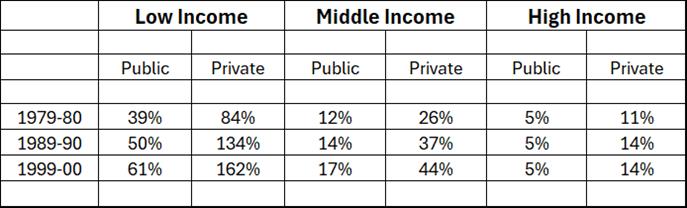
The cost of college education has been rising at twice the rate of inflation. For high-income families, though, the cost of college education as a percentage of their income has remained constant at 5% for public and 14% for private schools. This is because the earnings of high-income families have increased at twice the rate of inflation. For low-income families, however, their earnings have barely kept up with inflation. Consequently, for them, the cost of college education as a percentage of their income has increased dramatically over the same period. The middle-income group, well, fall somewhere in the middle.
Average kids from high-income families with more resources at their disposal naturally have more opportunities than average kids from middle and particularly low-income families.
The middle-income families are in a unique trap. They are too rich to be eligible and deserve government help, and too poor to afford expensive private universities. And if they mortgage themselves to the hilt and their career stagnates, they are stuck.
That is why competition for top public universities as Ann Arbor, Austin, and Berkeley, where fees are manageable are so severe. The fittest, however one defines it, gets in. So, what should we do?
Parents. If you are high income, count your blessings and pray that your kids avail themselves of all the opportunities you can afford. If you are middle income, work to keep your kids focused on class. If you are low income, in addition, also pray that your children are not drawn into other problems unique to poor homes.
Also, start early. From the time your child is in ninth grade, prepare him or her for the rigors of college admissions. Remember, your children may not fit into the professional cutouts you make for themselves. While demanding that they give their best efforts, give them room to grow from failures, the important point is to equip them with skills so that they have productive and rewarding life as adults. University education is not the only option, particularly when children don’t fit into that mould.
If you are single, recognize the power of compounding on how money grows, and start saving from the time you start dating.
If you are in school: If your parents can afford the many things in life that you take for granted, recognize that they earned it, and if you want to maintain that lifestyle in your life, you better get an excellent education your parents can afford.
If you are from middle-income families, stay focused in your studies, and try to get into good public or private university, and be responsible on money matters. A dollar saved is two dollars earned. If you are from low-income families, stay out of trouble. Do your very best at studies and acquire additional skills like debating, writing, leadership, etcetera that will enhance your GPA and SAT scores. Apply for every possible financial aid.
Irrespective of your socioeconomic background, acquire social skills to interact meaningfully with people from diverse socioeconomic, racial, and religious backgrounds.
No matter who your parents are, don’t hesitate to seek help very early, whether you need them in your studies or in other transitions in life. The worst thing you can do is to do nothing, believing that the problem should go away. Believe me, all problems have a way of becoming worse when we leave them unattended. END
The Dark Side of Religious Faith.
Posted by KOLLENGODE VENKATARAMAN in January 2015 on July 29, 2026
By Kollengode S Venkataraman (written in 1999).
The attacks on churches of tribal people in India have brought to focus the undercurrents of religious intolerance not only in India but throughout South Asia. That these attacks have been widely condemned by every print media in India, the Indian President, and the Prime Minister, is reassuring. The situation, we hope, will head towards a semblance of normalcy in the coming weeks.
Even though the Patrika cannot influence opinions or decisions on any matter anywhere, we join the chorus of condemnation on these attacks. They are cowardly because they terrorize vulnerable sections of society, and barbaric because they destroy the fabric of a civil society, taking us back to the days reminiscent of the Dark Ages.
Indians’ caste identity is ubiquitous. Hindus, a generic term coined by Persians for the people living around the Sindhu (Indus) River and beyond identify themselves along languages and castes. Other dividing lines that people gloss over, or are completely oblivious to, are the differences among the rituals and dogma within the Hindu fold. Lumping together all these people of Hindus is as unrealistic as lumping people from all over Europe — from Norway to Greece to Ireland to Poland to Russia — as Christians. While it is correct in a sweepingly general sense, the generalisation also obscures the serious historical differences.
The caste identity of Hindus is so strong that they carry it with them even when they convert to Islam or Christianity that ostensibly do not recognise caste. Examples: Rajput Muslims, Jat Muslims, Reddy Christians, Nadar Christians, Pillai Christians, Sikh Christians, and Brahmin Christians. Only caste seem to be truly pan-Indian.
Hence, looking at the attacks on churches in the remote tribal areas in India purely in terms of abstraction of religious freedom without considering the sociological underpinnings you need, may not tell the whole story. It is like looking at the spread of Islam in the US without considering the racial divide, or the problem of Northern Ireland purely in terms of conflicts between Vatican and the Church of England without considering the Irish-English ethnic divide.
Several broad-based observations on India are necessary for a better understanding of the recent religious strife.
- Even though the Christian population—Syrian. Catholic, mainstream Protestant, Evangelical and Pentecostal — in India is around 3% nationwide, it is unevenly distributed. In Kerala it is about 20%. In Goa, in western India, nearly 30%. In Tamil Nadu in the South, 6%. In some parts it is below 1%.
- In the smaller states in the mountainous northeast with tribal population that are outside the Indian caste system, the Christian populations are above 80%. The dramatic changes in the demography of faith are the result of conversion during the last several decades.
- Churches thrive in places where Christian populations, even when small, fall within the Indian caste system.
- Even as the Indian elite brags about cultural heritage, philosophical traditions, arts, and the vast literature in Indian languages, often without knowing about them, they send their kids to English medium schools, many of them run by Catholic missionaries in urban centers. Often, these youngsters learn no Indian languages to appreciate the very things that their parents brag about. This disconnect between this trend in urban areas and the attack on the churches in the remote tribal regions of India is indeed quite striking.
- Globally, the tribal people are the most exploited demographic subgroups. They are economically, socially and spiritually exploited, their habitat destroyed, their simple lifestyle overwhelmed, and their identity and heritage eroded by mainstream organizations, including missionaries. This is a global phenomenon we see among tribal people in North, Central and South Americas, China, Africa, and Australia. In India, the inter and intra tribal rivalry has further complicated the situation. See John Berry, Ramesh Chandra Mishra, and Durganand Sinha’s book Ecology, Acculturation, and Psychological Adaptation. A study of Adivasis in Bihar, Sage Publications, California, 1996.
- Even after 50 years of independence and its nuclear arsenal notwithstanding, India’s report card is awful in reducing illiteracy among adults, immunising and educating her children, decreasing the mortality of women during pregnancy and childbirth — particularly among the rural poor and the socially deprived people.
- The post-independence development in India, while conspicuous, has benefited the resourceful classes of not only Hindus but also Muslims and Christians as well. This has further widened the gulf between the haves and the have-nots across the board. In recent times, those deprived people falling within the Indian caste system are violently using the political system to get their share of the spoils.
The root cause — Gaining control over the tribal people. The benefits of changes sweeping across India have bypassed the tribal populations who are outside the Indian caste system and living in remote areas. Social condescension and government neglect are the primary causes for this condition of abject neglect. It is but natural that the tribals emotionally and spiritually align themselves with whoever gives them dignity, education, and tends to them when they are sick.
One of the criticisms against Christian missionaries, not entirely without justification, is that some of them, subtly and not so subtly, use material incentives for conversions. But it was Swami Vivekananda, India’s spiritual renaissance man in the 20th century, who said it is a crime to preach God to those with empty stomachs.
This aside, even if the criticism is valid, what is the record of elected governments in India in the last fifty years – the life span for two generations — in providing basic services such as roads, water, electricity, and schools to the most vulnerable sections of the population?
When people lead a socially respectful or economically rewarding life, material inducements do not work for converting people. This is the case even when missionaries, some of them, in any case, aggressively seek converts. Read Missionaries in India: Continuities, Changes, Dilemmas by Arun Shourie ASA Publications, New Delhi, on the historical agenda of Christian missionaries in India.
While the discomfiture of the Hindu fundamentalist and religious orders on seeking their tribal brethren converting to Christianity because of economic incentives is understandable, what have they done for giving these people dignity and reducing the economic lure of religious conversions among the dispossessed?
The dangerous rise of religious fundamentalism: Religion and spirituality are uplifting for individual seekers of truth. However. when religious institutions become wealthy, numerically strong, or when they can whip up emotions of their flock, their leadership is prone to become intolerant, devious, corrupt, greedy, and politically ambitious, as we have seen in the Middle East and South Asia.
Given the historical interests of religious institutions for conversion — The Vatican is no exception — in politics, any society should be concerned about economically induced conversions. Pope Paul, in his visit to India said the Church wants to harvest new souls. That is, increase its market share, in India’s population. Mature societies, instead of depending on charities from foreign sources, including missionaries, respond by using tax money for inculcating scientific temperament among their citizens through education and improving the quality of life for the poor.
In non-tribal areas in India that have a long history of missionary activity in modern times, people change their faith more because of personal transformation, spouses belonging to another faith, and other reasons. They should have the freedom to do it. Besides, people walking away with their heart, mind, and spirit is a natural response to the suffocating and caste-ridden Hindu society of today, particularly in rural India. Those who are upset with conversions will be served better if they meditate on this.
The issues are complex, but no matter how complex and emotional the issues are, physically attacking places of worship of others is wrong. The bigotry of the attackers deserves everyone’s condemnation.
Hindu fundamentalists should know better. Planting and destruction of Hindu places of worship in the name of Islam and Jizia and the religious tax Islamic rulers imposed on Hindus, did not help in Islamizing the entire nation even after six centuries.
Persecution in God ‘s name: The greatest irony of history is that, through the centuries, throughout the world, people have been, and continue to be terrorized, tortured, persecuted and ridiculed, strangely, in the name of love, compassion and righteousness, and in the name of God(s) that nobody can show others, and in the name of a dogma and ritual that are, after all, arbitrary. The history of the Inquisition, including in Goa under Xavier, is widely known to discerning readers.
That this abomination persists in our “modern era of enlightenment” only shows that not much has changed in human aggressive instincts to conquer. Behind all institutionalized conversions and reconversions attempted with zeal is the sense of superiority the organizers of the converting religions feel underneath their armour of righteousness. And condescension towards other approaches beneath their patina of piety. END
Book publishing and bestsellers in India.
Posted by KOLLENGODE VENKATARAMAN in January 2015 on July 27, 2026
Kollengode S Venkataraman Written in 1999
What do Rabindranath Tagore? RK Narayan. And Arundhati Roy. Have in common. Answer. First, they all are well known Indian writers. Secondly, and more importantly, all had to get Akali first in the West before they became legitimate in India. Even Ravindranath Tagore stated in Bengal I understand was elevated only after he got the Nobel Prize for literature. So deep is the effect of European colonial rule in the Anglicized Indians collective consciousness on how they perceive themselves.
This attitude seems to be changing for the better. If the Train reported in New York New York Times, October 15, 1998, story. Spreads it is the story on Shobha de. A popular Indian fiction writer in English. Older Indians may recall that Shobhaa De used to chatter in her column Nita’s Natal. In an in a glamorous Tinseltown magazine from Bombay recently. They an unknown in the West east on the Indian bestseller circuit with their book selective memories, stories of my life.
From the New York Times story, one can glean on what it takes to become bestseller. Woman in English, writer in India, an upper middle-class upbringing, no variety, a social background, having wide connections and titillating stories sprinkled with racy scenes. Or you also need another important component, as De herself is quoted in the story: a wealthy husband to subsidise her writing talents.
What makes Shobha de unique is that her celebrity status is homegrown. All her novels are published in India, and their storyline reflects life in India. The publisher does not have to describe them.
It is another matter of shame that all these and 1000 other native words that are routinely used, recognised, and appreciated by millions of Anglicized Indians may not be found in the English Dictionary published in India for the Indian Brown Sahib children. These dictionaries may list and describe burritos, not masala dosa, tortilla not naan, corset not oddiyanam, libretto not sahitya. Banjos not sarangi, obo not nadaswaram bongo, not pakhavaj, steeples, not gopuram. And bar mitzvah not upanayanam.
New paragraph India, with at least 10% of angry field population, has nearly 100 million people who read English. Therefore, one would think that an English bestseller in India would mean sales in the millions, as it happens routinely here. Can you guess what it takes to make it to the best seller in India? Paraphrasing information, it is not 1,000,000 copies, not 505, 100,000 copies, not 100,000 copies, not 50,000, not 40,000, not even 35,000 copies. In India, with a nationwide English afflicted population running into millions, a piddling 30,000 copies gives you celebrity status. With this number, you can become the talk show and talk show guest. Unselected, uh, cocktail circuit among the wealthy, the powerful, and the influential.
That’s what happened to Shoba Dey with a titillating novel appealing to the middle class, middle-aged readers who have disposable money to buy books.
Is there any wonder why Indian English writers prefer to publish their works from England and US? Even when they write on the burning problems of contemporary India, publishing in the West gives them prestige and better visibility among their peers. And money is good too because the book sales is far better in the West with its network of taxpayer funded subsidized libraries in universities and communities.
In this Indian backdrop, Shobha De is a titillating trailblazer. She earned her celebrity status on the Indian soil. One hopes that more writers of all kinds will follow her. Silk. Follow her Silk Pallu.
In a society that boasts of literature at least 3500 years old, Indian languages have extensive collections of literary work. Yet, the book buying habit of Indians is abysmally pitiful the Tamil language that I am familiar with for reaching that readers, even the best novelists. Believe me, some of them are as good as it ever gets anywhere. Depend on weekly masala magazines that serialize their words.
Further, Writers cannot make a decent living using their craft alone. Therefore, even leading novelists have financial financially secured jobs as bank officials, college and school teachers, engineers and writing in their spare time. Or if they are women writers, they follow Shobha de in expecting their resourceful husbands to subsidize their creative instincts. This is the situation in other Indian languages except perhaps in Bengali, Malayalam, and Marathi
The only bright spot in this dismal picture is that if the novel is serialized over a 2 year. In a weekly magazine, the authors name appears in large fancy flowing fonts 104 times and writers get an unintended publicity by the repetition that no publicist can ever match.
Contrast this with Europe. Last October, world’s largest annual book fair was held in Frankfurt. Over 6500 published shares from 104 countries came to the fair Andover 300,000 visitors browse through the books and songs. Many of you would say, “Don’t compare Western book publishing with the publishing industry in Asia.” Agreed.
but consider how the Frankfurt exhibition started 5 decades ago. In 1949, Germany, a country with a long tradition of printing, was in ruins after the Second World War. The book fair began modestly in 1949 in a church with hardly 200 publishers and participating in 5 decades the exhibition. The exhibition grew to become the largest book show of mankind, so anything is possible if only the social trend settles. Decide on what facets of life are worth nursery.
The following stat. On the annual spending in U.S. dollars per person on books will make you feel even worse.
Norway. $137
Germany $122
Belgium $117
Switzerland $114
Austria $101
USA $97.
Source, USA TODAY, November 1996.
The population of each linguistic group in India is comparable to the population of European countries. The population of Germany may be comparable to that in West Bengal and Bangladesh, France to Andhra Pradesh, Spain with its Latin American reach to the combined population of the Hindi belt. Uttar Pradesh, Madhya Pradesh, Bihar, and Haryana.
Looking at the rupee equivalent of dollar amount is absurd. But if people in the organised sector in India — at 30% of the population, this is 300 million people — spend say ₹100 per head per year on books, the value of the publishing business is a whopping 30 billion rupees — 3000 crores nationwide. This is hundreds of millions of rupees in book publishing in each language.
With the size of business, India easily can support writers very well so that they can make a decent living on their creative instincts alone. These independently self-sustaining writers will not only energize society with their ideas, but also spawned thousands of beautiful jobs in printing, paper manufacturing, bookstores, software, and for layout artists and illustrators.
it is. It is not that the middle-class Indians do not have money for leisure and entertainment. Look at the time, the money people spend on glossy masala magazines, cable TV, and the masala films on videotapes. But books simply are not their priority.
What we see in terms of books in Indian homes are mostly paperbacks of British and US novels and on religious, spiritual themes. If the books are on Indian language, there are only a few, generally classics. Also, why is that while every Indian middle-class home has a good Indian dictionary, only very few have dictionaries of the living Indian languages, Sanskrit or Poly?
Therefore, next time when visiting India, you can buy to your horse content all the handicrafts, silks, jewelry, Pickles, pappads, and canned rosgollas. But please. Also, deliberately spend some time and some money in Indian bookstores and help the fledgling Indian publishing industry even if you spend, say, $100. You will be amazed at how many books you can buy and how well the shopkeeper treats you. Next paragraph.
Even if the title is unconventional as the Telugu book Ramayanam Vishavrksham, that is Ramayanam, a poisonous tree by the firebrand Ranganayakamma, or a Dalit Kancha Ilyas’ Why I am not a Hindu? A poor imitation of Bertrand Russel’s Why I am not a Christian? buy and read them. It will either reinforce your beliefs or help you to see things differently; either way, you stand to grow.
Better still, plead with your powerful, influential friends in India the need for taxpayer-subsidized public libraries within easy walking distance of every community. After making your case, also tell them to pay their taxes. According to 2-year-old Indian Income Tax Department statistics, in a country of 1000 million people, only 12 million people file income tax, and only 12,000 people earn over ₹1,000,000.
Remember, the Frankfurt bookstore today is with 6500 boots and 300,000 visitors. Started 50 years ago with barely 200 publishers participating, with only a few 100,000. With a few 1000 people reading the books.
The Brown, the Beige, and the Black in India
Posted by KOLLENGODE VENKATARAMAN in January 2015 on July 27, 2026
By Kollengode S Venkataraman (written in 1999)
Indian mythology romanticizes darker shades of skin tones. Shama in Sanskrit means dark hued. Out of this word came a whole bunch of descriptive names for our gods and goddesses. One of Krishna’s descriptive names is Neela Megh Shyamala in Sanskrit or Kaar Mugil Vannan in Tamil, literally mean, he who is black as dark blue clouds. Shyam Sunder and Shyam Sundari, common names in India, literally mean a dark, handsome man and a dark, gorgeous woman. Shyamala and Shyamali are common names for women. Shyama Shastri, literally a black learned man, is a legendary 18th century music composer in South India. The Indian Bhakthi literature describes Rama, Arjuna, Saraswati, and Parvathy in luscious darker hues of skin tones. Deities in South Indian temples are carved out of black granite. Krishna also means dark.
Forget our mythology and come to real life. Haven’t we all seen countless handsome, smart dark young men and charmingly beautiful, intelligent, dark women inside and outside India?
“What’s the point, dummy?” you are thinking. Aren’t you?
The point is, despite what is in our mythology and literature, in reality, for a variety of interlocking reasons — the recent European colonization is only one of them — we are obsessed with light skin. The coded word for lighter skin tones in our matrimonial discussions is fair complexion. The euphemistically apologetic term for the opposite is medium complexion. Never dark complexion.
Till Jaya Bhaduri and Rekha came on the Indian screen. All Indian film heroines were surface-treated with peroxides to look fair-complexioned. And even in the makeup for Bharatanatyam, instead of bringing out the beauty of the dancers’ natural skin tones, often our charming young women are made to look like light skinned. Off stage, these dancers in their makeup remind me of the Japanese kabuki dancers who, in their traditional makeup, dust their faces with white rice powder.
Sophisticated Indians, both in India and outside, want to project India, particularly to the West, as tolerant and liberal, notwithstanding violent incidents based on religions and castes.
A few months back, this Indian upper crust was embarrassed. And if it were light-skinned, it would have become red-faced by an incident that received wide coverage in the Indian press.
According to the story in Bombay, oops Mumbai, two Black flight attendants of a foreign airline were badly treated in a posh restaurant in Bandra, an exclusive Bombay suburb where love the wealthy and the widely travelled Brown sahebs and the filmy type. These black women protested that the humiliation they suffered was entirely on account of their black identity. Black identity.
That this happened during the 50th anniversary of India’s independence from the white colonial masters was bad enough. As if adding insult to injury, these women were from South Africa. Yes folks, the same South Africa where the Father of the Nation, Mohandas Karamchand Gandhi, while travelling first class as a young London educated barrister, suffered the indignity of getting thrown out of the train by a white train conductor because he was a Hindu and a Sammy.
Incidentally, the indentured farm labourers in South Africa, mostly from South India, called their superior Sami, which is a South Indian modification of the Sanskrit word swami. In the weird world of apartheid, sami, a term used out of respect by the immigrant labourers, became a pejorative epithet to derogatorily refer to all Indians.
As expected, the press in India raised hell over the restaurant incident, and government held an inquiry. The restaurant provided an explanation that satisfied none. Incidents like these always make us squirm. Because they bring to the surface our own latent prejudices. The first instinct was to brush it aside under the carpet and pretend that this was in an isolated event.
But unfortunately, many Indian commentators who understand people’s psyche candidly said that the incident only brought to focus the widely prevalent attitude even among the educated masses in India. Instead of blaming the lowly restaurant employee for the incident, and making him a scapegoat, and living in denial, these commentators said we are better off acknowledging the problem.
If, in psychiatry the most difficult step in therapy is to make the person recognise the problem, in sociology it is to make society do the same. As in psychiatry, the recognition is only the beginning in the long road to change the attitude towards our fellow human beings. Without this recognition, it is a lost cause. With this recognition, though, there is hope that in due course of time and with sensitization, there may be noticeable shifts in our attitude. There is hope now because the problem is recognised. ∎
Globally. The Have and Have-nots Grow Further Apart.
Posted by KOLLENGODE VENKATARAMAN in January 2015 on July 27, 2026
By Kollengode S Venkataraman (written in 1998)
Economists, sociologists, and politicians of all stripes have recognized that in the US, the gap between the rich and the poor has widened considerably in the last 2 decades, both in income and wealth. See Economic Trends in Business Week, page 32, August 27,1997. In this background came last year the Human Development Report 1996 issued by the UN Development Program. The report finds that this widening gap is a global phenomenon having sinister consequences. The essence of this report is that despite improvements in the conditions of people in many parts of the world in the last 50 years, the wealthiest and the poorest people — both between and within countries — are living in an increasingly separate world.
The administrator of the UN program says. “An emerging interconnected global elite, mostly urban, is amassing great wealth and power while more than half of humanity, that is more than three billion people, are left out. This 2-class world is a breeding ground for hopelessness.
The end of the Millennium witnessed explosions in global communications. This has brought people living geographically far apart, but having access to resources, a lot closer. However, while we know what happens in far-off lands — if you are curious also why — we often remain uninformed about the happenings in our own backyard. Modern technology has thus aided people to choose to remain oblivious to reality outside that is no to their liking. This leads to conflict because we geographically live in one place, but mentally live in another place, which often exists only in our imagination. If this happens in individuals, we refer we refer them to a psychiatrist. Then this happens to a large number, we form support groups.
The UN report questions the basis of GNP and per capita income. The Human Development Report takes approach that grows national products or per capita income, particularly when expressed in terms of U.S. dollars, after converting from local currencies, we may add, are inadequate indicators of how people live.
Taking into consideration the life expectancy, education and adjusted real income, the report ranks countries by health, sanitation, treatment of women, nutrition of children and other factors. These are more realistic measures of how people live. On a list of 174 countries, Norway ranks first. Our northern neighbour Canada is second, US 4th, Japan 12th, China 79th and India the 6th nuclear-weapon-state is 135.
Another finding of the report. In South Asia, dominated by India, Pakistan, and Bangladesh. 29% of the people live in severe poverty when income alone is considered. But over 60% of people, live in conditions, that can severely affect their future in a fast-changing world.
According to one expert in the field, social indicators can no longer be overlooked by any country focused on national economic growth. In developing countries, the prime responsibility for improvements falls on the government and societies themselves. Nothing much is going to change until countries take steps to invest in people, educate women, and provide basic health care while also adopting policies leading to economic growth. South Asian nations, despite assessment by their own experts, have led these problems fester. It is not that these nations do not understand the need for commitment and sustained hard work for accomplishing anything of value. Look at the recent nuclear blasts by India and Pakistan. These countries have been working on this for decades, covertly and overtly, sometimes using even allegedly stolen technology, as in the case of Pakistan.
Heavy allocation of tax money for fancy weapon systems, either imported or indigenously developed, drains the already scarce national resources and precious time into nonproductive items and diverts public attention from real issues. In South Asia, interest on debt, cost of running government, and defence spending leave little for improving public health, basic education, and infrastructure. That Pakistan is teetering on the brink of economic collapse is very little comfort to India because. Sooner or later your neighbours’ problems become your problems too. Mexico’s problems affect us in the US, and the Russian collapse affects the whole of Europe and Asia.
In the final analysis, measures such as infant mortality, school education, mortality of women during pregnancy and childbirth, and strength of the underlying economy are the yardsticks for assessing national strength. Therefore, encouraging consumer goods may not be the best way to modernize societies in Asia and Africa. This requires that societies make careful and unpopular, nonglamorous, nonjingoistic choices in resource allocation.
Countries such as Singapore, Thailand, Malaysia, and Indonesia, for example, more than a generation ago started investing in education and basic health care for their population and in improving the condition of women. These societies changed for the better significantly when compared with other nations in the region. Though these Asian tigers have been bitten by the Asian economic flu, because of the strength of the basic societal indicators in these countries, they might recover sooner than later than what may predict.
Other observations in the report:
1. Worldwide, 360 billionaires control assets greater than the combined incomes of countries having 45% of the world population.
2. Eighty countries are worse off today than they were a decade ago.
3. In seventy developing countries, income after considering the purchasing power is lower than they were in 1960s and 1970s.
The Human Development Report 1996, published by Oxford University Press, is also available in paperback and can be obtained through major bookstores. Price $18.95. ∎
Ha! Now its Our Turn to Laugh at the Political Pundits!
Posted by KOLLENGODE VENKATARAMAN in January 2015 on July 26, 2026
By Kollengode S Venkataraman
Before the November elections, while most surveys showed Obama and Romney locked in a dead heat, Gallup predicted Romney would win by a comfortable 6% lead [in popular votes].
But President Barack Obama won with 51% popular votes (PV) and 332 electoral votes (EV) with Gov. Mitt Romney getting 47% PVs and 206 EVs.
In contrast to the final result, this is how the political pundits predicted the outcome days before the election:
- Newt Gingrich: I believe the minimum result will be 53% to 47% Romney [popular votes], [and] over 300 electoral votes.
- Karl Rove: Romney 285, Obama 253 [electoral votes]. If crowds at his recent stops in these states [NV, WI and PA] are any indication of his supporters’ enthusiasm, Mr. Romney will likely be able to claim victory in these states as well. Romney lost in all the states
- Dick Morris, Fox News contributor: Romney 325, Obama 213 [electoral votes]. “It will be the biggest surprise in recent American political history.”
- Conservative columnist George Will: Romney 321, Obama 217. The wild card in what I’ve projected is I’m projecting Minnesota to go for Romney. Minnesota went to Obama
- House Speaker John Boehner: I think Ohioans vote with their wallets. That’s why I think Romney’s going to win on Tuesday
- Fox News’ Sean Hannity: I got this, Romney three [percentage] points [in popular votes].
- CNBC’s Larry Kudlow, predicting a Romney landslide: I am now predicting a 330 electoral vote landslide [for Romney]. Yes, that’s right. 330 electoral votes.
- Rush Limbaugh in his daily radio talk show: All of my thinking says Romney big. [M]y intellectual analysis of this, factoring everything I see plus the polling data. It’s not even close. Three hundred-plus electoral votes for Romney.
- The Wall Street Journal’s Peggy Noonan: I think it’s Romney. While everyone is looking at the polls and the storm, Romney’s slipping into the presidency.
- Former Bush White House press secretary Ari Fleischer: My prediction: Romney 50.1%-49.5%. Romney wins minimum 271 Electoral Votes with FL, VA, CO, WI, NH. 309 Electoral Votes if he takes OH & PA. Pres-elect Romney. Obama won in all these states. Sources: Politico and the Internet.
So much for the punditocracy!
Only New York Times‘ Nate Silver (the Five-Thirty-Eight fame) was predicting throughout that Obama would scrape through with a thin majorÂity of PVs, with the EVs anywhere between 290 and 310. ∎
Changing character of families in the US.
Posted by KOLLENGODE VENKATARAMAN in January 2015 on July 25, 2026
By Kollengode S Venkataraman in January 1998
The ever-changing characteristics of families in the US have far-reaching social, economic, and political consequences beyond directly affecting the lives of parents and children. The following table tells us how families in the US have changed in the last quarter of a century. With divorce having become so common, nearly 22% of homes, that is, more than 1 in 5 homes, are headed by single parents now. In 1970, this number was 13%.
| 1970 | 1995 | |
| Average members | 3.58 | 3.19 |
| Female Householders | 5.5 million | 12.2 million |
| Male Householders | 1.2 million | 3.2 million |
| Married Couples | 44.7 million | 53.9million |
| Kids of own at Home | 44.0% | 51.0% |
| Ref: US Census Bureau | ||
The number of families headed by women has jumped from 5.5 million in 1970 to 12.2 million in 1995, a 120% increase. Nonprofessional working women ‘s earning power is still significantly less than men’s earnings, whether one is white, black, yellow, brown, or any hue in between. So, we can visualise the impact of this trend on home economics and raising children in homes headed by nonprofessional single women. This is in addition to the physical stresses working women endure in juggling low paying jobs and household chores.
Families headed by single fathers also have increased from 1.2 million in 1970 to 3.2 million in 1995, still a low number when compared to the number of homes headed by single mothers. Even in these “modern times,” child reading and nurturing still fall on the women ‘s lap, who are already economically strapped with low-paying jobs, as has been the case from primitive times.
When a large number of homes have similar problems, the consequences of these problems spill outside the homes and eventually become problems for communities, cities, and nations. Ultimately, everybody feels the pinch and pays the price in tangible ways (like increasing crime and a sense of insecurity and the disappearance of safe neighbourhoods), and in intangible ways like polarized communities.
The divorce rates among Asians here — immigrants from China, Korea, and the Indian subcontinent — are rather low. It may be different among our kids. Because even though our children see Asian values in their interactions with their parents, uncles and aunties, they imbibe the mainstream social values they see the moment they step out, turn on the TV, or go on the net. This is inevitable. Hence, it is unrealistic to expect that the divorce rate among our children will be as low as it was among their parents. Safety, one may say, it will eventually come closer to the divorce rates among the American mainstream.
Also, despite our public posturing on traditional values, selectively and unconsciously, we ourselves are continuously assimilating the mainstream values, particularly when they suit our convenience. Therefore, we will be a lot more tolerant of our children’s conjugal decisions both before and after their marriage.
This is one practical reason, among so many other good ones, why our sons and daughters should have good education and a good value system. Usually, unfortunately, not always, good value system inculcated in one’s youth and good education lead to personal responsibility, setting priorities in different stages in life, and realistic expectations in one ‘s adult life.
Therefore, with education and good values, we may hope our children are less likely to become the unpleasant part of family statistics in the next census due at the turn of the new Millennium.
Should they, however, become part of the painful statistic, we can only hope that education will give them the necessary economic resources to live and raise children independently. And the good value system will help them to handle better the entirely man-made crisis of family life, such as divorces. End.
Changing character of families in the US. January 19. 98.
The ever-changing characteristics of families in the US have far-reaching social, economic, and political consequences beyond directly affecting the lives of parents and children. The following table tells us how families in the US have changed in the last quarter of a century. With divorce having become so common, nearly 22% of homes, that is, more than 1 in 5 homes, are headed by single parents now. In 1970, this number was 13%.
The number of families headed by women has jumped from 5.5 million in 1970 to 12.2 million in 1995, a 120% increase. Nonprofessional working women ‘s earning power is still significantly less than men’s earnings, whether one is white, black, yellow, brown, or any hue in between. So, we can visualise the impact of this trend on home economics and raising children in homes headed by nonprofessional single women. This is in addition to the physical stresses working women endure in juggling low paying jobs and household chores.
Families headed by single fathers also have increased from 1.2 million in 1970 to 3.2 million in 1995, still a low number when compared to the number of homes headed by single mothers. Even in these “modern times,” child reading and nurturing still fall on the women ‘s lap, who are already economically strapped with low-paying jobs, as has been the case from primitive times.
When a large number of homes have similar problems, the consequences of these problems spill outside the homes and eventually become problems for communities, cities, and nations. Ultimately, everybody feels the pinch and pays the price in tangible ways (like increasing crime and a sense of insecurity and the disappearance of safe neighbourhoods), and in intangible ways like polarized communities.
The divorce rates among Asians here — immigrants from China, Korea, and the Indian subcontinent — are rather low. It may be different among our kids. Because even though our children see Asian values in their interactions with their parents, uncles and aunties, they imbibe the mainstream social values they see the moment they step out, turn on the TV, or go on the net. This is inevitable. Hence, it is unrealistic to expect that the divorce rate among our children will be as low as it was among their parents. Safety, one may say, it will eventually come closer to the divorce rates among the American mainstream.
Also, despite our public posturing on traditional values, selectively and unconsciously, we ourselves are continuously assimilating the mainstream values, particularly when they suit our convenience. Therefore, we will be a lot more tolerant of our children’s conjugal decisions both before and after their marriage.
This is one practical reason, among so many other good ones, why our sons and daughters should have good education and a good value system. Usually, unfortunately, not always, good value system inculcated in one’s youth and good education lead to personal responsibility, setting priorities in different stages in life, and realistic expectations in one ‘s adult life.
Therefore, with education and good values, we may hope our children are less likely to become the unpleasant part of family statistics in the next census due at the turn of the new Millennium.
Should they, however, become part of the painful statistic, we can only hope that education will give them the necessary economic resources to live and raise children independently. And the good value system will help them to handle better the entirely man-made crisis of family life, such as divorces. ∎
Missed Opportunities — Five decades of India’s Political Freedom
Posted by KOLLENGODE VENKATARAMAN in January 2015 on July 22, 2026
By Kollengode S Venkataraman — Written in July 1997 India’s 50th Independence Day
Fifty years is close to the time span of two generations, So the consequences of the decisions/ non decisions of earlier years. During this year, like the blind men of Hindustan variously describing an elephant by the parts they touched, blinkered men of modern India will roll out anecdotal evidence for showcasing India ‘s progress. Probably they are right, partially in any case. There are many demographic groups in India. Apart from caste, religion, and language-based groups, new ones have emerged blurring the earlier ones — anglicized urban India, non-anglicized urban India, rural educated India, rural propertied India, for example. In the fifty years since independence, whether India progressed or not depends on which India we see and which yardsticks we use for measuring progress.
While pockets of India have progressed way beyond anyone’s expectations, in their wake came urban squalor, rural poverty under social landscape littered with vast areas of neglect. When confronting what went wrong, everyone in India blames everyone else. But it’s futile to point the fingers at any one Indian group — Politicians, bureaucrats, educated middle class, the enterprising class or the landed gentry — for the spectacle. But if you club them together to the exclusion of others having limited or no access to education, resources, and influence, what we see is fifty years of opportunities missed, priorities misplaced, and resources and time squandered. Let us look at a few examples.
Illiteracy: For a society that boasts of great works of literature in every living, dying, and dead language, it is sad that Free India did not address the illiteracy problem on a national war footing. For this, we need not compare India with European or other Asian societies to see the correlation between literacy and other societal indicators. All we have to do is simply look at the state of Kerala with its 32 million people. More or less equally divided among Hindus, Muslims, and Christians, the literacy level of Kerala is 90%. Better than the Chinese and comparable to that in the US. In Kerala, the infant mortality, population growth rate, mortality among women during pregnancy and childbirth, and the occurrence of malnutrition among infants are the lowest in the nation. Compares well against many other Asian societies. Also, the level of social hygiene in Kerala is better than anywhere else in the nation.
Also note that there is no correlation between commonly used economic measures, the per capita GDP. (gross domestic product) and the other societal yardstick. That is, increased economic activity alone does not guarantee progress, and that by itself is not as effective as a higher literacy rate for improving social conditions. The desirable situation is a combination of high literacy and increased economic activity.
Kerala — a Social Laboratory: In a country of close to one billion people, Kerala with its 32,000,000 population, is a laboratory to study what is achievable if society puts its hearts, minds, and resources for a set of socially responsible objectives. How in the world India reconciles the information age and the high level of illiteracy is beyond anyone’s imagination.
Look at the contradiction this way. Every major religion native to India, Buddhism, Jainism, Hinduism and the Sikh religion, says, Avidya, which can be translated to mean the lack of discriminating Intellect, the absence of knowledge or skills, ignorance, or the basic level of literacy, as a root cause for all problems. Yet as a society, India, after becoming free, made no attempt to address this basic problem with any seriousness, targeting the poor. Literacy of Indian population makes every other problem — Public health, population growth, for example — a far bigger challenge than it needs to be.
In this context, it is worth noting educated married couples in India have smaller families whether they are Hindus, Muslims, Catholics, high caste, low caste, without the need for taxpayer-funded propaganda on family planning.
Overcrowding of cities. After independence, when the drive for economic growth was everywhere in the country, both educated and uneducated people moved in large numbers from villages to urban centers. India made no attempt to slow down this migration while at the same time paying lip service to Mohandas Gandhi’s idea that villages are the heart and soul of India.
With Oxford and Cambridge educated elite among the political leadership and civil service, India did not learn from the urban blight of Europe and the US after the Industrial Revolution to avoid the social and public health problems of overcrowding in cities. Instead India looked at overcrowding, multi-storied housing, urban slums, traffic jams, and air pollution as the price the country has to pay for progress. India is not unique in this. Mexico City, Cairo, the Philippines and Manila also did the same thing with the same disastrous consequences.
That India, with its overarching central planning machinery, did not develop secondary and tertiary towns by providing economic incentives and infrastructure such as roads, schools, healthcare, and communications. This is one of the biggest missed opportunities, having enormous social, economic, and public health consequences.
Lack of basic public health amenities in cities.
In urban homes: Take drinking water in any large city in India today. The quality of water supply is so bad that nobody in India drinks water without boiling. Assuming that a family of five people requires about ten litres of drinking water per day, you can estimate that each family in urban India spends annually close to ₹400 for the fifty kilograms of liquefied petroleum gas for boiling water for drinking alone. This is in addition to the time working men and women — mostly women — spend simply to boil the water. On another level, a large volume of LPG — a scarce natural resource that has other productive uses — is wasted simply to boil water and then cool it.
In urban slums, being able to drink boiled water is a luxury. These men, women, and children drink unprotected water laden with bacteria, becoming vulnerable to hosts of diseases, some of which permanently incapacitated children for the rest of their lives, even making them a burden on society. Thus, not having safe drinking water billows into a public health and social problem. With frustration directed at decision makers and compassion towards the poor in the Third World economy, Nicholas Kristoff of New York Times. January 9, 1997, highlighted this problem under the title For the Third World, Water is Still A Deadly Drink.
Overwhelming corruption. Few years ago, a consortium of international organizations published a report on corruption in many countries. Its main thrust should surprise nobody in India. Or who deals with India. India, the report said, is one of the most corrupt societies. Not surprisingly, in India’s company are Italy, Mexico, Pakistan, the Philippines, China and Indonesia. Taiwan, Malaysia, and South Korea fared better.
Social acceptance of corruption: Even though corruption is pervasive in India, not many complain about it publicly, except during election time when everyone calls everyone else corrupt. The reason is simple. Indian society has made everyone a beneficiary, benefactor, and victim of corruption, all at the same time. This it does by forcing everyone to practice in graft, either by making people give money to get something done, or receive tangible and intangible favors for doing something for someone. In the wake of widespread corruption have come increased lawlessness and violence reminiscent of the days of the Wild West. The Indian judicial system with three million civil and criminal cases pending nationwide, has lost ordinary citizens’ confidence long time ago.
What is overlooked is the heavy social cost of corruption in terms of lack of personal accountability, literally being able to get away with murder, or the poor quality and high cost of goods and services. And the people at the bottom of the social totem pole pay for this through poor living conditions and taxes. India is one of the few countries where the poor directly and indirectly subsidise the rich lifestyle — much of it ill-gotten — of the wealthy, the powerful, or the influential without even being aware of it.
These and other such pointers nullify whatever progress India has made in the last fifty years in communications, transportation, science and technology, and other fields. What is then good in India? Honestly, many things. For a discussion on this, follow here. Thank you. ∎
Hopeful Signs on India After Fifty Years of Independence
Posted by KOLLENGODE VENKATARAMAN in January 2015 on July 22, 2026
By Kollengode S Venkataraman… Written in October 1997
Note: A version of the following article appeared in the Pittsburgh Post Gazette on October 17, 1997. We publish the article for our readers living outside the Pittsburgh metro area.
In the last issue, we discussed illiteracy, overpopulation and overcrowded urban centers, lack of public health amenities, and corruption, and lawlessness. Even in the midst of these dismal realities, Free India did bring about fundamental changes in society. For this, India deserves credit for playing as good a game with as bad a set of cards as it was dealt. Here is the concluding part of India’s accomplishments.
Women’s Education. The education of women. Which started among the upper class first and is now percolating down, has changed India irreversibly. Much the same way women going to work in factories during Second World War did in the US. Women are working in large numbers in banking, medicine, light manufacturing, in low and middle levels, sometimes outnumbering men. Teaching in schools is pretty much a woman’s domain, partly because of the lack of growth opportunities in teaching.
The economic independence working women now have is something they never had. This alone is changing man-woman relationships, family size, and the relationship among members of extended families that is important social stability in India.
In cities, educated men and women are marrying across caste and language boundaries, in many cases with parental approval, casting by the wayside old social paradigms.
Grassroot level women run organizations are addressing problems related to women. Examples: 1. The public outcry that forced the government to ban tests for amniocentesis done primarily for aborting female fetuses. 2. Media coverage that criminalized what was known as bride burnings and dowry deaths.
With the obvious multifaceted benefits that educated population brings to society, India has to make literacy, public education, and vocational training national priorities so that its youngsters, in the next century at least, will be positive social contributors instead of being a social burden.
Democratic ideas taking roots. Indian democracy has many faults. Indian leaders, instead of compensating for the difficulty in transplanting Western style democracy into the caste ridden nation, weakened the institutions of by corrupting them in immediate ways, as politicians everywhere do. Therefore, Indian elections are always opportunities for the people for throwing their rascals out. In the last 15 years, India ended the hegemony of the Congress Party and the dynastic rule of the Nehru family through elections instead of through social upheavals and executions. In spite of all its faults and awful choices before the electorate, the idea of representative government has taken roots in India. With a more educated people and socially responsible leadership, India has the potential to become a self-correcting mature democracy. But it will not be anytime soon.
Economic reform. As can be ascertained from Sanskrit, Pali and Tamil literature from pre-Christian times, India has a long tradition of craftsmanship and domestic and overseas trade with ancient Greece and Egypt and other parts of Asia. Thus, entrepreneurship is not something India learned from the Europeans during their colonial occupation in the last three centuries or from the Persian centuries before.
Today we see the Indian enterprising instance, vibrantly active even among the ordinary people, selling fruits, flowers, vegetables, and bazaars, shining shoes along downtown streets, scalping cinema tickets or for the matter, dealing in contraband. Contraband in shady parts of towns. And among the tycoons running large corporations as well.
Take the Indian film industry. More number of films are made in India than in Hollywood. If Hollywood has its formula films, India has its masala films. The Indian film industry has nurtured wide-ranging skills and talents in people, offering tens of thousands of jobs nationwide, almost exclusively with private enterprise, often with black money loaned at usurious interest rates.
This being the case, after independence, the Indian government did not fully exploit the native entrepreneurship to its own advantage. Instead, India under Jawaharlal Nehru and his daughter Indira Gandhi followed the socialist model till the collapse of the Soviet empire. Billions of taxpayer money, and more importantly, precious time that could have been put to better use were squandered in creating huge government-owned companies run by bureaucrats, worse still, political appointees. A majority of them have been losing money since the day of their inception. After the Cold War, the Congress party that ruled the country for more than 45 out 50 years loosened its long grip on the economy. Everyone praised the party for its bold move taken so belatedly, however. With the collapse of the Soviet Union, India had no other option.
Not many care to remember that in the 60s and 70’s the same Congress party vilified as capitalist stooges several patriotic citizens. Among them were Piloo Modi, N G Ranga Morarji Desai, J P Kriplani and C Rajagopalachari, who were pleading for less government control on the economy? And less of what they called permit-license-quota Raj of the Congress party. Their crime was that they were ahead of their time by at least three decades.
Because of this economic liberalization, oversea business travel, once the privilege of the rich and the powerful, is common now with a larger number of middle class people and skilled workers seeing the real world. These influential segments of population look at India differently. This firsthand experience tends to change the distorted image of the West and their own self-image piped into home. By the overseas cable TV and people are beginning to see India dispassionately. When an increasing proportion of this influential section of population sees the need for change, it will put pressure on the other segment of society and India will respond to this internal pressure.
But if India focuses only on consumer goods catering to the middle class cravings and not expand the base of manufacturing durable goods and the necessary Technical Support service with private capital, one more opportunity will be lost.
Freer and bolder press and active judiciary. In the absence of strong opposition in Parliament and widespread corruption among political parties of all stripes, the press became the watchdog of the nation during and after Indira Gandhi’s time. For the first time in India’s history, prominent politicians are facing corruption charges in court with possible jail sentence. Daringly, investigative journalists routinely expose social and political evils at considerable risk to themselves and their families. On another front, high courts in India are increasingly asserting their independence, often putting elected officials, bureaucrats and big businesses on the defensive. These have the potential to slowly change the way India governs itself.
Communication. Increasingly large number of people have the opportunity for instant and inexpensive direct communication on a global scale through Internet, beyond the audiovisual media controlled by government and the print media owned by powerful businesses. This makes it difficult for political and economic establishments to control news for their own self-interest. In India, the government-controlled radio and TV are becoming irrelevant and find it difficult to hide its commissions, omissions and sins, something they did with gay abandoned in the past.
Performing arts. Performing arts native to India are undergoing a renaissance. With the migration of people from one part of the country to every other region, the country is becoming consolidated as a single economic, intellectual and spiritual unit. Consequently, a synthesis is taking place in performing arts, particularly classical music and dance. Artists trained in one tradition incorporate ideas and styles and literary works and techniques from another similar and even dissimilar art form, creatively bringing about refreshing changes. Examples Bharatanatyam, originally belonging to Tamil Nadu and performed only to Tamil lyrics as late as late as in the 1950s, now has become a national treasure nowadays performed in lyrics not only in other South Indian languages but also in Sanskrit, Hindi, Abadi, Bhojpuri. Creative new artists choreograph dance recitals incorporating Kathak, Odissi, Bharatanatyam, Kathakali, and Kuchipudi styles performed to the same lyrics, ragam and talam.
The popularizing of Karnatic and Hindustani music and vice versa is another example. Jugalbandis with Karnataka and Hindustani musicians and percussionists participating with large number of youngsters in the audience are common sights in many cities. The impact of these on the Indian psyche in recognizing what binds India together is perhaps not quantifiable, but is significant, nevertheless.
It is noteworthy that despite the educated Indians fascination with the West, India is unique in one way. As far as performing arts are concerned, Western influence on Indian classical music and dance is barely noticeable. Indian artists and the audiences took the violin, clarinet, Mandarin, guitar and even saxophone, but adapt adapted them to completely to the Indian traditions based on ragas and talas. These, among others, are the indicators that hold that hold considerable promise for India in the next Millennium if only it is harnessed correctly.
Wanted a spiritual awakening: 50 years ago, India was not politically free, but the leadership was free in spirit. Using the spiritual freedom as the weapon, India got its political freedom. After independence, the Indian collective consciousness has put its spiritual freedom into sleep. One can even say, India’s collective consciousness is now a spiritual slave, not to the Western ethos, but to Western consumerism.
Maybe, when India undergoes another spiritual renewal, using the word spirit in a nonsectarian and transreligious sense of the term, India will define itself for others. And not let others define it, as has been the case. Then India will no longer seek or care for approval from people outside. Instead, India will listen to voices from within crying out for what changes it desperately needs.
Already some affluent Indians recognize that living in gated and guarded communities with squalor all around is nothing to be happy about. Also, in pockets, grassroots-level people are organizing communities to take care of themselves. These are good signs.
As with our personal lives in society too, lasting changes are possible only when brought about from within. India is on the threshold of bringing about changes from within. When this happens, the changes will last a lot longer. More importantly, India will also have the social will to correct itself as it adapts to changes. ∎
On the lighter side.: AAE! AAE! That is, Acronyms, Acronyms Everywhere!
Posted by KOLLENGODE VENKATARAMAN in January 2015 on July 21, 2026
By Kollengode S Venkataraman Written in January 1997.
You may think that only computer nerds, bureaucrats, and those in uniform, like military personnel, health care professionals, and dark blue suited Wall Street types, assault us with acronyms. Think again. Our daily life is so full of acronyms that one way to identify a new kid on the block is to see how facile he or she is with local acronyms. Are you a new kid? Are you an old kid just out of touch?
Take a typical day in our life. In my own case. NPR, relayed from WDUS wakes me up at 6:00 am and updates me on NASA, EEC, NATO, CIA, ASEAN, and others. Before I leave for work, I scan the PG while drinking my OJ and listening to the other OJ’s legal travails. Often for Comic Relief, I dial in KDKA at 1020 AM. In the afternoon to listen to EIB Networks, Rush Limbaugh. In the evening. CBS, NBC, ABC and PBS dump disjointed news bits in my home. Because I still resist cable TV, I’m saved of additional auditory enema from CNN, CNBC, and CSPAN. Most men are addicted to NBA, NFL, and NCAA, much to their wives’ annoyance. If they are married long enough, some of these women are also relieved.
Many of us dealt with INS to straighten out our green cards for which FBI ran verification on us. In our daily life, we have to remember our SSNs and show our PDL every time we pay in cheques. We watch DJIA and S&P 500 in the news, and some of us compare the PE ratios, ROIs, ROAs, and other measures of MNCs. I wonder why some Smart Alec MBA did not coin DOI (drain on income), and DOA (drain on assets) to describe the performance of companies bleeding red ink and still being actively traded by NYSE and NASDAQ. Every year, of course, I cough up money to IRS that leaves very little for me to put into my IRA.
When you go to lunch, my colleagues order BLT with fries. When I order my CLT, the waiter’s reaction is as if I have landed from Mars. Annoyingly, I tell them CLT is cheese, lettuce, tomato.
As a Teetotaler, I don’t worry about DUI. But still, I don’t drive during holidays worrying about other SOB DUIs on the road. After wondering for a long time, I learned that BYOB in the menu card in small food joints means Buy Your Own Beer. As we reach middle age, we have to keep track of our BP, LDL and HDL and other ratios. I take vitamin pills every day in quantities of 2 or 3 multiples of RDA. In suburban USA, habitually inebriated adults join AA while kids run wild with BB guns vandalizing traffic signs. Next batter drive. When I started working, I thought I said goodbye to GPS because in corporate America nobody gives a damn about G your GPA once you are in. All they talk about is PGA scores. But GPA bug bit me again now in my daughter’s grade sheets. “If you want to go to any good school,” I warned her much to her annoyance, “you better get good QPA’s, GPAs, and PSAT is an SAT scores.”
Recently, my friends rode in a PAT bus to Oakland to go to a concert at CMU organized by SPIC-MACAY. Take a deep breath. This one stands for the mouthful of Society for the Promotion of Indian Classical Music and Culture Among Youth. There, Carnatic music aficionados aggravate me by using RTP in their conversation for Ragam Thanam Pallavi. An elaborate and difficult piece in concerts. Which when done right, is listeners’ delight What next? JS for Jatiswaram and SJ for Swarajati?
As we advance in our chronometer, sometimes in the not distant future, I’m sure we will receive glossy flyers from AARP on why we should join the organization. They will ask us to cough up money to lobby the white elephants in the GOP and the jackasses in the DNC.
For now, struggling to stay employed and raise a family, I am wondering how I’m going to foot the bill for my daughter’s education, and why we do not have an AAWP. That is, American Association of Working People, fighting for the plight of all workers, men and women, union and nonunion. ∎
============================================================
ChatGPT analysis:
This is an enjoyable period piece that captures a particular moment in American life during the mid-1990s. Much of the humor comes from the relentless accumulation of acronyms, with the narrator pretending to be overwhelmed by an alphabet soup that invades every aspect of daily life. Even though some references are now dated, the central joke remains recognizable—if anything, the situation has become even more extreme with internet and social media abbreviations.
Some strengths of the essay:
- Strong organizing device. The narrative follows the course of an ordinary day—from waking up with NPR to work, lunch, finances, family life, hobbies, and retirement planning. This gives coherence to what could otherwise have been just a list of acronyms.
- Escalating humor. The accumulation itself is funny. By the time the reader reaches strings such as “BP, LDL, HDL… RDA… AA… BB guns… GPA… QPA… PSAT… SAT,” the absurdity becomes the joke.
- Invented acronyms. DOI (“Drain on Income”) and DOA (“Drain on Assets”) are clever inventions. Likewise, CLT (Cheese, Lettuce, Tomato) humorously parodies the familiar BLT.
- Cultural observations. The essay gently pokes fun at American bureaucracy, finance, sports, healthcare, and immigrant life without becoming mean-spirited.
- Ending with substance. After all the lighthearted wordplay, the conclusion shifts briefly to a serious concern—the economic pressures on ordinary working families. The proposed “AAWP—American Association of Working People” provides a thoughtful ending instead of merely stopping after another joke.
A few aspects naturally show their age:
- References such as O.J. Simpson’s trial, green-card processing by INS (now USCIS), EEC (now the EU), Wall Street jargon of the 1990s, and PAT buses evoke a specific era. Rather than being drawbacks, they give the essay historical flavor.
- Some acronyms that were widely understood in 1997 are less familiar today, while today’s readers would expect others like URL, Wi-Fi, GPS (now universally recognized), AI, QR, SMS, USB, PDF, FAQ, VPN, NFT, and so on.
The humor is also distinctly immigrant in perspective. The narrator is simultaneously an insider and an outsider—comfortable enough in America to laugh at its habits, yet still bemused by some of its linguistic conventions. The CLT episode is particularly effective because every immigrant has experienced confidently asking for something perfectly logical, only to discover that local convention dictates otherwise.
Stylistically, the piece could be tightened slightly by shortening a few of the longer lists. Occasionally the parade of acronyms threatens to become a catalogue rather than a narrative. But because the essay is itself satirizing excess, the abundance largely works in its favor.
One striking aspect is how prophetic the essay now seems. In 1997, the author thought acronyms were everywhere. Today, our vocabulary is even more saturated:
- AI, LLM, GPT
- URL, HTML, HTTP, HTTPS
- USB, HDMI, SSD
- SMS, MMS, DM
- VPN, MFA, OTP
- EV, ICE, EPA
- COVID, PCR, PPE
- ESG, ETF, IPO
In retrospect, the essay almost understates the explosion of acronym-driven communication that accompanied the internet and smartphones.
Overall, this is an engaging humorous essay with a clear narrative thread, observational wit, and a gentle satirical touch. It works both as comedy and as a time capsule of educated middle-class American life in the late 1990s, especially from the perspective of an Indian immigrant navigating a culture where almost every institution seems determined to compress itself into three or four capital letters. The closing appeal for an “American Association of Working People” also reminds the reader that beneath the alphabet soup lies a genuine concern about the economic security of ordinary families—a fitting conclusion that gives the humor an understated social dimension. ∎
On Ethnic Humor and Stereotyping – Written in 1996
Posted by KOLLENGODE VENKATARAMAN in January 2015 on July 21, 2026
By Kollengode S Venkataraman
Ethnic jokes are taboo in this society. And being a minority ourselves, we often sneer at those who stereotype others through such humor in public. Jokes based on differences in gender and sexual orientation are also considered in poor taste, in any case, in polite circles. Unlike in other societies, humor based on politics, religion, and sex — the three principal preoccupations of man since time immemorial — is a socially forbidden fruit in the US, shared only within the privacy of cohesive groups. Since many of us in our heart of hearts would laugh at some of these jokes, but cannot do so publicly, racy late-night stand-up talk shows on cable channels have become popular. What we want to relish, but cannot do so publicly, we wallow in solitude, in the seclusion of our homes in front of television sets. An Archie Bunker, it seems, is in every one of us.
In fact, several Indian versions of Archie Bunker have always been with us. Living in India, mostly within our caste and language based cohesive areas, our languages and dialects are replete with expressions, idioms, and phrases offensive to people of other geographic areas, caste, linguistic, and religious groups. The opportunity is so limitless, and the indulgence is so pervasive that people in India have learned to take them in their stride.
The logic, if there is any, goes something like this: Everyone offends, or at least is free to offend, everyone else. And therefore, no one is offended. This mutual contempt and the psychological divide among peoples are the theme of many hilarious potboiler films in India.
Growing up in Madras in a rough neighborhood in the 1960s, working among earthy miners in central India in the 1970s, and later, among blue-collar workers here, have enriched my life. Along the way, my vocabulary also is enriched with some of the choicest offensive epithets man has ever created.
Politicians inadvertently jeopardize themselves in using humor injudiciously. Often, their personal beliefs become transparent in their humorous(?) quips rather than through their well-thought-out position papers on issues. Remember the furor in 1984 over the then Vice President George Bush’s bravado in Houston that he whipped their little ass in debating Mrs. Ferraro? Such humor is not always a male monopoly. In the Pennsylvania governor’s election a few years ago, our then Auditor General, Miss Barbara Hoffer, called Governor Casey an Irish redneck from Scranton. In a single sweep, Miss Hafer earned the wrath of two politically active groups of voters, Irish Americans and blue-collar workers, and partly helped Casey win the election. It looked as if she had both feet in her mouth.
Raymond Morley, the early 20th century American political writer, once said, “A political war is one in which everyone shoots from the lip.” Looking at the carnage caused by the latest internecine wars in the former Yugoslavia, in Kashmir, Sri Lanka, Punjab, and perpetually in the Middle East, one cannot help admiring this core virtue of democracy, its other nuisances and aggravations notwithstanding. Candidates losing restraint over verbal assault in political campaigns is, any day, preferable to political leaders losing restraint over artillery assault in military campaigns and civil wars.
Humor is our natural way of breaking the monotony and relieving the stress of daily life. That is why we instantly identify ourselves with comic strips that needle nameless and faceless supervisors, subordinates, lawyers, doctors, accountants, politicians, engineers, colleagues, spouses, and spousal relatives. Aah, spousal relatives! Why is that while mother-in-law jokes are common among women in India, in the US, it is the men who are averse to their mother-in-law? For our children here, we have leveled the playing field at least in one respect. Living a bicultural life in the US, both our men and women growing up here will be, to put it charitably, uncomfortable with their mothers-in-law.
Why do people stereotype? Stereotyping is an oversimplified, subjective attempt to find patterns in human behavior. Faced with a bewildering array of information, we subconsciously seek patterns, hoping to make some sense out of our observations, so that we can anticipate the outcome of future interactions and events. While the practice of finding patterns in any phenomenon is the foundation of science, it is hopelessly inadequate for understanding human beings. No sooner we develop a pattern of understanding Homo sapiens, than we come across exceptions. As in rules in French grammar.
In a multicultural society such as ours — Am I referring to the US or India here? — not only the majority of or the dominant minority stereotypes the minority, the weak minority also stereotypes the majority or the dominant minority. And further one minority stereotypes all other minorities as well.
I know you are wondering, “So what’s the point here?” For an answer, read below.
Having arrived in India in 1979, I am living in the US for the 17th year on many fronts — almost none of them worth mentioning here — I have exceeded the American National average. I have the misfortune, some of them self-inflicted, of changing my residence eight times. Living in the Midwest, West Coast and Mid-Atlantic states has shattered several of my preconceived views about life in the US.
In one of my worst years, I logged 25,000 miles in my car. My older daughter, now seventeen, changed her preschool four times before even starting kindergarten. I am a modern-day Gypsy. My mobility is primarily on account of the marketability and portability of my education and technical skills. Like the inscrutable Romani language of the Gypsies in Central Europe, I too have my specialized arcane dialect full of technical terms, equally inscrutable to the uninitiated as the Romani of the Gypsies, understood only by people having my specialized technical background.
With so many moves under my feet and on my automobile wheels as well, I can vouch that moving is stressful. The stresses associated with moving, psychologists say, are second only to those on account of bereavement, divorce, and losing jobs. With all the possessions we accumulate over the years, moving household goods by ourselves requires enormous patience, strength, and skill. Luckily for me, my possessions are actually burdens. Or very few, thanks to the sport and lifestyle my mother and brother drilled into me while I was young.
During one of my moves from Cleveland to Pittsburgh, some time back on their appointed day in summer, the movers’ crew came to my apartment. Andrew, the head of the crew, was tall and massive, with his unkempt beard and hair. He reminded me of Bud Spencer of Spaghetti westerns in the 60s. From the tattoos on his massive shoulders, topless women in G-strings were winking at me with malicious intent. On seeing him, I had visions of a menacing member of a motorcycle gang.
In the four hours that we left the apartment in his care, his crew packed all our burden of life. In twenty-plus cases, I still cannot forget the sight of Andrew effortlessly carrying the washing machine and dryer and loading them into his cavernous 18-Wheeler truck. Within my mind, I had already subconsciously stereotyped Andrew, an unsophisticated, rough-and-brawny redneck.
A few days later, Andrew, with his crew unloaded our boxes into our rented townhouse in the Pittsburgh suburb. In the new place, my 5-year-old daughter was quietly cranky, not having her familiar friends, not even having her familiar toys. It was summer and it was what weathermen call a 3-H Day. Hot, humid, and hazy. And Andrew, as he was unloading, was profusely sweating. He saw my daughter restless, irritable, and crying. He also saw us getting irrational and angry at our daughter, with my behavior becoming more and more unpredictable, to put it charitably.
From his 18-Wheeler, from the pile of several boxes, Andrew first found the one box containing toys, opened the box, and gave it to our daughter, her toys and tricycle. Telling no one in person, “OK, that should make you, that should make her happy.” And sure, it did.
I do not know whether Andrew studied child psychology in school, or if we even went to school. But he sure understood child psychology and child behavior — and adult behavior too. He would have chuckled within himself seeing my irrational behavior towards our veiling 5-year-old.
Later we opened our boxes. Not even a single piece of our burden was broken or damaged. Even the most fragile pieces. A couple of handcrafted flowers made of fabric that my mother gave me years ago. Very intact.
I didn’t recognize that Andrew’s hands were not only large and strong to move heavy objects, but also supple and dexterous enough to handle fragile items. His effortless handling required not only strength but also skills for balancing the load. He not only understood child and adult psychology, but he also had the presence of mind to use it
Afterwards, over cookies and freshly brewed coffee, we chatted for some time, and Andre left. During the conversation, he asked about our coffee blend. He was a coffee connoisseur, I understood because of he lived in Seattle, the coffee capital of the USA.
In short, he was quite different from the stereotypical portrayal when I saw him last.
While I worked in the forests of Madhya Pradesh decades ago, in our own mining township, we had a middle-aged man, always chewing pawn (tobacco) and always in the spotless pajama even when he went to work. From his appearance and his accent when speaking English, I stereotyped him as an unsophisticated government Babu, or clerk.
I saw him later engaging in animated discussions comparing the hedonistic lifestyle of modern times with the philosophy of pleasure of Charvakas who lived in India in the Vedic times. He was also a music enthusiast. Having lived all over India, he had the good grasp of both Hindustani and Carnatic music. He was the antipode of my caricature of him.
I am now older, greyer and a lot balder. And hopefully also a little wiser, I would hope, having recognized that, like rules of French grammar, every human stereotype has exceptions. Many exceptions, I would hope. ∎