
By Kollengode S Venkataraman (written in 2000)
In a land of opportunity, we want to believe that everybody gets an equal chance in life. However, nobody can deny that opportunities for youngsters either narrow considerably or open up unimaginably depending upon their socioeconomic home environment.
Suppose a child growing up in an inner city or poor suburb manages to excel in school and gets admission into a good university, whether public or private. For the child, the 4-year college is a passport for a productive, rewarding life after graduation. However, for low-income parents, it is four years and sometimes even more years of severe austerity. As the table below shows, for low-income and middle-income families, the economic impact of children’s college education on families’ finances has worsened in the last two decades.
The share of annual family income to pay for 4-year college expenses
(Source: The College Board quoted from USA Today)
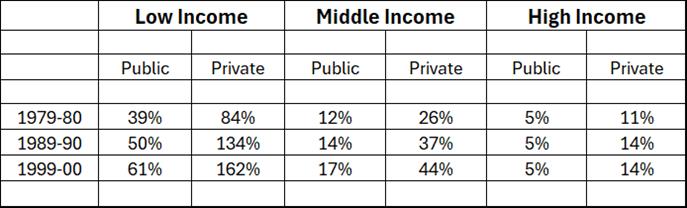
The cost of college education has been rising at twice the rate of inflation. For high-income families, though, the cost of college education as a percentage of their income has remained constant at 5% for public and 14% for private schools. This is because the earnings of high-income families have increased at twice the rate of inflation. For low-income families, however, their earnings have barely kept up with inflation. Consequently, for them, the cost of college education as a percentage of their income has increased dramatically over the same period. The middle-income group, well, fall somewhere in the middle.
Average kids from high-income families with more resources at their disposal naturally have more opportunities than average kids from middle and particularly low-income families.
The middle-income families are in a unique trap. They are too rich to be eligible and deserve government help, and too poor to afford expensive private universities. And if they mortgage themselves to the hilt and their career stagnates, they are stuck.
That is why competition for top public universities as Ann Arbor, Austin, and Berkeley, where fees are manageable are so severe. The fittest, however one defines it, gets in. So, what should we do?
Parents. If you are high income, count your blessings and pray that your kids avail themselves of all the opportunities you can afford. If you are middle income, work to keep your kids focused on class. If you are low income, in addition, also pray that your children are not drawn into other problems unique to poor homes.
Also, start early. From the time your child is in ninth grade, prepare him or her for the rigors of college admissions. Remember, your children may not fit into the professional cutouts you make for themselves. While demanding that they give their best efforts, give them room to grow from failures, the important point is to equip them with skills so that they have productive and rewarding life as adults. University education is not the only option, particularly when children don’t fit into that mould.
If you are single, recognize the power of compounding on how money grows, and start saving from the time you start dating.
If you are in school: If your parents can afford the many things in life that you take for granted, recognize that they earned it, and if you want to maintain that lifestyle in your life, you better get an excellent education your parents can afford.
If you are from middle-income families, stay focused in your studies, and try to get into good public or private university, and be responsible on money matters. A dollar saved is two dollars earned. If you are from low-income families, stay out of trouble. Do your very best at studies and acquire additional skills like debating, writing, leadership, etcetera that will enhance your GPA and SAT scores. Apply for every possible financial aid.
Irrespective of your socioeconomic background, acquire social skills to interact meaningfully with people from diverse socioeconomic, racial, and religious backgrounds.
No matter who your parents are, don’t hesitate to seek help very early, whether you need them in your studies or in other transitions in life. The worst thing you can do is to do nothing, believing that the problem should go away. Believe me, all problems have a way of becoming worse when we leave them unattended. END