
Archive for category January 2015
On Wars and Women’s Liberation Over a Hot Pot Dinner in NYC
Posted by KOLLENGODE VENKATARAMAN in January 2015 on September 25, 2026
By Kollengode S Venkataraman, (September 2026)
People cherish friends whom they have known for a long time, or those who they have interacted with in domains outside their profession and with whom they “click.” Here, people don’t have to wear masks of propriety or social and political correctness.
And when these friends get together over regional or international cuisine — “ethnic food” is a pejorative term these days — tasting unfamiliar food for the first time, they engage in “carefree, reckless” conversations. “Gay abandon,” again, is socially incorrect, particularly in NYC or SFO. People freely converse jumping from work life, family life, personal life, travel, politics, arts, and literature… without the need for neat segues. Any one phrase used by one person can be the jumping-off point to go to another topic.
That is what happened when we went to dinner, taking a friend known for over 40 years, who was new to Chinese Hot Pot. We went to a noisy small food joint in midtown Manhattan, not a fancy spot. We started off with a spicy broth with a variety of mushrooms, Chinese-cut vegetables, and noodles.
War between Russia and Ukraine, and the American aerial invasion of Iran have been dominating US newsrooms for quite some time. So, it was inevitable that among the topics we meandered over dinner was the nature of wars. My friend raised the question for all of us to jump in: why nation-states continue to indulge in war in this day and age. This is a serious question many other noble souls have pondered over. We were in good company, after all.
During WW II, seeing the material devastation and the brutal deaths of people in the tens of millions in Europe alone, the Pacifist Movement was reinvigorated with a new lease of life. Great minds like Aldous Huxley and Bertrand Russell, familiar to the English-knowing world, were active in this discussion. There were others in Germany and France too.
In my formative years, by happenstance, I read their works. One was a thin book, Science, Liberty and Peace by Huxley. I was in my late teens with limited grasp of the nuances of the English language — I started learning English only in the sixth grade — and I was greatly impressed by his ideas.
What follows is my simple — maybe also simplistic — understanding of mass killing that goes on in modern wars aided by science and technology.
Individuals are motivated by a mixture of ambition, profit, greed, and insecurities (real or imagined), and the need for power/control. This is what propels society forward, for better and for worse. Such motivated people become leaders in all facets of society, culminating as leaders in the geopolitical entities called nation-states. When these instincts among leaders are not restrained, either by individuals themselves, or by the social norms of their times, we end up with undesirable, unexpected, and unintended consequences.
The urge to expand one’s influence has been the driving force ever since mankind started organizing itself into societies. Even animals seem to have this instinct. When attempts to expand one nation-state’s influence are resisted by other nation-states, sooner or later, we end up in armed conflicts. While preparing for wars, and during wars, political leaders of nation-states unleash a potent potion of the above ingredients on their citizens, amalgamating them around the idea of patriotism, nationhood, and/or ethnic survival (real or imagined) — often imagined. They also add a good dose of xenophobia, prompting their citizens to obey their diktat, with disastrous consequences, often to themselves. And throughout history, all manufacturing resources of nation-states have been drafted into these war efforts in direct and indirect ways.
Man — the gender is important here — has been aggressive by nature (physiology, with testosterone and adrenalin) and insecure, anxious, and fearful of threats (psychology). You may wonder why this detour, and how is it relevant here. It is, indeed, simply because the behavior of people in small groups only magnifies when organized into large groups as in modern nation-states. Remember Deutschland, Deutschland Uber Alles, American Exceptionalism, We are the Chosen People, and We are the Sole Superpower!
Society also rewards man’s aggressiveness in various ways. In prehistoric times, a man returning from jungles carrying a lion’s head in hand earned the respect of elders, envy (and eventual admiration) from his peers, and adoration of the women in the tribe for his courage. He became the de facto leader of the tribe — like an aggressive lion controlling the territory and leading the pride.
In politics today, people (mostly men) coming to power through one of the routes in practice today is the same as the pre-historic man returning from jungles with a lion’s head in his hand. They use highly manipulated electoral democracies, party-controlled elections, revolutions, coups, tribal wars within nation-states, and others to come to power. These leaders are respected (or feared), envied, and admired by different segments of society.
The small book Science, Liberty and Peace by Huxley, written in the 1940s was a good starting point for me to plough through abstract ideas on modern wars in terms of mankind’s physiology and psychology aided by science and technology. This book discussed, among other things, aggression and the impulse in men to dominate and control, which manifests as wars among nation-states.
Going through this genre of books written in mid-20th century requires time and a temperament to read and re-read sentences to internalize their messages. In today’s digital world, however, when people are in a great hurry chasing their individual Holy Grails, both time and temperament are in short supply. And it has become difficult for them to comprehend the multifactorial nature of complex issues. They prefer to leave the analysis of such complexity to apps downloaded, or AI-assisted programs. They have surrendered — they would call it subcontracted — their discriminating faculties to AI-assisted programs.
And here, as we changed the broth with different spices and ordered new course of soybean items to the boiling hot pot, our conversation meandered to another topic: today’s “pairing scene” among single men and women where they size each other as potential mates. Outside politics, society assesses men using more nuanced metrics.
Here, the lion’s head in a prehistoric man’s hand is replaced by degrees from prestigious schools, PhDs or MBAs from leading universities, fellowships from hospitals, partnerships in law and accounting firms, tenured professorships, or running successful businesses. And the potential for a few million dollars in bank accounts in his 40s. Family pedigree could be the icing on the cake, so to speak.
Among Desis in our young days (between 1970s and 1980s), a US or Canadian Green Card was even better when compared with family pedigree in India.😀 In the early 2000s, an H1-B visa was good enough as a big plum on the cake in the marriage bazaar in India. Today, in the Desi courting scene and marriage bazaar, H1-B visa is a big liability.
Women, while dating and during prolonged courtship, size-up men for “success” markers, with the factors changing with the mores of the time. This continues to be the case even after Women’s Liberation. The social and economic liberation of women in the middle of the 20th century did not liberate them, it appears to me, in one fundamental way:
“Liberated” women today, even with their economic independence, continue to desire and seek men equally powerful or more, in their time-consuming and stressful pairing game, as in prehistoric times. They seem to be not yet liberated from the compulsions of psychological dimorphism seen in the animal kingdom 😒. And successful women prefer to pair with other successful men.
This has led to the unintended, but quite predictable sharp economic polarization in one generation within every homogeneous, demographic, and ethnic group, like the Chinese, Jewish, Indian, Caucasian… Professionals today marrying across their racial and ethnic identities has added yet another dimension to this sharp rise in the economic disparities among married couples in the same age groups.
You may intellectually challenge this assertion. Then, go beyond your narrow professional, ethnic, demographic group, and look around. And count how many professional women have married nonprofessional men, and satisfy yourself. Or go online and see the statistics and satisfy yourself.
To put this in everyman’s language, throughout history, successful men — however one defines success — have been more desirable, and therefore have had better picks in the cruel world of pairing among Homo sapiens. Those successful in this stressful social game of pairing — parents in “arranged” marriages, and the young men and women in “self-arranged” marriages — are gleefully smug … at least temporarily 😆. Others who lose out are glum. 🤔
This is how our totally unplanned dinner conversation ended. We left the restaurant and walked around the block for a cup of coffee. As we took leave, we said to each other, “Have a great day. We had a good time at the Chinese hot pot joint — with both food for our palate and food for thought as well.” END
On Wars and Women’s Liberation Over a Hot Pot Dinner
Posted by KOLLENGODE VENKATARAMAN in January 2015 on September 23, 2026
By Kollengode S Venkataraman, (Written in September 2009)
People cherish friends whom they have known for a long time, or those who have interacted in domains outside their profession and with whom they “click.” Here, people don’t have to wear masks of propriety or social and political correctness.
And when these friends get together over regional or international cuisine — “ethnic food” is a pejorative term these days — tasting unfamiliar food for the first time, they engage in “carefree, reckless” conversations. “Gay abandon,” again, is socially incorrect, particularly in NYC or SFO. People freely converse jumping from work life, family life, personal life, travel, politics, arts, and literature… without the need for neat segues. Any one phrase used by one person can be the jumping-off point to go to another topic.
That is what happened when we went to dinner, taking a friend known for over 40 years, who was new to Chinese Hot Pot. We went to a noisy small food joint in midtown Manhattan, not a fancy spot. War between Russia and Ukraine, and the American aerial invasion of Iran have been dominating US newsrooms for quite some time. So, it was inevitable that among the topics we meandered over dinner was the nature of wars. My friend raised the question for all of us to jump in: why nation-states continue to indulge in war in this day and age. This is a serious question many other noble souls have pondered over. We were in good company, after all.
During WW II, seeing the material devastation and the brutal deaths of people in the tens of millions in Europe alone, the Pacifist Movement was reinvigorated with a new lease of life. Great minds like Aldous Huxley and Bertrand Russell, familiar to the English-knowing world, were active in this discussion. There were others in Germany and France too.
In my formative years, by happenstance, I read their works. One was a thin book, Science, Liberty and Peace by Huxley. I was in my late teens with limited grasp of the nuances of the English language — I started learning English only in the sixth grade — and I was greatly impressed by his ideas.
What follows is my simple — maybe also simplistic — understanding of mass killing that goes on in modern wars aided by science and technology.
Individuals are motivated by a mixture of ambition, profit, greed, and insecurities (real or imagined), and the need for power/control. This is what propels society forward. Such motivated people become leaders in all facets of society, culminating as leaders in the geopolitical entities called nation-states. When these instincts among leaders are not restrained, either by individuals themselves, or by the social norms of their times, we end up with undesirable and unexpected consequences.
The urge to expand one’s influence has always been the driving force ever since mankind started organizing itself into societies. Even animals seem to have this instinct. When attempts to expand one nation-state’s influence are resisted by other nation-states, sooner or later, we end up in armed conflicts. While preparing for wars, and during wars, political leaders of nation-states unleash a potent potion of the above ingredients on their citizens, amalgamating them around the idea of patriotism, nationhood, and/or ethnic survival (real or imagined) — often imagined. They also add a good dose of xenophobia, prompting their citizens to obey their diktat, with disastrous consequences, often to themselves. And throughout history, all manufacturing resources of nation-states have been drafted into these war efforts in direct and indirect ways.
At another level, man — the gender is important here — has always been aggressive by nature (physiology, with testosterone and adrenalin) and insecure, anxious, and fearful of threats (psychology).
You may wonder why this detour, and how is it relevant here. It is, indeed, simply because the behavior of people in small groups only magnifies when organized into large groups as in modern nation-states. Remember Deutschland, Deutschland Uber Alles, American Exceptionalism, We are the Chosen People, and We are the Sole Superpower!
Society also rewards man’s aggressiveness in various ways. In prehistoric times, a man returning from jungles with a lion’s head in hand earned the respect of elders, envy (and eventual admiration) from his peers, and adoration of the women in the tribe for his courage. He became the de facto leader of the tribe – like an aggressive lion controlling the territory and leading the pride.
Today, the lion’s head in a prehistoric man’s hand is replaced by degrees from prestigious schools, PhDs or MBAs from leading universities, fellowships from hospitals, partnerships in law and accounting firms, tenured professorships, or running a successful business, and several million dollars in bank accounts when he is in his 30s. Family pedigree could be the icing on the cake, so to speak. Among Desis in our young days, a US or Canadian Green Card was even better when compared with family pedigree in India.😀 Ten years ago, even an H1-B visa was a big plum on the cake in the marriage bazaar among men and women in India. Today, in the Desi courting scene, it is a big liability.
And here, our conversation meandered to another topic on the what I would call today’s “pairing scene” among single men and women sizing each other as potential mates. Women while dating and during prolonged courtship seek men for their “success” factors, with the factors changing with the mores of the time. This continues to be the case even after Women’s Liberation 😀. The social and economic liberation of women in the middle of the 20th century did not liberate them, it appears to me, in one fundamental way:
“Liberated” women today, even with their economic independence, continue to desire and seek men equally powerful or more, in their stressful pairing game, as in prehistoric times. They seem to be not yet liberated from the compulsions of psychological dimorphism in the animal kingdom 😒. And successful women pair with other successful men.
This has led to the unintended, but entirely predictable, sharp economic polarization in one generation within every homogeneous/demographic/ethnic group, like Chinese, Jewish, Indian, Caucasian… Professionals today marrying across their racial and ethnic identities has added another dimension to this sharp rise in the economic disparities among married couples.
You may intellectually challenge this assertion. Then, go beyond your narrow professional/ethnic/demographic group, and look around. And count how many professional women have married nonprofessional men, and satisfy yourself. Or go online and see the statistics and satisfy yourself.
To put this in everyman’s language, throughout history, successful men — however one defines success — have been more desirable, and therefore have had better picks in the cruel world of pairing among Homo sapiens. Those successful in this stressful social game of pairing — parents in “arranged” marriages, and the young men and women in “self-arranged” marriages — are gleefully smug … at least temporarily 😆. Others who lose out are glum. 🤔
In any case, on war, the small book Science, Liberty and Peace by Huxley was a good starting point for me to plough through abstract ideas on modern wars in terms of mankind’s physiology and psychology aided by science and technology. This book discussed, among other things, the aggression and the compulsion in men to dominate and control, which manifests as wars among nation-states.
Reading through this genre of books requires time and a temperament to read and re-read sentences to internalize their messages. In today’s digital world, however, when people are in a great hurry chasing their individual Holy Grails, both time and temperament are in short supply. And it has become difficult for them to comprehend the multifactorial nature of complex issues. They prefer to leave the analysis of such complexity to apps downloaded, or AI-assisted programs. That is, they have surrendered — they would call it subcontracted — their discriminating instincts to AI-assisted programs.
This is how our totally unplanned dinner conversation ended. We left the restaurant and walked around the block for a cup of coffee. As we took leave, we said to each other, “Have a great day. We had a good time at the Chinese hot pot joint — with both food for our palate and food for thought as well.” END
First Person Memory in Third Person
Posted by KOLLENGODE VENKATARAMAN in January 2015 on September 21, 2026
By Kollengode S Venkataraman, (Written in 2009)
He was in Coimbatore in December 2009, to spend three weeks with his old mother in its suburb. He was walking one evening along the shopping area on D.B.Road (Dewan Bahadur Road) in R.S.Puram (Ratna Sabhapati Puram), a mostly upper middle class professional neighborhood. With temperatures in mid 70s, it was pleasant.
Coimbatore, a second-tier city in India and the most commercialized and industrialized city in Tamil Nadu next to Chennai, has reached this position by the hard work of its enterprising ethnic groups — the Naidus, Gounders, Chettiars and others — without too much government help. Their philanthropic institutions are scattered all over the city as simple and ornate marriage halls, primary and secondary schools, and colleges in higher education in the sciences, liberal arts, engineering & technology and healthcare.
He has been living in interior US for decades, and has not even seen tropical flowers for quite sometime. As he was walking along D.B.Road, the fragrance of jasmine wafted in the gentle breeze. This was quite refreshing to his olfactory senses. He turned around and saw a flower vendor selling fresh and still-blossoming jasmine buds densely tied together on strands of fibers of dried banana stem (வாழை நார் in Tamil or വാഴ നാർ in Malayalam).
To his utter surprise, the floral scent of jasmine brought back memories he thought he had completely forgotten. He was amazed — you can even say he was shocked — that he recalled the finer details of the event with such stunning clarity even after FORTY years … …
It was early 1970, and he was in his late teens or early 20s. In connection with the wedding preparation for one of his neighbors’ daughters, he had to go to Mylapore in Chennai to talk to the caterer who lived near the famous Kapaleeshwarar Temple. His very good friend — she was close to his age and was related to the bride — also went with him.
They got off the bus at Luz Corner in Mylapore and were walking to the place where the cook lived. As they walked towards the temple, the fragrance of jasmine wafted in the air. He saw flower vendors at the street corner selling strands of fresh jasmine.
With the irrationality of his youth (he was 19 or 20 years old), and with great hesitation, awkwardness, and anxiety, he bought two strands of jasmine and gave them to her.
Only after giving them to her, he realized, what he did might not be quite appropriate.
What would he do if she did not accept the flowers? Or worse still, if she took offense at his gesture as improper? These thoughts rushed through his mind. He was completely ill at ease.
But much to his surprise, with a simple “Thanks” uttered sotto voce, and with an imperceptible smile and sparkling eyes behind her glasses, she took the flowers and kept them on her short curly tresses .
His sense of relief that she did not take offense at his gesture of giving her flowers was more than his exhilaration that she accepted the jasmine!
That was the only time he ever gave flowers to a woman before his arranged marriage a decade later.
More than forty years later, when he smelled jasmine on a street in Coimbatore, he was surprised that the fragrance triggered the fountain of memory to gush out spontaneously from the depths of his unconscious. Something he thought he had forgotten a long, long, long time ago.
Nepal Floods: Another Natural Event Mankind Made Into A Human Calamity
Posted by KOLLENGODE VENKATARAMAN in January 2015 on September 13, 2026
By Kollengode S Venkataraman, (September 2026)
For those who are curious, below is the map of the Kosi River, its flow route, and how its course has changed by nearly 180 kilometers over the last 200 years. The river descends from Nepal into India’s Bihar state. These changes have occurred as the Kosi River descended into Bihar from Nepal, where it is known as Sapta Koshi (or Kosi with seven tributaries) in Nepal:

The roughly 180 km is the distance between Pune and Mumbai, Chennai and Villupuram, Delhi and Mathura, or New York City and Philadelphia. This is a fricking HUGE distance for a river to change its course over a short period of 200 years — short in geological terms. In Nepal, the shift in the river’s course is only 20 kilometers, still a significant distance.
Kosi is called Bihar’s River of Sorrow in India because of periodically erratic and unpredictable flooding during monsoon. I remember in my young days seeing INR — Indian News Review — newsreels in black-and-white, shown in film theaters, about monsoon flooding in Bihar. With slow, melancholic shehnai music in the background conveying pathos, the Tamil voice-over would start with the caption பிஹாரில் (not பீகாரில்) வெள்ளம்!
The river involved in the recent Nepal landslide and floods is the Bhote Kosi River, a tributary of the Sapta Kosi River in Nepal, with seven tributaries (sapta in Sanskrit means seven): Arun Koshi, Sun Kosi, Dudh Kosi, Tama Kosi, Bhote Kosi, Indravati, and Likhu Khola

So, flooding and the rivers changing course in the Nepal/Bihar area are well known to the locals. It is there in the collective living memory of ordinary people, if not in textbooks or the Bihar and Nepali babus, who are transferred every few years in their jobs.
And the name Kosi itself has a fascinating origin: Kosi is a local modification of the Sanskrit name Kowshik. Kowshik morphed into Kosi, like Gowtama morphing to Gotama. Like the Dravidian Tamils corrupting மஹாபாரதம் to the atrocious மகாபாரதம்.
In any case, “Why Kowshik as the name for the river?” is a good question. In the Ramayana, the name Sage Kowshika refers to Vishwamitra, Rama’s teacher, known for his short temper and unpredictability about when he will explode in anger.
So, centuries — maybe millennia ago — natives of the Bihar/Nepal area, where the Ramayana is a living epic even today, named the river Kowshik. Why? Because they observed again and again that nobody could predict how terrible and severe the flooding in the river would be in the monsoon — like Sage Kowshik’s unpredictable temper. And Kowshik morphed into Kosi.
With this history, letting human settlements on the very banks of the Kosi tributaries to attract tourists hugely contributed to the deaths and material loss in the floods. In the absence of these human interference, the episodic landslide/flooding would have caused minimal damage to life and property.
The climate change only added new dimension to the already complex phenomenon. The huge landslide was caused by the glacier collapse (due to warming) further up in Tibet. Over 100 million cubic meters of ice and rocks detached from the bigger glacier and fell down very quickly over 1000 meter vertical drop — numbers that are difficult to comprehend for most mortals — enough to cause a mild earthquake.
Deaths in this year’s floods in Nepal are over1400, and missing over 5000 (reported by Asia Net). Many were European tourists. The material loss is estimated over $3 billion, in a country with $45 billion GDP and 30 million people. Nepal’s per capita GDP is only $1500. Even within South Asia, which is not a prosperous area, Nepal in a poor country. Nepal’s tourism dollars is estimated below 7%% of its GDP.
What is the lesson for Nepalis and the rest of us? Learn to abide by Nature’s ways and design our life and lifestyle, and culture around Nature’s way. In many parts of the world, we have not internalized this simple and important lesson. In big cities in Asia and South and Central America, new settlements evolved haphazardly when internal migrants moved to cities — Karachi, Mumbai, Chennai, Mexico City, Manila… — seeking livelihood. In these cities, they pitched their tents, so to speak, wherever they found open space, often in flood planes or areas earlier known as lakes. The city elites called these places “slums.” Secondly, poorer nations to make the place attractive to tourists throughout the year, built resorts and hotels along the river banks, and ON the river banks as in Nepal and also in India. But Nature eventually wins, and wins with vengeance towards us for not respecting Her.
The best way to see and LEARN how people have designed their lives, lifestyle, and even culture around Nature, is to go and study the Netherlands. In the Netherlands, around 25% of the landmass is below sea level. And another 50% of the landmass is at sea level or 1 meter above sea level. That is, 75% of the landmass is below one meter, with 25% below sea level.
The Dutch have very strict codes on where people can live and where they should not live and develop tourist activities. Their hydrologists’ advice is taken seriously — very, very seriously — by their legislature, government, media, and even insurance companies. Remember, tourism is a big part of the Netherlands’ economy, a country of only 18 million people, with a tourism volume over $100 billion, around 4% of its GDP.
In the wake of the floods, one Nepali girl’s song thanked the people in India for its help. It was quite sentimentally proper, for sure. Maybe everyone — affluent tourists from Europe, Japan, North America included — should also ask her, and every Nepali, to sing another song. This song should be addressed to the Nepali government to prevent human settlement and building tourism-based hotels ON riverbanks. They must leave on and along the river banks open space of a few hundred meters to be decided by hydrologists and geologists. This will reduce, if not altogether prevent, deaths in hundreds and material losses in billions of dollars.
And the affluent American and European tourists — they were 300,000 of them in Nepal among over one million international tourists last year — can create a similar song in Gregorian chant to acknowledge their contribution to the calamity. Their chant will be widely shared in all social and mainstream media in Europe to create an awareness on this issue.
Remember, many touristy destinations in Europe are quite resentful and hostile to tourists flooding their neighborhoods during the season. Their local governments are trying to restrict the tourist volume by increasing or adding new user fees to visitors in creative ways.
And the Nepali Tourism department has to be restrained from going overboard to bring in tourism $$$$s and and from organizing discounted tours during the monsoon season.
This applies to India also to varying degrees. Chennai floods every November-December, and floods in Mumbai’s “low-lying’ area occur as predictably as the annual normal monsoon. These also have the same basic root cause: not respecting Nature. In Chennai, simply renaming old lakes as low-lying areas does not make the old lakes disappear!!!! END
Why We Go to War? Dinner Discussions in a Chinese Hot Pot Joint in NYC
Posted by KOLLENGODE VENKATARAMAN in January 2015 on September 13, 2026
By Kollengode S Venkataraman, (September 2026)
People cherish friends whom they have known for a long time, or those who have interacted in domains outside their profession and with whom they “click.” Here, people don’t have to wear masks of propriety or social and political correctness.
And when these friends get together over regional or international cuisine — “ethnic food” is a pejorative term these days — tasting unfamiliar food for the first time, they engage in “carefree, reckless” conversations. “Gay abandon,” again, is socially incorrect, particularly in NYC or SFO. People freely converse jumping from work life, family life, personal life, travel, politics, arts, and literature… without the need for neat segues. Any one phrase used by one person can be the jumping-off point to go to another topic.
That is what happened when we went to dinner, taking a friend known for over 40 years, who was new to Chinese Hot Pot. We went to a noisy small food joint in midtown Manhattan, not a fancy spot. War between Russia and Ukraine, and the American aerial invasion of Iran have been dominating US newsrooms for quite some time. So, it was inevitable that among the topics we meandered over dinner was the nature of wars. My friend raised the question for all of us to jump in: why nation-states continue to indulge in war in this day and age? This is a serious question many other noble souls have pondered over. We were in good company, after all.
During WW II, seeing the material devastation and the brutal deaths of people in the tens of millions in Europe alone, the Pacifist Movement was reinvigorated with a new lease of life. Great minds like Aldous Huxley and Bertrand Russell, well known in the English-knowing world, were active in this discussion. There were others in Germany and France too.
In my formative years, by happenstance, I read their works. One was a thin book, Science, Liberty and Peace by Huxley. I was in my late teens with limited grasp of the nuances of the English language — I started learning English only in the sixth grade — and I was greatly impressed by his ideas.
What follows is my simple — maybe also simplistic — understanding of mass killing that goes on in modern wars aided by science and technology.
Individuals are motivated by a mixture of ambition, profit, greed, and insecurities (real or imagined), and the need for power/control. This is what propels society forward. Such motivated people become leaders in all facets of society, culminating as leaders in the geopolitical entities called nation-states. When these instincts among leaders are not restrained, either by individuals themselves, or by the social norms of their times, we end up with undesirable and unexpected consequences.
The urge to expand one’s influence has always been the driving force ever since mankind started organizing itself into societies. Even animals seem to have this instinct. When attempts to expand one nation-state’s influence are resisted by other nation-states, sooner or later, we end up in armed conflicts. While preparing for wars, and during wars, political leaders of nation-states unleash a potent potion of the above ingredients on their citizens, amalgamating them around the idea of patriotism, nationhood, and/or ethnic survival (real or imagined) — often imagined. They also add a good dose of xenophobia, prompting their citizens to obey their diktat, with disastrous consequences, often to themselves. And throughout history, all manufacturing resources of nation-states have been drafted into these war efforts in direct and indirect ways.
At another level, man — the gender is important here — has always been aggressive by nature (physiology, with testosterone and adrenalin) and insecure, anxious, and fearful of threats (psychology).
You may wonder why this detour, and how is it relevant here. It is, indeed, simply because the behavior of people in small groups only magnifies when organized into large groups as in modern nation-states. Remember Deutschland, Deutschland Uber Alles, American Exceptionalism, We are the Chosen People, and We are the Sole Superpower!
Society also rewards man’s aggressiveness in various ways. In prehistoric times, a man returning from jungles with a lion’s head in hand earned the respect of elders, envy (and eventual admiration) from his peers, and adoration of the women in the tribe for his courage. He became the de facto leader of the tribe – like an aggressive lion controlling the territory and leading the pride.
Today, the lion’s head in a prehistoric man’s hand is replaced by degrees from prestigious schools, PhDs or MBAs from leading universities, fellowships from hospitals, partnerships in law and accounting firms, tenured professorships, or running a successful business, and several million dollars in bank accounts when he is in his 30s. Family pedigree could be the icing on the cake, so to speak. Among Desis in our young days, a US or Canadian Green Card was even better when compared with family pedigree in India.😀
Both in marriages “arranged” by parents and “self-arranged” marriages by today’s men and women in dating and during prolonged courtship, this continues to be the case, even after Women’s Liberation 😀. The social and economic liberation of women in the middle of the 20th century did not liberate them, it appears to me, in one fundamental way:
“Liberated” women today, even with their economic independence, continue to desire and seek men equally powerful or more, in their stressful pairing game, as in prehistoric times. They seem to be constrained by, and not yet liberated from, the compulsions of psychological dimorphism in the animal kingdom 😒.
And successful women pair with other successful men. This has led to the unintended, but entirely predictable, sharp economic polarization in one generation within every homogeneous/demographic/ethnic group, like Chinese, Jewish, Indian, Caucasian… And professionals marrying across their racial and ethnic identities today, has added another dimension to this sharp rise in the economic disparities.
You may intellectually challenge this assertion. Then, go beyond your narrow professional/ethnic/demographic group, and look around. And count how many professional women have married nonprofessional men, and satisfy yourself. Or go online and see the statistics and satisfy yourself.
To put this in everyman’s language, throughout history, successful men — however one defines success — have been more desirable, and therefore have had better picks in the cruel world of pairing among Homo sapiens. Those successful in this stressful social game of pairing — parents in “arranged” marriages, and the young men and women in “self-arranged” marriages — are gleefully smug … at least temporarily 😆. Others who lose out are glum. 🤔
In any case, on war, the small book Science, Liberty and Peace by Huxley was a good starting point for me to plough through abstract ideas on modern wars in terms of mankind’s physiology and psychology aided by science and technology. This book discussed, among other things, the aggression and the compulsion in men to dominate and control, which manifests as wars among nation-states.
Reading through this genre of books requires time and a temperament to read and re-read sentences to internalize their messages. In today’s digital world, however, when people are in a great hurry chasing their individual Holy Grails, both time and temperament are in short supply. And it has become difficult for them to comprehend the multifactorial nature of complex issues. They prefer to leave the analysis of such complexity to apps downloaded, or AI-assisted programs. That is, they have surrendered — they would call it subcontracted — their discriminating instincts to AI-assisted programs.
This is how our totally unplanned dinner conversation ended. We left the restaurant and walked around the block for a cup of coffee. As we took leave, we said to each other, “Have a great day. We had a good time at the Chinese hot pot joint — with both food for our palate and food for thought as well.” END
Greek and Indian Mythologies, Mankind’s Hubris and the Reality of AI Becoming A Myth
Posted by KOLLENGODE VENKATARAMAN in January 2015 on September 12, 2026
By Kollengode S Venkataraman. September 2026
Mythological stories are, tautologically speaking, built around myths. What exactly is “myth,” as the West understands the word? Well, the meaning you get depends on the social, cultural, religious, and educational background, as well as the sophistication and biases of the Western scholars you approach. Here, “Western” does not refer to the geographic location of the scholar. If scholars — say Indians — are educated by Western methodologies and sources (books and journals) with no moorings in any Indian classic languages, epics, and traditions, they are “Western” scholars. Secondly, what you get will also depend on whose mythology — Greek or Indian, or others — you are asking about.
The West understands Greek mythology using a sophisticated yardstick with nuances, simply because stories of Greek gods and characters have already been woven into European languages. One example — there are many — is the story of Sisyphus, a cunning character in Greek mythology who imprisoned Death and created chaos because nobody died. Eventually, Sisyphus was punished for his hubris by making him engage in an endless task: rolling a massive boulder up a steep hill. Each time Sisyphus neared the top, the boulder would roll back, forcing him to start over again. This story, the West interprets with nuances describing tasks that never seem to end and never seem to give any results. Hence the English adjective Sisyphean.
However, the colonial and missionary-era West, with its own idea of sense of superiority, biases, and arrogance, was disdainful in understanding and explaining Hindu-Buddhist-Jain mythologies with any nuance.
So, we can even psychoanalyze the collective Western mind, studying how it understood, interpreted, and explained stories in Greek and Indian mythologies. Information available in the open literature will tell you a lot about these built-in biases in the Western psyche.
In many stories in Indian mythology, a powerful or ambitious man is portrayed as an asura or demon, given to intense pride, ambition, greed, and vanity (usually, a combination of these). He wants some extra power he does not have. So, he goes into intense tapas (disciplined austerities over a long time), seeking the specific power from Gods (who are different manifestations of Nature). After such intense, dedicated work, Gods cannot deny him the boon, because, after all, he has been working so hard for so long with total discipline, and with Herculean efforts (another English adjective rooted in Greek mythology!). In these mythological stories, hubris takes over the minds of the asuras who obtain these invincible powers from Gods, and they will self-destruct themselves.
This is equivalent to today’s modern nation-states (or corporations) spending an enormous amount of taxpayer (or investor) money running into hundreds of millions, even billions of dollars on R&D, committing hundreds of men and women to working for years and years. And they seek boons from Mother Nature (Prakrti), the Ultimate God in the Indian system of beliefs. The boons they seek can be lethal weapons and delivery systems, landing on the moon, conquering space, a new designer drug, or weapon-grade pathogen… …
Mankind with its tentacles wrapping the whole globe thus obtains great powers. Nation-states (and corporations) use these powers extracted from Nature to subdue enemies, competitors, or other real and perceived threats so that they can be at the top of the world, hopefully forever.
After some time, hubris takes over (“The Empire Where Sun Never Sets,” Deutschland, Deutschland Uber Alles, “American Exceptionalism,” “Sole Superpower”…) and the nation-states or corporate entities will be destroyed by their own inventions and their own power.
Exhausted in protracted wars, society becomes remorseful and reflective, and collectively says, “Never Again!” And then are born the League of Nations, the United Nations, NATO, SEATO, WTO, NAFTA, WB, WHO, ASEAN and other alphabet soups.
This works for a few decades, enough time for the new people to succeed to leadership roles in these institutions, which, by now, have become bureaucratic behemoths. These new leaders have no visceral connection to why these organizations came into existence, and successive generations do not learn much from their predecessors. So, every second or third generation goes through the same iteration — tapas-boon-hubris (pride)-destruction-tapas — coming up with more powerful and lethal toys in each iteration that science and technology develop. Hence more disastrous consequences.
The physical deaths in the conflicts and wars these days may not be in the tens of millions, as they were during WW-II, or in 5 to 6 million in Vietnam, Korea, and Cambodia after World War-II. But modern-day conflicts and localized wars destabilize hundreds and hundreds of millions of people globally, not to speak of the damage to flora, fauna, and the environment.
The cycle of wars-remorse-new wars has been the template ever since man started recording global events. These invasions, conquests, and wars have ALWAYS been there throughout history, whether man recorded them or not. Before the Industrial Revolution, warring armies used foot soldiers with spears and swords, cavalry, elephants, and horses. The conflicts and their immediate effects were confined to an area of radius of one hundred miles, with deaths in a few thousands.
[But here was the problem: Man’s recording of history was not comprehensive. He was recording history only when he saw it worthy of recording, and if he saw it. If the conflicts happened thousands of miles away that was not of any interest to him, or he did not even know about them, it never happened because there was no record of them in his history books. The lack of objectivity adds another dimension to the complexity.]
But after Sir Isaac and Jim Watt, mankind’s instinct to control and dominate gave us guns, artillery, tanks, jet planes and now drones, and all kinds of fancy bombs and delivery systems. And these bombs are fired by technicians staring at computer terminals, sipping coffee, playing with joysticks to fire missiles. Very often, they sit hundreds – even thousands – of miles away. The deaths are in hundreds of thousands, spread over a vast swath of land spreading over a few thousand miles.
As someone cynically remarked, peacetime is a short interregnum between periods of war and conflict.
In earlier wars, nation-states fought with each other for control of resources or strategic locations — spices, oil and strategic minerals, Suez or Panama Canals, Straits of Malacca or Hormuz… In the colonial days in India, believe it or not, Anglo-French wars were fought on Indian soils with Indian soldiers spilling blood for the French and the English in Europe. What an anachronism!
But today, AI is adding yet another dimension whose ramifications are ominous to the collective civilizations of the entire mankind. AI is automating most of the repetitive human activities, and even eliminating any human interface to run many machines. For many activities — meteorology, radiology, sorting, stacking, packing, shipping merchandise, proof reading, editing, and a host of other activities — human interface will not be, or only very minimally be needed. Thus, we see huge reduction of workforce for all kinds of activities, with power and wealth concentrated in an ever-shrinking number of global elite groups.
See New York Times articles here and here on Jacob Coxon, an engineer, and Dario Amodei the CEO at Anthropic, on the threat of an unbridled AI’s growth to our collective civilization. Anthropic is a privately-held AI startup that has the potential to go over one trillion dollars on the day it goes public.
And nobody knows how to bridle this demon, given that all big players in the US, EU, China, Japan, and other places want to get ahead of others in this geopolitical lethal race. There is nothing new in this game. This has been the template for ALL development throughout history in Science and Technology.
While all science and technology developments in their abstraction are value-neutral, Man, throughout history, has done a fantastic job of abusing these value-neutral findings in his urge to control and dominate. Left unchecked, the new demon AI has the potential to devour mankind itself without firing a single shot.
Centuries later, in remote places, people may still be living on Earth with no record of written history. They will be looking at the sudden and inexplicable disappearance of a very large number of their species a long time ago simultaneously in many parts of the globe. And when one of their elders, with insight like that of the Rishis of Ancient India, tells them how their ancestors destroyed themselves by the hubris of their own invention, the AI, nobody would believe. They would laugh and walk away as a mythological story, much like the European colonialists and missionaries looked at stories in Indian mythology.
Thailand Vignettes: A Week In Phuket
Posted by KOLLENGODE VENKATARAMAN in January 2015 on August 31, 2026
By Kollengode S Venkataraman, (written in 2006)
Recently, I had to visit Phuket in Southern Thailand on the coast of the Andaman Sea, which is part of the Bay of Bengal. If you go due west from Phuket across the sea by over 1500 miles, you will be in Tamil Nadu.
Thailand is overwhelmingly Buddhist with strong roots in Buddhism’s Southern School, or Theravada School, in which the Buddha is seen not as God, but only as a spiritual role model for inspiration. There are exquisite Buddhist temples everywhere.
The hotel where I stayed was an hour from the airport. The landscape en route reminded me of Kerala where I grew up. Verdant hills and valleys with a variety of palm trees — coconut, arecanut, Panai, Eecham, and Kamugu — were everywhere. And then, the bamboo shrubs, banana trees, rubber plantations, hardy teaks, jackfruits, mangoes, tamarind, even cashew nuts. Water buffaloes and elephants were roaming along the road. Flowers too were familiar: kolambi, jasmine, pavizhamalli (frangipani), arali, Even the Thai letters in road signs and shop signboards resembled the curvy Malayalam script. If Kerala is called God’s own country, God was smart enough to make several countries his own…….
Phuket, an island 400 miles north-south, and 100 miles east-west at its widest, is very touristy, with over 50% of its population at peak season comprising of tourists mostly from Germany, Russia, France, Italy, Scandinavia, the Middle East, Japan, China, and now India. In the resort hotel where I stayed, the cable TV beamed programs in French, German, Italian, Spanish, Russian, Chinese, Arabic, Japanese, and English programs from Australian TV, and BBC. The only American channels were ESPN and Discovery. No CNN.
On the basis of Purchasing Power Parity, or PPP, the per capita income in Thailand is $8100 (Ref: http://siakhenn.tripod.com/capita.html/ So with $1 ~ = 35 baht (the Thai currency), a few hundred dollars go a long way. So, if you are from the industrialized societies, you don’t have to be rich or sophisticated to be a visitor in Asia. The PPP-based per capita income in India is only $3000. So, dollars go even farther in India than in Thailand.
With 50% of the population being affluent tourists compared to the Thais, the entire economy is tourism-driven. With the tourists playing such a dominant role, the locals are forced to make every effort to gratify every need and every fantasy of these tourists. I leave the rest to your imagination, given that this magazine is read by school-going children.
Before improving the standard of living of the poor in India, the gora-friendly in India want to make India a tourist Mecca for relatively affluent international visitors, mostly Europeans. They need to go and take a look at Phuket at what would become of India if the brown sahebs succeed, given India’s poverty.
Desis are color-conscious. Not many desi men, not to speak of desi women, with brown skin tones developed over tens of generations and hundreds of years in evolution, would dare to bare their brown-skinned torsos and midriffs in pools.
In conversations on the Phuket beaches I heard and overheard, I was struck that even white women were embarrassed about their pale and pallid skin tones. Caucasian women coming from above the Tropic of Cancer were sharing their embarrassment in having to display their pasty skin in their swimwear.
This only confirmed my belief that there is nothing absolute in people’s sense of beauty. Whatever is relatively scarce in a given region will be considered something worthy of possession — lighter skin tones (at least “wheatish” as they say in Shadi.com) in the Tropics, and tanned skin north of the Tropic of Cancer.
I read somewhere that during Napoleon’s time in the 17th century, in palace banquets, while the emperor’s noblemen and noblewomen ate off gold and silver plates, Napoleon alone had an aluminum plate. Aluminum in Napoleon’s time was so rare that only the emperor could have it. (It is an entirely different matter that, given the excesses and debauchery of the nobility, there was nothing “noble” about them.)
When many svelte women were showing off their tan and trim waistlines in skimpy swimsuits in the hotel lobby; many 9-to-5 women tracing their stock to Northern Europe were embarrassed to reveal their not-so-svelte and not-so-tanned bodies even in the poolside and covered themselves with Turkish towels.
And past-middle-aged white men — Germans, Russians, Eastern Europeans — and a few Arabs were also in the pools. Many of them had pork bellies carefully cultivated over several decades of living on beer, vodka, bad food, and inertia. These men too were embarrassed and covered themselves with even larger towels as they walked in the hotel lobby.
In the bazaar outside the resort, the past-middle-aged male tourists with leathery skins, like Mahabharata’s Yayati, were refusing to age gracefully. They were hanging around with their Thai “girlfriends,” who were a few decades younger, and at least one hundred pounds lighter than themselves.
One sign of the Indians’ increasing affluence is their social and office functions organized in upscale resorts outside India. In India now, holding weddings in upscale hotels in big cities is prosaic. The in-thing is weddings in overseas resorts. In Phuket, there was a desi wedding — one Nitin marrying one Nayantara. Well into the wee hours of the Saturday night, one could hear in the hotel lobby and the bars upstairs Punjabi and Bollywood beats from the dance floor below. And the Indian operation of Max New York MetLife was having their annual sales meeting in the resort, with over 100 Indians participating in the meeting and the following revelry.
In the 1960s, with the US economy booming and the dollar soaring, many poor European immigrants who migrated to the US decades ago went to Europe with their families to see their ancestral land. This was the beginning of the guided tours. Remember the Hollywood movie If It’s Tuesday, It Must be Belgium?
While these loud Americans were happy to be everywhere during summer in Europe’s tourist spots — Big Ben, the Eiffel Tower, Venice’s waterways, Rome’s cathedrals, and Parisian roadside cafes — the European natives only had condescension for these expats. This condescension was also partly out of jealousy. The term Ugly American gained currency not only in Europe, but also in the US itself.
Then, in the 1980s, with the strong Yen, it was the turn for the Japanese to become “ugly” and the butt of jokes in many touristy US cities like San Francisco, LA, NY, DC. These short Japanese men and women in their khaki shorts and T-shirts, with their expensive cameras dangling from their necks, were everywhere. Californian newspapers of that era, with their tongues firmly planted in their cheeks, recalling Pearl Harbor, were talking about the new Japanese “invasion.” Envy was part of this condescension.
These Japanese tourists would go in buses to the Golden Gate Bridge Vista Point in San Francisco, come out of the bus, and stand in line. One by one, they would take pictures of themselves in the same spot with the Golden Gate Bridge in the backdrop, and whoosh, off they go to the next photo-op spot.
Now, with India’s economic emergence, it is the turn of the Desis to be “ugly.” In Phuket’s hotel lobby, many Desis, almost all of them men, were loud. And in their Hinglish — Arre, Bell Boy ka call karo yaar thoda, or dekho yaar, idhar breakfast me desi fruits vagayara sub hai. Woh tasty bhi hai. They were as usual, late checking out and were in a hurry. Some were even trying to cut the line in front of the check-in counter in the hotel lobby, much to everybody’s annoyance.
End Piece: The Thai language is Sanskrit-based, with vowels and consonants similar to Indian languages. Even the names sound Sanskrit. The king’s name is Bumbol Adulyadej, which can be traced to Bhumi-Pal Atulya-Tej, which means Ruler-of-the-Land with Unparalleled Brilliance. END
Politics and Minimum Wage Increases
Posted by KOLLENGODE VENKATARAMAN in January 2015 on August 31, 2026
By Kollengode S Venkataraman (written in 2006)
Folks, there is no way around bringing class and wealth in discussing this issue. Towards the end of July, the US Senate did not pass a bill that proposed to increase the minimum wage from $5.15/hour set in 1997 to $7.25 in three steps over several years. This bill was passed by the US House of Representatives with a Republican majority. The Republicans, facing an uphill task in the November midterm elections, wanted to outfox the Democrats with a bill increasing the minimum wage that was dear to Democrats. So, the Republicans, despite their dogma not to disturb the Market Forces in diminishing wealth, yielded to election-year compulsions and passed a minimum wage bill
But true to their commitment to give tax breaks to the real rich, the Republicans also piggy-bagged an item to the bill that would reduce the estate tax for the real wealthy, benefiting only slightly over 8,000 people in a country of 300 million. Republicans were only helping the really rich cushion the adverse impact of the rise in minimum wage on their lifestyle. Some Compassionate Conservatism!
Republicans talked about how bipartisanship is the need of the hour in today’s poisoned political environment. Sen. Santorum waxed on how the bipartisan compromise bill would give something both to Democrats and Republicans to take home.
While the bill increasing the minimum wage gave something to Democrats to take home, it gave much more to Republicans. In the fall campaign, Republicans, likely to lose the majority in one or both chambers of Congress, sure will take full credit for the minimum wage increase. And also, for more tax-cut goodies to their wealthy friends.
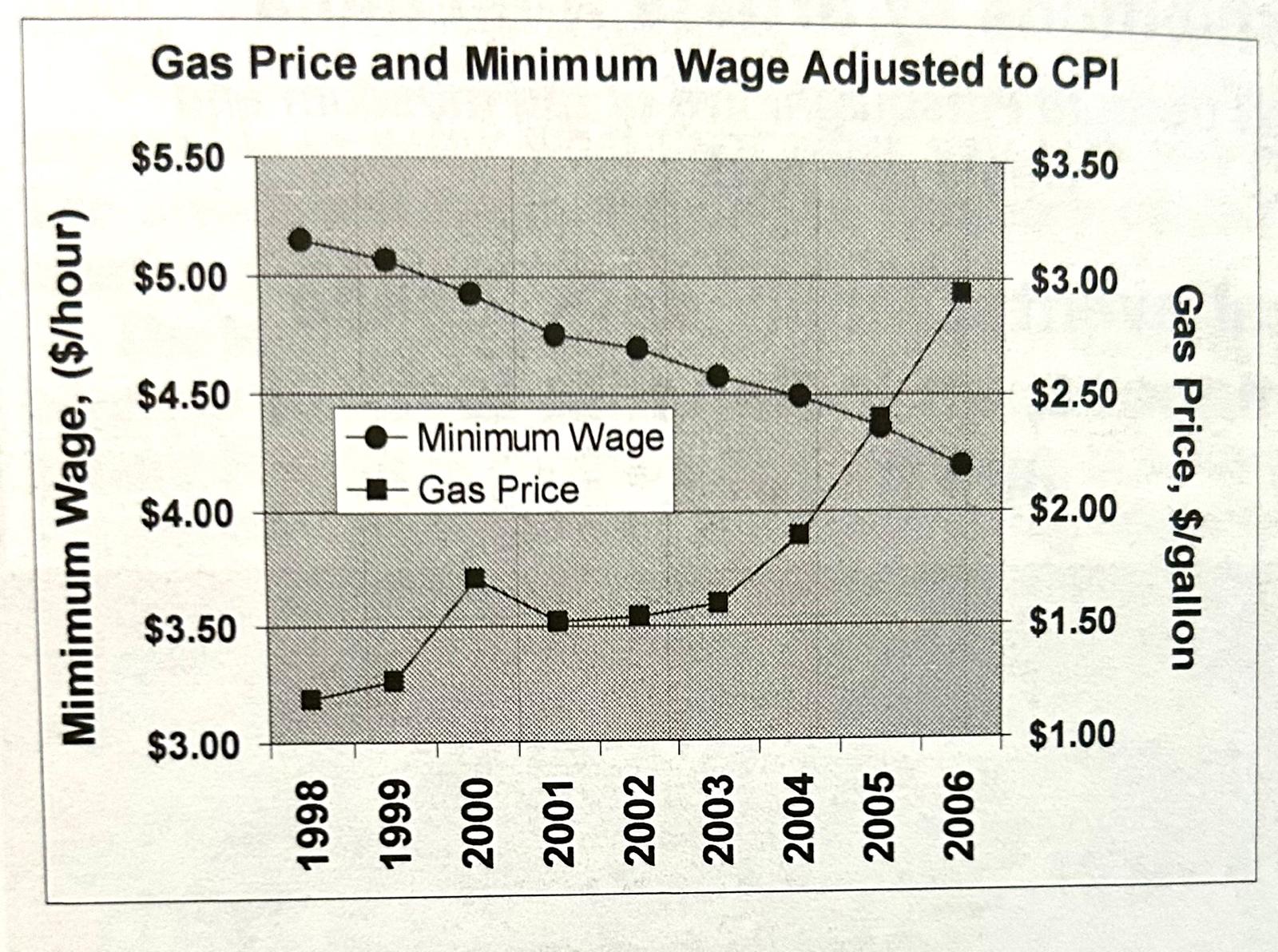
The minimum wage of $5.15 was fixed in 1997, which has the same
purchasing power of around $4.20 in today’s dollars. The plot above gives the minimum wages and the gas price after adjusting for increases in the US Department of Labor’s consumer price index (CPI). In the history of minimum wages, this is the longest time during which the minimum wage did not see any cost-of-living adjustment. The members of the US Congress during the same time gave themselves several wage increases with impunity. Remember, Republicans have been in the majority since 1997, and they have had their president since 2000. So much for Bush’s compassionate conservatism.
The Democrats in the Senate, sending the Republican blood in the water in November elections, managed to defeat the bill in the Senate. If Democrats win a majority in one or both chambers in Congress in November, they sure will send a bill to President George W. Bush’s desk a stand-alone wage increase bill.
The philosophical basis for the estate tax is well known. Paul Volcker, the ex-Federal Reserve chairman, and Bill Gates Sr, the father of multi-billionaire Microsoft’s Bill Gates support some form of Estate Tax.
After all, we have adjusted to the phenomenal increases in gas prices in the last 3 years that have a cascading effect on price increases on everything; we have survived the Republican tax cuts to the wealthy; we are continually adjusting to companies walking away from their pension plans; we have survived runaway increases in healthcare costs and the rapid increases in the cost of higher education. So sure, we can adjust to marginal increases in the minimum wage as well!
End note: The annual salary of someone on a minimum wage is around $10,500/year. This annualized minimum wage is below the government-estimated poverty level income of over $12,000/year for a single parent with one child. Besides, people who work at incomes close to minimum wage rarely have health insurance. These people can as well be living in the much-derided Third World. In fact, they do live in Third World living conditions, but in the First World. END
On Marketing … … with Apologies to Golfers
Posted by KOLLENGODE VENKATARAMAN in January 2015 on August 31, 2026
By Kollengode S Venkataraman, (written in 2005)
We hear all the time the axiom of good marketing: Know your product or service, know your audience, and tailor your message to your target audience using a suitable medium. Recently, I came across an infomercial on the Golf Channel that followed this to the “t.”
I am not a great fan of golf. So why was I watching golf in the first place, and why a golf infomercial? I watch the golf channel to draw cheap pleasure when a veteran or a wannabe veteran misses an easy putt. I don’t care about their drives (unless the ball goes into deep rough with trees all around, or in a sand pit, or better still, into the water). Mostly, my interest starts only after the ball has landed on the greens, particularly with putts not too easy, usually ten feet or longer.
When all golf enthusiasts on the fringes of the green look for the ball to plop into the hole, I, like the golfer’s competitors standing by, eagerly wait for the ball to miss the hole — he closer it comes and misses, the more enjoyable it is for me. Particularly when the player is obnoxious or flamboyant on or off the field, which many of them are.
I was sweating it out on my treadmill as I was watching the infomercial. The TV’s clicker was too far away, and I didn’t want to get off my treadmill to change the channel. So, I was stuck with the golf channel.
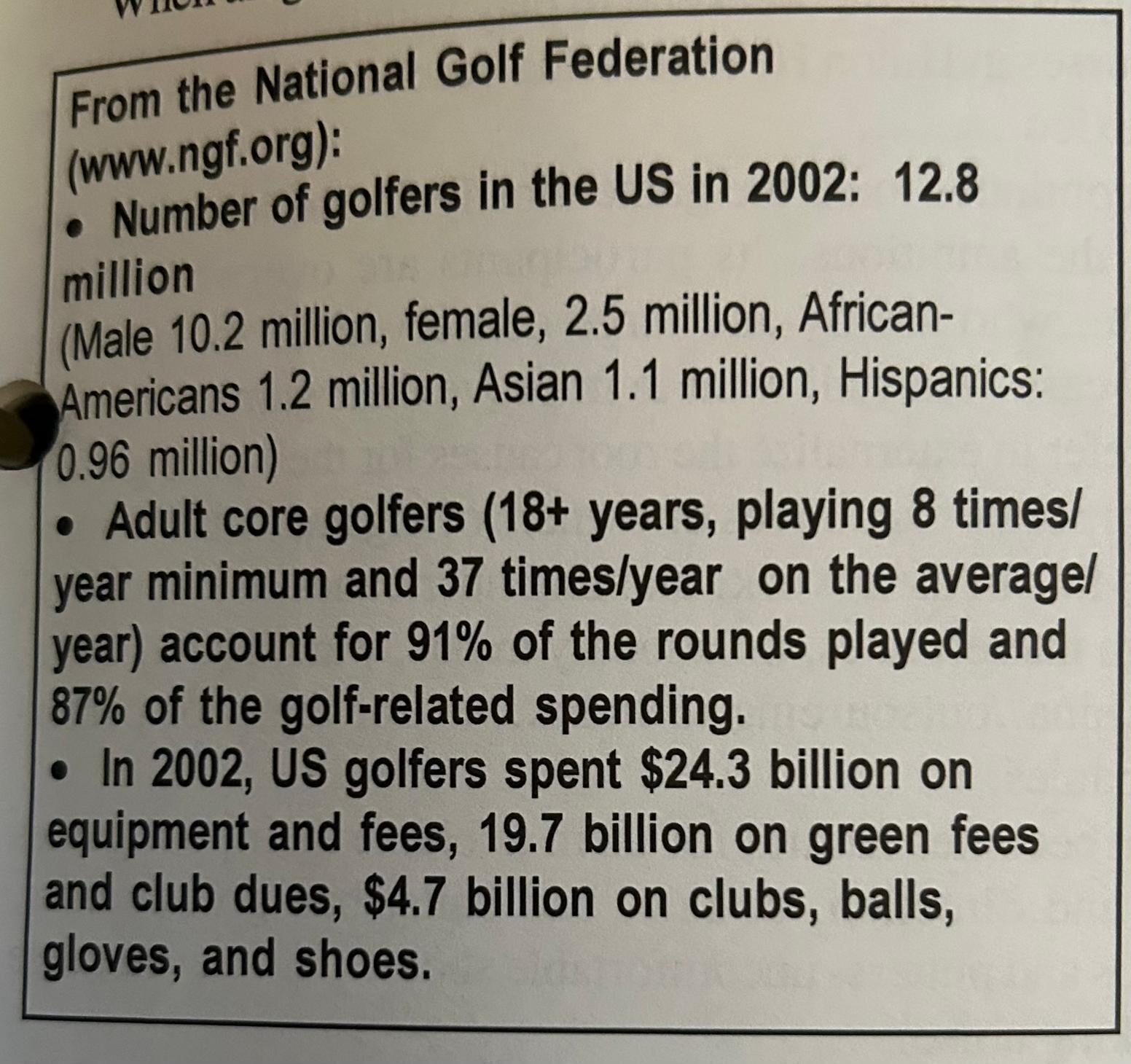
Golf is a multibillion-dollar sport. See the inset of the basic golf stats taken from the National Golf Federation (www.ngf.org). That’s why there is an exclusive golf channel with golf infomercials. To the best of my knowledge (I only have basic cable) you don’t see infomercials for tennis, football, or ice hockey. Only for golf.
The infomercial I was watching was
* Not about new and improved golf balls with the latest elastomers that give the balls the longest drive and the most bounces,
* Not about the new and improved design of dimples and how they improve the aerodynamics of the ball in flight to give the longest drive and the most bounces,
* Not about the symmetry of distribution of the weight within the ball,
* Not about the better design of the contour of the blade, or the newer alloy of the blade material of the club, and
* Not about the new and improved sweet-spot on the drivers.
It was also not about the correct posture and stance for the swing shown in an ad. In this ad, the peddler was showing his “training” golf club. This had a flexible joint in the middle. This joint remained straight only when the club was used, in what the peddler said, as the “correct swing.” If you swing it any other way, the joint buckled awkwardly, making the golfer look dumb.
The informercial was about the golfer himself or herself. Not the pro-golfer though. The target for the informercial was “mature” golfers –- golfers who are over forty who are “into the sport” because of social needs or business compulsions. The type you see in airports carrying huge golf bags on their way to seal big contracts on golf courses, or the affluent and leisurely class getting away for the weekend to play with their social equals on the manicured courses in Hilton Head, Florida beaches, or in the deserts of Arizona, New Mexico…
Golf in the US continues to be the game mostly for the leisurely, for the affluent, or for the ambitious. Its participants are overwhelmingly male, majority white, who are by and large conservative, socially and economically. They are desperate to to improve their game.
These golfers prefer to externalize the root causes for their poor games. Many of them are corporate executives or owners of big and small companies, and they routinely use these at work, blaming hurricanes, tsunamis, oil prices, droughts, high interest rates, inflationary trends, wars, Nafta, Cafta, competition from China, outsourcing to India… for the poor performance of their companies.
So, as golfers, it becomes natural for them to blame their poor games on the wind speed and direction, drizzle, bad balls, bad golf courses, somebody coughing, poorly designed clubs and putters, uncomfortable shoes… even geese flying overhead making noise.
Finally, here comes the Golf Guru, Roger Frederick* trying to sell his idea for helping golfers to improve their game by focusing on the golfers themselves, on their flexibility, rather their lack of flexibility.
It shouldn’t surprise anyone if these middle-aged golfers are stiff like their golf clubs, particularly the male species among them. After all, there are the movers and shakers in businesses and in their professions, putting in long, arduous hours to keep abreast in their narrow field of specialization. If you take away their sleeping and eating hours, travel times, and hours and hours in front of TV watching NFL, NBA, and other games, not much is left for anything, particularly if it demands commitments and regularity such as any exercise regimen.
Roger Frederick’s central thesis for improving golfers’ game is to improve their flexibility of their musculoskeletal system.
These days, when you think of flexibility, the things that would come to your mind are Tai-chi from China or Yoga from India. Roger Frederick’s infomercial talked about the same ideas that any $5 book on Yoga and Tai-chi would give in its first introductory chapter for improving the flexibility around shoulders, hips, elbows, wrists… necessary for general living and for any sport, including golf.
But Roger knows his audience very well. These 40-plus male target audiences are from a social class that is kind of supercilious, if not condescending, to learning anything from other cultures, especially if they are from emerging societies and old civilizations such as India or China.
So, Roger introduces the need for improving flexibility for golfers using all the appropriate golfing jargon, not mentioning even once “Yoga,” or “Tai Chi ” or “asanas.” There is no Omm, there is no Soorya Namaskar, no tongue-twisting Sanskrit names for the different postures, no loose garments, nor svelte women in leotards, no incense sticks, and no soothing music in the background. The only thing that tells you that Roger is familiar with Yoga is the sticky Yoga mat he is using to squat. I was impressed with Roger’s marketing strategy.
The backdrop is golf greens with trees, with portly men in their golfing pants and T-shirts practicing stretching.
With golfers spending over $4.7 billion on golfing clubs, balls, and accessories, Roger will be gleefully walking away to his bank with his DVDs selling for $29.99, without having to design, manufacture and sell any new golfing gadget, but asking golfers to sweat it out on a yoga mat on golfing greens.
(* www.frederickgolf.com). END
Hindu Religious Organizations Need Reforms
Posted by KOLLENGODE VENKATARAMAN in January 2015 on August 31, 2026
Kollengode S Venkataraman, written in January 2005
As a species, we are reactive organisms. Only the most exceptional among us are capable of proactively changing the status quo even in our personal lives. No wonder, even the institutions we build tend to be reactive. As we have seen time and time again, organizations change the way they operate only in response to huge problems — financial crisis or scandals, usually both. Religious institutions are no different.
Hindu religious institutions, when they become rich, seem to forget that their assets are not in their ornate buildings, jewelry in gold, diamonds, & precious stones, ostentatious floats, and huge bank accounts.
Their real asset — in fact, their only asset— is the trust/faith devotees have in them. After all, devotees donate money to them out of blind faith. Lack of transparency in money matters and organizational details is the starting point for all scandals. When they abuse this trust in matters of money and people, we need to hold them accountable.
US-based Hindu religious organizations, particularly larger temples, are not known for their transparency on money matters and other dealings. These temples’ financial statements are open only till they owe money to banks. Once they clear their debts, a pall of secrecy insidiously settles in.
This can change only if donors, big and small, demand at the very least, information on how their money is spent by the temples’ governing bodies. But this is unlikely to happen any time soon because of donor apathy. Besides, in the case of larger US temples, donors contributing over 90% of temples’ revenue are dispersed in many near-by states, often, all over North America. These donors have no voice in the affairs of the temple. Eventually, a handful few, often outside the formal organizational chart, end up having disproportionate influence on temple’s temporal affairs.
Besides, on organizational matters, US-based temples buy peace among quarrelling ethnic subgroups by yielding to regional/ethnic pressures, and self-inflicted compulsions of dogma. The governing bodies often hide behind saffron-robed India-based heads of orthodox religious institutions, and others steeped in the ritual part of the faith. These Acharyas have their own agenda as they try to get a toehold in the lucrative and resourceful North American Hindu organizations.
Many of these men in ochre robes are either unfamiliar with, or do not want to recognize, the diverse composition of US temple-goers, their needs, and the compromises they continuously make in their personal life in synthesizing their own unique Indo-American lifestyle. These people struggle to reconcile their traditions and faith with the mainstream ethos, while raising their children in their “newfoundland.”
Members of the governing bodies of these temples, for their part, use these Sannyasis as their armor to fend off internal opposition, real and perceived. Soon, these India-based God-men exert enormous influence on US temples’ organizational matters. Scandals in religious organizations start innocuously as policy disagreements among members that morph into irregularities in their internal affairs and billow into scandals. Then these religious organizations, like any other organization, try to buy peace through money and favors, failing which, through intimidation, blackmail, and litigation. And when these also do not work, and if one can get away with it, through violence.
In this matter, Hindu religious organizations are not alone. In the 1980s, the Vatican Bank and Banco Ambrosiano were involved in financial shenanigans involving billions of dollars. Recently, in the US, many Catholic archdioceses filed for financial bankruptcy after pedophilia cases came out against scores of parish priests. The Rev. Jim Bakker’s and the Rev. Jimmy Swaggart’s tryst with prostitutes is another story. The real problem with religious organizations today is their moral and ethical bankruptcy.
So, it is time the faithful donating money to temples started demanding, at the very least, financial transparency from temples and religious heads.
On organizational matters and finances in Hindu temples, skepticism, not implicit faith, is the need of the hour. Often, among Hindus, people’s implicit faith is erroneously founded on the fear of Godly wrath, believed, and often subliminally reinforced, by what people hear second- and third-hand on events in other people’s personal lives. This is a deplorable way to inculcate and reinforce faith.
Don’t get me wrong. Implicit faith, rituals, and catechisms are wonderful, even necessary, in the early stages of one’s life-long spiritual journey. But they are only means to a greater end, not ends in themselves.
When religious organizations are built around rituals and dogma, and are confined to them, they become like any other organization, given to venality, pride, exclusivity, hatred, aggression, and desire for control.
Mercifully, in India, throughout ages, reformers have repeatedly reminded us that the true basis for religion is freedom from ignorance, anxiety, fear, and bondage. Thiruvalluvar, the Tamil sage, over 2000 years ago wrote:
“Grasp and hold on to the One who is free from all attachments, so that you can free yourself from even that grasp.”
US-based Hindu temples would be doing themselves and everybody else a favor if they do some introspection on these. But will they? END
The Celebrity News You Don’t Read in the Indian Media
Posted by KOLLENGODE VENKATARAMAN in January 2015 on August 30, 2026
By Kollengode S Venkataraman (written in 2004)
Recently, the UK’s Prince Charles was in India. His visits to Mumbai’s Victoria Terminus, chawls, and his interactions with dabbawallas (whose delivery performance is better than FedEx’s) were all over the Indian media. However, the event that did not receive wide publicity was his meeting with the Indian IT gurus at the Taj Hotel’s ornate Crystal Room, where he heard how the Indian IT wizards eased the traffic problem in central London’s shopping district.
Ramananda Sengupta covered this for Rediff.com, a web magazine (www.rediff.com/money/2003/nov/04charles.htm).
According to Sengupta, industry leaders — Kiran Karnik, chief of the Indian software industry organization, Ashank Desai, chairman of an Indian software company, and others — made multimedia PowerPoint presentations to the prince highlighting India’s software industry.
Desai presented the challenges he faced in designing a system for collecting the toll from the 250,000 cars daily entering London’s shopping district: 1) The already congested London traffic should not be slowed down further, 2) no booths or barriers are to be erected, and 3) vehicles should not be stopped.
Desai told the prince how his group did it: Every day a) 500 fixed and mobile cameras read number plates of over 250,000 cars, b) computers process 1,000,000 images and issue 75,000 permits for new drivers wanting to enter the area, and c) an India-based call center answers 64,000 calls and processes 100,000 financial transactions.
Desai told the prince, “All this was completed and delivered in record time. Not only has this brought down noise and traffic pollution, but it has also earned revenue for London’s Municipality.”
Charles then asked questions. Even though he had a microphone, journalists didn’t hear his questions, a reminder that low-tech problems are still endemic in India. But they heard a peal of polite laughter from the software gurus at one point at what the prince told them.
Sengupta later came to know what made the Indian software gurus laugh. The prince told them: “You’ve cleaned up London’s congestion. What about Mumbai?”
While the Indian software gurus solve the problems of the English-speaking societies and the industrialized West, India’s nuts-and-bolts problems are only fit for their polite laughter.
During our visits to India, most of us make similar remarks to our friends and relatives. Hearing it from a videshi Desi who was one of them years ago, our remarks only evoke their anger.
But hearing it from the descendant of India’s erstwhile colonial master, the latter-day Indian brown sahibs politely laugh it off instead of feeling embarrassed, betraying their own assessment of India. END
Desis’ Wealth and Social Obligations
Posted by KOLLENGODE VENKATARAMAN in January 2015 on August 30, 2026
By Kollengode S Venkataraman (Written in 2003)
On May 13, 2003, the Indian media widely quoted a Merrill Lynch study that said that in the US, over 200,000 people of Indian origin have a net worth over $1 million each. This study was done in 2000 during the overheated “dot.com” euphoria days, well before the bubble burst. But still, this number is impressive considering that we have only two million people of Indian origin in the US. Assuming an average of 3.5 people per household, this is around 500,000 families. So, roughly, one in three families of people of Indian origin is a (multi)millionaire household.
Granted, a million these days is not what a million used to be, say, in the 1970s and 80s. Granted, the study’s basis for net worth includes homes, stocks, 401-k, PAYSOPs, and other savings.
But considering that the US has only 2.1 million millionaires in a population of 280 million, the 200,000 desi millionaires are noteworthy. On this basis, nearly 1 out of 11 millionaires in the US is Desi.
Also, while the national median family income is around $38,500, the median family income of a desi household is over $60,000. As observed by Merrill Lynch executives, these 200,000 Indian millionaires, along with their less wealthy NRIs — and also shall we say, less “worthy” NRIs, given our obsession with wealth — we may be the wealthiest immigrant group in the United States.
This is impressive any which way you analyze. The desi millionaires are among physicians and surgeons, motel owners, entrepreneurs, business executives, and two-career professional couples.
Even without the Merrill Lynch study, the resourcefulness of the Indian immigrants is well recognized by real estate agents, auto dealers, financial planners, banquet organizers, brokerage houses, insurance agents, and lawyers.
We have every reason to be proud of our accomplishments given that most of us have come to this country with the proverbial “$100 in pocket” that our children have heard ad nauseam. We should be equally evocative in being thankful to this bountiful land of opportunity, and a society that accepts people from every nook and corner of the world, embracing them as one of them legally, if not socially.
More importantly, the US has accepted us in their communities with our lifestyle, faith, and ethos quite different from those of the US mainstream; and given us the freedom to pursue our interests — even criticize it, as we have done several times.
We are proud of our accomplishments and hard work. But we need to recognize that this was possible only because the US has the environment to bring out people’s potential and an economic system that lets us cash in our skills to accumulate this phenomenal wealth. Honestly, how many of us could have become this wealthy within a few decades had we stayed in India? This is not just a rhetorical question.
So, it is prudent for us to remember, particularly after 9-11, that along with this distinction of being immigrants who have access to considerable wealth come a few obligations to the communities in the US where we live.
On this point, how the mainstream USA perceives us is quite telling. Only 15% of us vote. One refrain one hears from outside is that we are disengaged from local issues. The perception comes from our very limited interactions with mainstream USA. This has to change.
The early and more successful Indian immigrants are in their retirements, or at least looking at their retirement options. So, maybe it is time to consider giving back something to local communities in the US where you live: Endowments in your names as your legacy for annual scholarships and lectures in schools, colleges and universities; for concerts in Indian performing arts; for grants to inner-city children’s centers, soup kitchens … …
The list is long, and the needs are many. The important point is that the beneficiaries of these endowments/ charities should be the people in the US mainstream.
If we want inspiration, we can look at the Parsi and Jain charities in Mumbai, or Chettiar and Nadar charities in interior Tamil Nadu. Or we can just look at the Jewish charities in the US.
If we emulate our own Indian forebears, America would recognize us not simply as an immigrant community that became rich in the US, as Merrill Lynch did. America would also recognize us as successful and resourceful immigrants who recognized their social obligations that come with wealth, and who acknowledged the bounties they have received from this land.
A Point to Ponder: Given our relative prosperity, it tells a lot about us when we expect free lectures, music/dance recitals, etc. This forces desi organizers to sheepishly seek discounts in renting auditoriums from public institutions. This is embarrassing. Besides, accompanying artists — mrdangists, violinists, tabla, and flute players — are often paid a pittance, sometimes none at all. We’ve heard horrifying stories from accompanying artists — sometimes from main artists themselves — on their experiences with the US-based desi organizers.
We can call ourselves arts patrons only when artists — accompanying artists in particular — get decent honorariums. For this, we need to buy tickets, for starters. END
Monkey Business & Organizational Behavior
Posted by KOLLENGODE VENKATARAMAN in January 2015 on August 30, 2026
By Kollengode S Venkataraman (written in 2003)
Adapted from a story available on the Internet
A wily zookeeper had fifteen monkeys in a cage. In the middle of the cage, he kept a ladder that reached a bunch of bananas hanging from the ceiling. The monkeys always wanted the bananas, but the crafty man wanted the bananas all for himself. So, each time any one of the monkeys tried to climb the ladder, he doused ice-cold water on all monkeys. Each time any one of the monkeys tried to climb the ladder for the bananas, the same thing was repeated again and again.
Soon, whenever any one monkey went near the ladder, all other monkeys, not wanting to be doused with ice-cold water, pounced on the monkey trying to climb on the ladder to get the bananas and beat him up. Eventually no monkey ever went near the ladder.
The crafty man then removed one monkey and replaced him with a new one. The new monkey, seeing the bananas and the ladder, wondered why none of the other monkeys was doing the obvious. As he began to climb the ladder undaunted, all other monkeys joined together and beat the crap out of him. The new monkey had no idea why.
However, he learned not to try to reach for the bananas.
A second original monkey was likewise removed and replaced.
The newcomer again tried to climb the ladder, but all other monkeys, including the previous new monkey, hammered the crap out of him. The previous new monkey, even though he was grateful that he was not on the receiving end this time, trigger-happily participated in the beating nonetheless because the other monkeys were doing it. But he had no idea why he attacked the newcomer. Thus, one by one, all the original monkeys were replaced.
Eventually, even with all the original fifteen monkeys gone, none of the new fifteen monkeys ever dared to climb the ladder, even without the need to spray the ice-cold water. And all of them enthusiastically beat up any new monkey who tried for the bananas, even though they had no idea why. END
No Tears of Grief tor US Airways’ Chapter-11 Woes
Posted by KOLLENGODE VENKATARAMAN in January 2015 on August 30, 2026
By Kollengode S Venkataraman (Written 2002)
Note: A condensed version of this appeared in the Pittsburgh Post-Gazette as Note: A condensed version of this appeared in the Pittsburgh Post-Gazette as a Letter to the Editor.
On Sunday, August 11, 2002 US Airways, which occupies over 70% of the gates and accounts for over 80% of the arrivals and departures in Pittsburgh International, filed for bankruptcy under Chapter 11. I was in Little Rock on business, and on August 12, US Airways CEO David Seigel said (quoted in USA Today,) “When an airline files for bankruptcy, there is always some erosion. But we are in a strong cash position. The sophisticated customers will understand.”
In the post-Enron, post-Arthur-Anderson, post-WorldCom, post-Tyco world, people, sophisticated and unpadh, are not trusting company executives when they try to reassure the public, particularly when they are in deep doo-doo. So, I didn’t take Seigel’s comments seriously.
With US Airways dominating Pennsylvania’s air travel industry (it has hubs both in Pittsburgh and Philadelphia), news on US Airways is always on the front page above-the-fold in papers. With thousands of jobs directly and indirectly tied to air travel, not to speak of the tax revenues, this is, as it should be. So, on 8/13/02, the Post-Gazette ran a story on US Airways’ problems, assuring readers with a bold caption, “Fliers won’t see much change, but stockholders will.”
If fliers indeed do not see much change, US Airways has the real possibility of not recovering from its Chapter 11 woes. Here is why:
Let me start by saying I am not a “sophisticated” traveler. I work for a large, Pittsburgh-based corporation, and I travel on and off on business. Neither my company nor my immediate boss has insisted — or even reminded me, for that matter — that we should always choose the least expensive air carrier. They have left it to our judgment.
Years back, when I booked tickets through our travel agents, I started routinely asking ticket prices for different airlines. I started comparing US Airways ticket prices to cities to which US Airways was the only one flying nonstop, or worse still, US Airways is the only airline flying. And I was outraged.
Once I flew to San Francisco on business. The US Airways nonstop ticket was over $1500, nearly three times as American Airlines ticket with one connection, for identical travel dates and times.
I go to Little Rock frequently on work. US Airways flies 50-seater small jets nonstop to LR, and the ticket price at short notice is over $1100. American Airlines and Delta routed through St. Louis, Cincinnati, or Atlanta, are slightly over $700 for identical terms of travel.
I was mad. And I wondered, “How come US Airways is in the red despite gouging its corporate customers?” As a helpless single business traveler, I did the only thing in which I had full control: I simply refused to fly US Airways. For several years now, even without any prompting from my company, I’ve been choosing the inconvenience of connections via Cincinnati, St. Louis, Dallas, Chicago, you name it, instead of letting US Airways fleece my company.
You can imagine how other companies with tighter travel budgets, not to speak of individual travelers, make their travel decisions.
If you have to travel from Pittsburgh to, say, Raleigh-Durham, Indianapolis, Philadelphia, and similar places that are too far away to drive, and not far away enough to warrant a ticket with a connection, you are out of luck. You have no option other than getting ripped off by US Airways.
Pittsburgh has first-hand experience of the vulnerability of its well-being tied to one industry — Steel. It took Pittsburgh more than twenty years to recover from the demise of Steel.
If tying your fortune to one industry is bad, tying it to one company is even worse. And yet, that is precisely what Pittsburgh International did by letting US Airways overwhelm the airport.
Pittsburgh airport and the region can, and will, recover from the US Airways mess in the next several years. Pittsburgh International has the advantage of its location, and is an excellently designed airport with over 100 gates. It is one of the finest airports in the nation, perhaps in the world.
What we need are two or three dominant carriers using Pittsburgh International as their hub. Having two or more carriers operating from Pittsburgh will serve the traveling public better, and bring stability to the airport’s finances and the region’s economy.
My eyes swell with tears upon hearing US Airways Chapter-11 bankruptcy humiliation. But they are not tears of sorrow. END
US Preaches Free Trade to the World, but is Protectionist on Home Turf
Posted by KOLLENGODE VENKATARAMAN in January 2015 on August 30, 2026
By Kollengode S Venkataraman, (written in 2002)
Industrialized nations, with the U.S. leading the pack, preach to the less developed countries the virtues of Free Trade and dissuade them from imposing duties on the goods they import from them.
The argument is compelling: Import duties are protectionist and artificially make the imported goods more expensive even though they cost less and are better made. The real losers, the industrialized nations argue, are the ordinary citizens of the LDCs (Least Developed Countries) since they have to live with costlier, but poorly made goods than the imports.
Many LDCs during the last fifty years never attempted to nurture internal competition while they gave protection to native industries from overseas competition. The Nehruvian India is a classic example.
The unholy alliance among India’s Congress Party, big industrialists (in the Indian context) and India’s entrenched bureaucracy kept alive what was derisively called the Permit-Licence-Quota Raj.
The politicians’ palms were kept greased. And the already established industrialists (the Tatas, Birlas, Mafatlals, Kamanis and their ilk), by working on both the politicians and the bureaucrats, saw to it that no competition-domestic or overseas-ever came in their way.
The top-level civil servants got their vicarious pleasure in making the industrialists wait at their door for an appointment even as they took the crumbs the tycoons threw at them periodically. This system was preserved for decades till it imploded after the Cold War. Given this background, it was no surprise that none of the Indian industrial giants ever dared to enter the aggressively competitive global marketplace.
But in asking the LDCs to remove trade barriers, the industrialized West is driven more by self-interest. While the industrialized West tells the rest of the world to remove duties on imported goods, it grants subsidies to its farm products — grains, cheese, meat, poultry — to artificially depress their prices in the global market.
The industrialized nations spend over $300 billion of their taxpayer money per year on agricultural subsidies. This subsidy alone is roughly close to the total GNP of sub-Saharan Africa.
Gov. George W Bush, in his election campaign two years ago, said in stump speeches that if elected, he would phase out farming subsidies so that farm products would be produced and priced by market forces.
That was two years ago. But his election rhetoric was replaced by the realities of US congressional election in November 2002.
So, what did he do? He signed legislation increasing the farming subsidies by nearly 80%, ostensibly to protect small farmers, that would cost US taxpayers nearly $90 billion over the next ten years.
But the truth is the largest beneficiaries of this subsidy are large-scale corporate farmers who are driving family-owned farmers out of business. And when Treasury Secretary Paul O’Neill and the Irish rock star Bono toured sub-Saharan Africa for 11 days, he heard an earful on the US hypocrisy on farm subsidies. Bono publicly chided O’Neill that the US-backed International Monetary Fund has pressured Ghana to drop farm subsidies, while dumping US taxpayer-subsidized rice on Ghana (Wall Street Journal, editorial, May 30, 02).
In LDCs, where over 70% of their populations are in farming, this makes domestic products less competitive than the imports. This is a prescription for social disasters. In the less populous industrialized West, only ~ 5% of the workforce is engaged in farming. It needs no imagination to know the social consequences in nations where 80% are engaged in farming lives on food grains imported from richer nations.
This is similar to companies underselling to kill competition. When businesses do this, others go to court. But when powerful nations do this to poorer nations, they have to plead for fairness, or for mercy.
The free-market Republicans seem to give a perverted meaning to “Think Globally, but Act Locally.” If you ask them, they will still say they believe in what they preach. But they would add, “Look, we didn’t say we have to reconcile the ‘thinking’ and the ‘preaching’ part with the ‘acting’ part.”
The “local” considerations for President Bush are the 2002 Congressional election in which he wants to wrest the US Senate from Democrats’ 51-49 majority and retain his majority in the House. Midwestern states are toss-up states in the senatorial election. And the farm subsidy comes in handy to tilt the balance in the Republicans’ favor.
* In another decision, the Bush administration yielded to the lobbying of steel manufacturers in the US by raising duties on imported steel by up to 30%, again, ostensibly to protect the domestic steel industry and the steel jobs against dumping by mostly third-world steel producers.
But the real reason is to increase the odds of his second inauguration in January 2005. Thanks to Enron and the energy mess of 2000-01, California, with its largest number of electoral votes, is gone for the Republicans in the 2004 election. So, the steel-making states — West Virginia, Pennsylvania, Ohio, Florida — are important to him in 2003 because in 2000, Bush won or lost by a wafer-thin margin in these states.
And even though Republicans are ideologically averse to the power of organized labor, they also know it doesn’t hurt to keep unions on their side because organized labor brings in voters.
* The Teamsters Union and the US trucking industry are trying to stop Mexican 18-wheel trucks from coming into the US as per the NAFTA agreement. They are using all kinds of arguments, such as the poor safety records of Mexican trucks, even though the Mexican trucking industry is bending over backwards to comply with US standards.
The real reason is that since moving goods to and from Mexico using Mexican trucks is cheaper for US businesses, the US trucking industry will lose its business, and the Teamsters Union will lose their jobs. Mexican President Fox threatened that if Mexican trucks cannot ply in the US, then US 18-wheelers will have “No Entry” signs at the border. So, bye, bye Free Trade! END
Chudiyan (Bangles) in the Charged South Asian Political Rhetoric
Posted by KOLLENGODE VENKATARAMAN in January 2015 on August 30, 2026
By Kollengode S Venkataraman, written in 2002
South Asian politicians display their exaggerated machismo in ridiculous ways, thereby unintentionally revealing their mental time-warp.
Many South Asian men stereotype women as weak despite innumerable characters of courage in Sikh, Rajput, and South Indian history, not to speak of mythological characters such as Panchali, or deities such as Durga or Kali. Besides, is standing up against brute force the only sign of courage? How about fortitude and endurance against adversities? South Asians’ ossified idea of courage surfaces on and off.
When Nawaz Sharif was Pakistan’s prime minister in 1999, India pressure to explode Pakistan’s nuclear bombs, and Japan and the West pressured him not to do so. The latter dangled goodies for him for not exploding bombs. Given Pakistan’s bad economy, and caught between the proverbial devil and the deep sea, Nawaz Sharif agonized for several days over how to respond.
Benazir Bhutto, who Nawaz defeated in the preceding election, was in her element to put Nawaz on the mat. In a public meeting in Karachi, she threw her chudiyan (bangles), asking Nawaz to wear them as a sign of his wimpishness and his lack of “manly” courage, known as mardangi in the subcontinent.
The public outburst of Bhutto, herself a woman and the first woman prime minister of a Muslim nation, was both ironic and paradoxical.
Piqued by this ultimate “insult” heaped on him by his woman predecessor and his Islamic hardliners, Nawaz upped the ante by exploding six nuclear devices, giving a “befitting reply to India.” That Pakistan got into a deeper economic quagmire was a small price to pay.
The chudiyan metaphor in Pakistani politics didn’t end. In the current US-led war against the Taliban, Musharaff abandoned the Taliban, its 20-year-old ally, in “Pakistan’s supreme national interest,” and joined the US-led coalition. General Musharraf was on Pakistan TV addressing Pakistani citizens. Using fauji (army) language, he was trying to divert public attention from the change in his Taliban policy to Pakistan’s traditional enemy, India. He asked India to “lay off” Pakistan. Speaking in Hindi/Urdu, he said, “Pakistan is not a chota-mota (piddling) country,” and threatened India “with a befitting reply.” In his desi bravado, chudiyan surfaced again: “Hamne bhi chudiyan nahin pehni.” (“We are also not wearing bangles.”)
[On CNN, Musharraf morphed from the hawk to a dove. When Larry King asked him about peace with India, Musharraf replied, “We need two hands to clap,” indicating India’s lack of response to his overtures. King and his US audience would never know of Musharraf’s blow-hot-blow-cold overtures for talks with India.]
The chudiyan metaphor was picked up by Sushma Swaraj, Information and Broadcasting Minister, who took umbrage as a woman at General Musharraf dangling the feminine bangles in front of his viscerally “manly” Pakistani audience.
In New Delhi she told reporters Musharraf should not belittle chudiyan. After all, Sushma said, Pakistan’s General Niazi surrendered to a chudiyanwali (woman with bangles) in 1971 after the Bangladesh War. Sushma’s chudiyanwali is, of course, Indira Gandhi. Paradoxically, in India the joke among us college students at that time was that the chudiyanwali Indira Gandhi was the only “man” in her Congress party and her all-male cabinet.
Prime Minister Atal Behari Vajpayee, a seasoned statesman-cum-politician and a Hindi/Urdu maven, did not miss the opportunity to display his mastery. He told reporters in Gujarat: “Baat chudiyon tak pahunch jaye yeh koi mardangi ki baat nahin hai. (When the level of discussions stoops to bangles, it is not a sign of manliness.” There you go, bhayya! END
Watch Out: Problems May fester in Indo-Pak Relations Even Beyond Kashmir
Posted by KOLLENGODE VENKATARAMAN in January 2015 on August 30, 2026
By Kollengode S Venkataraman (written in 2001)
Pakistan’s dictator, president and general Parvaiz Musharraf repeatedly said before the failed Agra Summit that “Kashmir is the core problem, and all others are only minor irritants” for the bad relations between India and Pakistan. This assessment is too simple.
With the failed summit, is a quarter of the world population living in South Asia condemned to live in hostility and poverty? Not necessarily, though it looks likely. If Germany and France, the sworn enemies during WW II, live in peace now, anything is possible.
But this requires Indian and Pakistani leaders to integrate their foreign policy goals with their social priorities; show sensitivity to the anxieties of each other in words and deeds to gain trust; and be realistic in their expectations. They need to persuade their domestic hardliners to compromise while talking to each other even as they disagree on issues. They can learn from the US, USSR, and China. Even during the nuclear brinkmanship of the Cold War, they never ceased talking to each other.
Granted, neighbors — individuals and countries— will always have problems even under the best of circumstances. The atmosphere in the Indian subcontinent was not in the past, is not now, and will not be in the immediate future, anywhere near the best. Seasoned analysts on both sides are aware of the history not only of the last century, but also of the last 1000 years. That’s why they don’t endorse Musharraf’s simplistic characterization of Indo-Pak relations.
The general’s public posturing in India before the talks began doomed the summit. Kashmir’s pro-Pakistani All Party Hurriyat Conference (APHC) wanted to have an exclusive meeting in New Delhi with him during his visit. India conveyed its discomfort, and the general publicly said in Islamabad that he would be a good guest. Then he bowed to his hardliners. He gave a tea party in Delhi inviting only the APHC from Kashmir, as if there is no other Kashmiri voice. In turn, Vajpayee introduced Kashmir Chief Minister Farooq Abdullah to the general during the banquet. Thus, the stage was already set for the summit’s failure.
Musharraf praised Mahatma Gandhi’s nonviolence at Raj Ghat even as his jehadis were slaughtering Hindus in Kashmir. Then, like a hormone-driven teenager on his first date, he focused only on Kashmir, talking to Vajpayee. Vajpayee reiterated Pakistan-inspired cross-border terrorism by the jehadis, Kashmir, bilateral trade, etc.
Then the general in the supposedly off-the-record talk with Indian editors, distorted history of the subcontinent, with the editors sitting as potted plants. Not once did the Indian editors question Musharraf till the very end on his distortions, or the lack of his credibility as the military dictator to preach the right of self-determination for Kashmiris, or the fact that Pakistan itself occupies 1/3 of Kashmir.
China is the Real Winner: The real beneficiary in the doomed summit is China. China too occupies a part of Kashmir, and not once did India or Pakistan raise the issue of how—or if—they are going to deal with the Chinese on this issue. China being Pakistan’s only benefactor outside the Islamic world, Pakistan will not dare to raise the issue.
Pakistan is still nursing its self-inflicted wound of losing its eastern wing in 1971. The dictator blamed India for supporting the Bangladeshi freedom fighters. He conveniently forgot that in 1970-71 West Pakistan denied Pakistan’s premiership to Mujibur Rahman from East Pakistan when Rahman had the majority in Pakistan’s parliament. Ten million East Pakistanis ran into India, escaping Pakistani tyranny.
In losing the eastern wing, Pakistan suffered a spiritual defeat. The breakaway of Muslim Bangladesh negated Pakistan’s core principle that Islam would be the bond to hold its people together.
Other issues on the horizon: From Pakistan’s perspective, other issues would take the center stage to vitiate Indo-Pak relations even if Kashmir is solved to the complete satisfaction of India, Pakistan, and the Kashmiris — an unlikely event. Why unlikely? Because treaties are essentially compromises between sovereign nations on substance. And the military mindset inspired by religious fundamentalism abhors compromises. And there are hardliners in India too.
So, before embarking on high-stakes summitry, both nations need to mobilize public opinion on their home turf towards compromise.
Dictators, trained to give marching orders, are ill-equipped for persuading people. When summits fail after raising expectations, hardliners dig in their heels. After the summit, rhetoric from Delhi and Islamabad is shriller, and the jehadis have become more violent.
Besides, the Pakistan government has built its foreign policy around Kashmir, its military establishment against India, and its national identity around Islam to checkmate the “Hindu” India. With so much internal strife in Pakistan today-sectarian killings between Shias and Sunnis, and among different sects of Sunnis; the Kalashnikov culture; drug traffic and addiction; religious fundamentalists drowning out moderates; ethnic strife among Punjabis, Sindhis, Mohajirs, Balochis and Pathans; mounting debt; sagging economy-the Pakistani establishment needs a glue to hold its people together.
Politicians with insurmountable internal problems often create external enemies, real or imaginary, to divert public attention. Pakistan cannot publicly cultivate hatred against neighboring Iran, Afghanistan, the Central Asian Republics (all Islamic), or China (its only other benefactor). But India is a perfect enemy. Pakistan even calls its missiles Gaznavi and Ghaur, after Mohammad Gazni and Mohammad Ghori who repeatedly raided and plundered India (that paradoxically included today’s Pakistan) over 1100 years ago. By their very name, these missiles are India-specific.
Pakistani leaders supporting the jehadis militarily, politically, and materially may be thinking that the low-intensity proxy war is a cost-effective way to bleed India to death. For Pakistan’s discomfiture, however, its Kalashnikov-wielding jihadis are now turning their guns against Pakistanis who do not tow their line. Hundreds of lawyers, doctors, and journalists are murdered in broad daylight under military rule. Like the rakshasas (demons) in Hindu Puranas harassing the very Gods who granted them the boons of immense power, the jihadis are tormenting their own mentor.
And consider these from Pakistan’s perspective: The deep scars of Partition (the scars among Indians are equally deep); the size of India’s economy, population, and military; India’s diversity; India’s growth (relative to Pakistan) in industry, higher education, and IT sector; and India’s competitive edge in bilateral trade.
Anxiety Over Cultural Invasion: However much Pakistan’s orthodoxy denies it, her sophisticated and anpadh citizens alike recognize Pakistan and India share a common heritage for better and for worse. Pakistani schools teach history only after the arrival of Mir Qasim on the Sindhi shores in 8th century AD, thus denying their children their pre-Islamic heritage. By contrast, Egyptians are proud of their Pharaoh, and Iraqis, of their Mesopotamian history, both dating back to millennia before Christ. Both are 100% Arab, 100% Muslim.
Besides, Indian women — at least middle class and above — freely pursue their careers in all fields. India’s tradition of encouraging women in classical performing arts is likely to plant ideas in Pakistani women to seek artistic expression, taking inspiration, not from India (God forbid), but from their own historical roots. This may not go well with the mullahs. Further, Pakistanis see Muslims in India living with Hindus. This is likely to reopen old questions.
India has as many Muslims as Pakistan. And Pakistan’s record in treating minorities — not Hindus and Sikhs — but Christians, Ahamadias, Shias, and its treatment of women are there for all to see.
Bilateral Trade May Not Be Easy: Pakistani industrialists will resist inexpensive goods from India flooding Pakistan — as Indians resist cheap Chinese goods entering India — as this requires a structural change in its economy. Pakistani labor leaders and farmers also have reasons to oppose trade with India. Some Pakistani writers derisively refer to the Bania-Brahmin nexus in India as a threat to Pakistan.
So, if Kashmir is amicably solved, the Pakistani establishment needs something other than India hatred to hold its people together. Creating a newer glue to hold together its heterogeneous Muslim populace would need structural changes in Pakistan. In Pakistan today, members of just over 400 families dominate all facets of life. This will have to change.
But vested interests don’t give up without a fight. Look how difficult it was — and still is — to bring about land reforms or eradicate untouchability in India, or break Nehru’s permit-license-quota raj that suffocated Indians’ entrepreneurial instincts for decades.
So, sentiments and lofty intentions are inadequate to improve Indo-Pak relations.
And commando attacks, whether in battle fatigue or in three-piece suits from the podium, rarely settle disputes. What we need are leaders with patience and endurance to build national opinion for compromises, and who are sensitive enough to instill trust between the two governments. Only such leaders are likely to succeed in settling England’s sinister parting gift to the subcontinent.
Want a Good Indicator for Progress? See How Much An Average Family Spends on Food
Posted by KOLLENGODE VENKATARAMAN in January 2015 on August 29, 2026
By Kollengode S Venkataraman, (written in 2001)
Among Desis, even highly-educated Desis, all kinds of subjective and anecdotal indicators are tossed around in conversations on how rapidly things are improving “back home” such as: The availability of a) high quality private school and college education, b) enclaves pr luxurious flats and access to contemporary household gadgets, c) private modern medical establishments, d) consumer electronics, Internet access and cable TV, e) old-age homes, f) the wider choice of food in restaurants…… The list goes on and on.
Add to this the overflowing crowds of vacationing NRIs seen in jewelry stores and expensive sari stores in India during their visits.
While all these things and more are available, when we ask if they are affordable to the average Indian who earns in rupees and spends in rupees, we confront the uncomfortable answer that most of these are affordable only for the wealthy and the powerful in India, and not for the “average family” (husband and wife, 2 kids, 2 parents) struggling to live in their 800 sq. foot flats in urban India’s concrete jungles.
Traditionally, village folks in India list man’s needs as roti, kapda, aur makaan (unavu, udai, uraividam in Tamil) or food, clothing, and shelter. The order in which people list the three is significant. As an animal, man is instinctively driven first by hunger and thirst, and only then as a social animal, by the sense of shame, and only then he thinks about a roof over his head. So, rational indicator of social development in today’s “modern” world is the percentage of income an “average” family earning “average” income spends on roti.
The US Department of Agriculture’s statistic on the money the American family spends on food is revealing. It is remarkable that in the US the proportion of money a family spends on food has decreased from 21% in 1940 to 11% in 2000. This, in spite of all the economic ups and downs and the structural changes in the economy, from the one dominated by manufacturing in the 1940s to the one driven by services in 2000s. Life in the US is still manageable for the average guy.
% Income spent on food by the average US household (Ref: https://www.ers.usda.gov/data-products/chart-gallery/76967 :
1940: 21%
1960: 18%
1980: 13%
2000: 11%
In today’s India, an average urban Indian family (couple, two kids, two parents) earning in rupees and living in rupees spends a whopping 40%-50% of its income on food alone. How do I know? Personal experience. If you want reference, Google-search In 2000, an average urban middle-class family in India spent. Approximately 60% to 70% of an average urban family’s budget in India was spent on basic food items in the 1960s, which steadily decreased toward roughly 42% to 48% by the late 1990s and 2000 (source: Google-search under Between 1960 and 2000, % of family income an average urban middle-class family in India spent on food). But still not anywhere clos to the number in the US.
Add to this another 30 to 40% of their income going towards the even more sky-rocketing cost of housing – for a small 800 sq. feet 1-bed room flat, that is. “Average” young couples struggle to make down payments for their flats without parental support, which brings its own complications in the complicated checkerboard of relationships among the in-laws. That is why average Indians are leaving India in hordes to wherever destiny takes them. Instinctively they believe any place else would be better. And they are right.
With so much availability and so little affordability, is there any wonder why corruption has permeated society in less developed nations in so many perfidious ways?
Besides, with more than 80% of an average Indian family’s income gobbled up by food and shelter, very little is left for other activities-recreation, hobby, travel, health care, fine arts.
Recently my friend told me about the bill for the last stages of his mother’s hospitalization was Rs. 700,000. In India, there is no equivalent of Medicare or health insurance, and the quality of healthcare in government hospitals so wanting, and the private medical industry borders on racketeering. So older people dread hospitalization. With their liquid assets eaten away by inflation, they are forced to depend on their sons and daughters physically and financially.
Now you can see how easy it is for us to send our kids to tennis lessons, piano classes, golfing, Indian dance classes… … We have the luxury of disposable monies and disposable time too.
And we in the US also use other taxpayer-funded social services — public education, good roads, libraries, and parks, for example, to make effective use of our disposable time and resources in the activities of our choice. These activities, affordable only to the affluent in India, are well within the grasp of middle-class NRIs here, not to speak of the affluent desis.
The problem with emerging economies is that their development is skewed. A large number of low-income vernacular-educated families — not to speak of very low-income families — are overrun by sweeping changes whose beneficiaries are mostly urban middle class, or the rural propertied class. END
Gender Imbalance in India: A Grim Picture
Posted by KOLLENGODE VENKATARAMAN in January 2015 on August 29, 2026
By Premlata Venkataraman, (written in 2001)
The increasingly skewed gender ratio in India’s population is a sad reflection of Indians’ outright bias against girls. See below. The social consequences of man messing with nature by abusing technology can be horrendous.
(Already, in the poorer northern provinces of China, because of the skewed gender ratio, villages inhabited mostly by men dot the landscape. Police say crime is up among the men in the marriageable age who cannot find brides. Kidnapping of women is common, and gangs traffic in Vietnamese and North Korean women for Chinese men (Washington Post, May 29, 2001). India cannot escape a similar trend.)
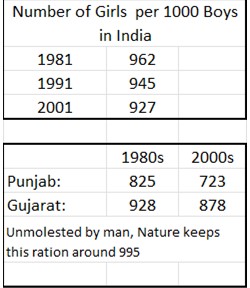
These skewed gender ratios are not because Indians have perfected the technique for conceiving male fetuses. No, it is only because of an unholy alliance between technology (ultrasound and amniocentesis) and the unscrupulous, unethical, and irresponsible radiologists and gynecologists in India-some of them women themselves.
This alliance has given a diabolical option to Indians to eliminate girls in families. “Spend Rs. 5000 now [for tests/abortions] and save a bundle later [in dowry],” says an ad hanging from trees in Punjab.
Adding to this disgrace, girls in poorer rural families go undernourished in their early years giving them problems in their child-bearing years. Girls’ literacy levels are low compared with boys’.
. This is the state of affairs in Gujarat and Punjab, the most industrialized states in India, where the literacy rates are low in spite of industrialization.
By comparison, in the less industrialized, but almost fully-literate Kerala, this gender-based disgrace is a lot less severe. So, education, not industrialization, is the key to address gender-related issues.
A cording to Hindustan Times, in India 430 mothers die during delivery per 100,000 live births. Even in low-income countries, this number is around 350. The statistic stands in sharp relief, given India’s accomplishments in missiles, nuclear weapons, satellite technologies and in the IT sector. Among the Indian middle class (~25% of the population), the mortality of mothers during childbirths is very low because of better medical care. So, death of uneducated, and poor mothers during delivery would be dreadfully high.
NRIs living outside India may not relate to these numbers. But beneath the surface, “Old World” values persist even among the educated NRIs with reference to gender preference.
Jagtar Singh, a machine operator in Punjab, summed it up with rural panache to the New York Times reporter: “Now it’s the girl’s family who pays the dowry,” he said. “In 20 or 25 years, you’ll see, it will be the boy’s family paying the dowry.” END
Minds of Poets
Posted by KOLLENGODE VENKATARAMAN in January 2015 on August 29, 2026
By Kollengode S Venkataraman (written in 2001)
Sri Sri (Srirangsm Srinivasa Rao) was a well-known firebrand Telugu poet in post-independent India. He claimed himself as one of the Digambara Kavulu (Naked Poets). In the 1960s and 70s, he and other Digambara Kavis defied the orthodoxy of their time by getting their work published in street corners by lesser-known personalities such as a rickshaw puller, even a prostitute.
When I was a student in Berkeley in the early 1980s, Sri Sri visited the campus. In his talk, he read his work first in Telugu, after which he translated the lines into English for the benefit of those like me who did not know Telugu.
Sri Sri was freely using imagery from Hindu epics in his firebrand poems asking people to arise and end the social oppressions and economic exploitations he saw all around. The similes he used were very Hindu: “Arise like the arrow from Vijaya’s Gandhiva; destroy your enemies like Kaali overpowering Mahishaasura.”
Later, at a friend’s place, hesitantly I asked him, “You are one of the revolutionary extreme-leftist poets who denounce religion as the opium of man. Yet in your poems you use themes from the very religion you denounce. How do you reconcile this contradiction?”
Sri Sri stared at me for a few seconds and said something along these lines: “I am an atheist. But as a poet, I recognize that the imagery from our epics is so deeply embedded in my people’s consciousness that nothing else will convey my passion and verve better. I cannot remain without using the similes, metaphors, and other imagery that are chiseled deep into our languages. No poet, however revolutionary he is, can completely insulate himself from his linguistic traditions, if he wants to reach his audience.” I admired him. Sri Sri died in late 80s.
Kaifi Azmi is another left-leaning poet, but in Hindi/Urdu mélange. Last December, in New Delhi, they released his selected poems translated into English. In the function, I read in newspapers recently that poet Kaifi Azmi peppered his talk with anecdotes and appropriate couplets to illustrate his points.
His poem on the destruction of the Babri masjid was poignant. Kaifi Azmi, a born Muslim, took imagery from Ramayana to drive his point as if he had talked to Sri Sri.
This is what Kaifi Azmi said: “On December 6, 1992 (the date on which Babri Masjid was razed years ago in Ayodhya), it was as if Shri Ram Chandra was returning after fourteen years of exile. Seeing what had been done in his name by others, instead of reclaiming his throne, Shri Ram Chandra decided to go back to the jungle.”
They may be speaking different languages. They may not even be aware of each other’s existence. But their minds work remarkably alike. END