
By Kollengode S Venkataraman, (written in 2005)
We hear all the time the axiom of good marketing: Know your product or service, know your audience, and tailor your message to your target audience using a suitable medium. Recently, I came across an infomercial on the Golf Channel that followed this to the “t.”
I am not a great fan of golf. So why was I watching golf in the first place, and why a golf infomercial? I watch the golf channel to draw cheap pleasure when a veteran or a wannabe veteran misses an easy putt. I don’t care about their drives (unless the ball goes into deep rough with trees all around, or in a sand pit, or better still, into the water). Mostly, my interest starts only after the ball has landed on the greens, particularly with putts not too easy, usually ten feet or longer.
When all golf enthusiasts on the fringes of the green look for the ball to plop into the hole, I, like the golfer’s competitors standing by, eagerly wait for the ball to miss the hole — he closer it comes and misses, the more enjoyable it is for me. Particularly when the player is obnoxious or flamboyant on or off the field, which many of them are.
I was sweating it out on my treadmill as I was watching the infomercial. The TV’s clicker was too far away, and I didn’t want to get off my treadmill to change the channel. So, I was stuck with the golf channel.
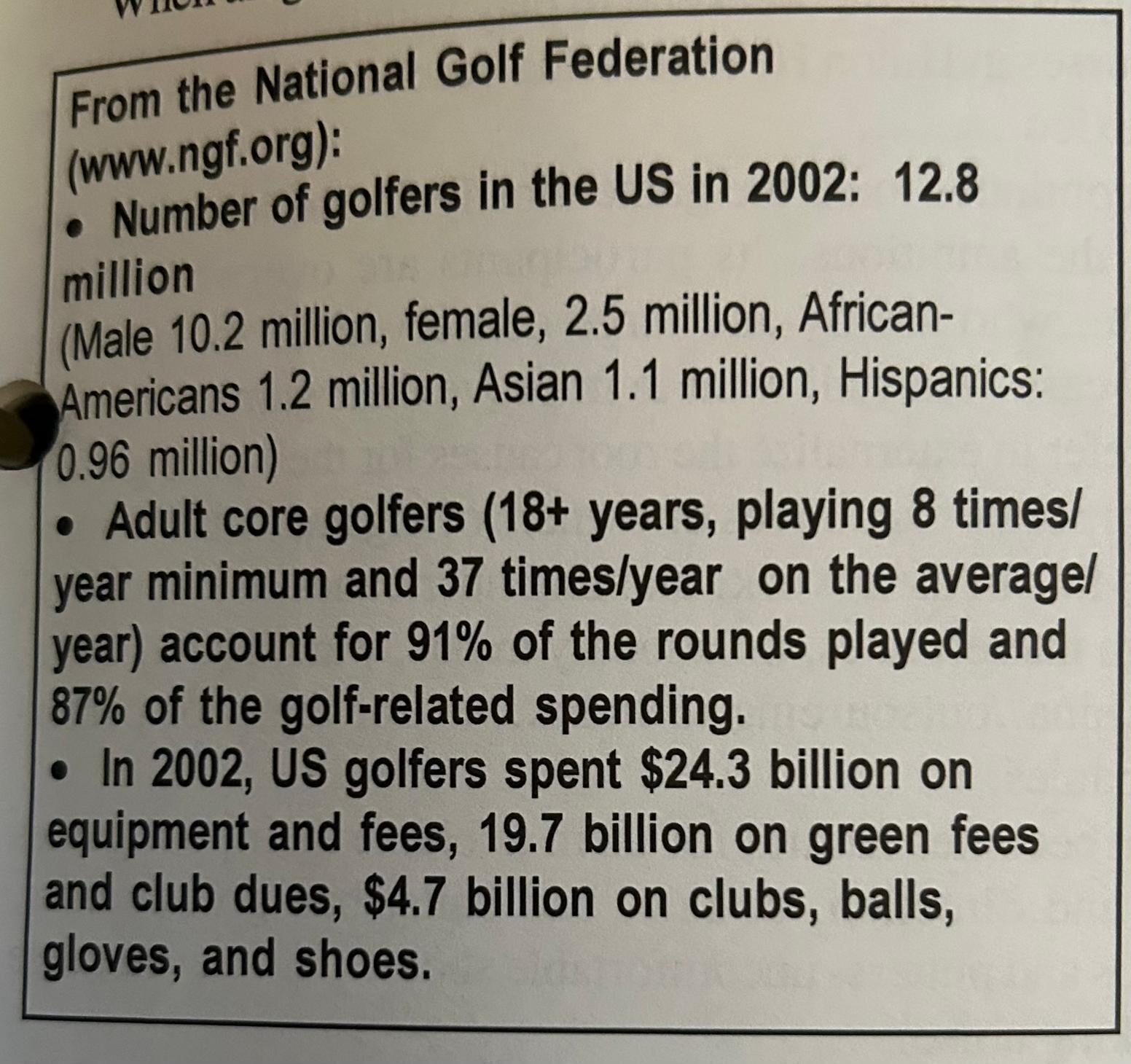
Golf is a multibillion-dollar sport. See the inset of the basic golf stats taken from the National Golf Federation (www.ngf.org). That’s why there is an exclusive golf channel with golf infomercials. To the best of my knowledge (I only have basic cable) you don’t see infomercials for tennis, football, or ice hockey. Only for golf.
The infomercial I was watching was
* Not about new and improved golf balls with the latest elastomers that give the balls the longest drive and the most bounces,
* Not about the new and improved design of dimples and how they improve the aerodynamics of the ball in flight to give the longest drive and the most bounces,
* Not about the symmetry of distribution of the weight within the ball,
* Not about the better design of the contour of the blade, or the newer alloy of the blade material of the club, and
* Not about the new and improved sweet-spot on the drivers.
It was also not about the correct posture and stance for the swing shown in an ad. In this ad, the peddler was showing his “training” golf club. This had a flexible joint in the middle. This joint remained straight only when the club was used, in what the peddler said, as the “correct swing.” If you swing it any other way, the joint buckled awkwardly, making the golfer look dumb.
The informercial was about the golfer himself or herself. Not the pro-golfer though. The target for the informercial was “mature” golfers –- golfers who are over forty who are “into the sport” because of social needs or business compulsions. The type you see in airports carrying huge golf bags on their way to seal big contracts on golf courses, or the affluent and leisurely class getting away for the weekend to play with their social equals on the manicured courses in Hilton Head, Florida beaches, or in the deserts of Arizona, New Mexico…
Golf in the US continues to be the game mostly for the leisurely, for the affluent, or for the ambitious. Its participants are overwhelmingly male, majority white, who are by and large conservative, socially and economically. They are desperate to to improve their game.
These golfers prefer to externalize the root causes for their poor games. Many of them are corporate executives or owners of big and small companies, and they routinely use these at work, blaming hurricanes, tsunamis, oil prices, droughts, high interest rates, inflationary trends, wars, Nafta, Cafta, competition from China, outsourcing to India… for the poor performance of their companies.
So, as golfers, it becomes natural for them to blame their poor games on the wind speed and direction, drizzle, bad balls, bad golf courses, somebody coughing, poorly designed clubs and putters, uncomfortable shoes… even geese flying overhead making noise.
Finally, here comes the Golf Guru, Roger Frederick* trying to sell his idea for helping golfers to improve their game by focusing on the golfers themselves, on their flexibility, rather their lack of flexibility.
It shouldn’t surprise anyone if these middle-aged golfers are stiff like their golf clubs, particularly the male species among them. After all, there are the movers and shakers in businesses and in their professions, putting in long, arduous hours to keep abreast in their narrow field of specialization. If you take away their sleeping and eating hours, travel times, and hours and hours in front of TV watching NFL, NBA, and other games, not much is left for anything, particularly if it demands commitments and regularity such as any exercise regimen.
Roger Frederick’s central thesis for improving golfers’ game is to improve their flexibility of their musculoskeletal system.
These days, when you think of flexibility, the things that would come to your mind are Tai-chi from China or Yoga from India. Roger Frederick’s infomercial talked about the same ideas that any $5 book on Yoga and Tai-chi would give in its first introductory chapter for improving the flexibility around shoulders, hips, elbows, wrists… necessary for general living and for any sport, including golf.
But Roger knows his audience very well. These 40-plus male target audiences are from a social class that is kind of supercilious, if not condescending, to learning anything from other cultures, especially if they are from emerging societies and old civilizations such as India or China.
So, Roger introduces the need for improving flexibility for golfers using all the appropriate golfing jargon, not mentioning even once “Yoga,” or “Tai Chi ” or “asanas.” There is no Omm, there is no Soorya Namaskar, no tongue-twisting Sanskrit names for the different postures, no loose garments, nor svelte women in leotards, no incense sticks, and no soothing music in the background. The only thing that tells you that Roger is familiar with Yoga is the sticky Yoga mat he is using to squat. I was impressed with Roger’s marketing strategy.
The backdrop is golf greens with trees, with portly men in their golfing pants and T-shirts practicing stretching.
With golfers spending over $4.7 billion on golfing clubs, balls, and accessories, Roger will be gleefully walking away to his bank with his DVDs selling for $29.99, without having to design, manufacture and sell any new golfing gadget, but asking golfers to sweat it out on a yoga mat on golfing greens.
(* www.frederickgolf.com). END