
By Premlata Venkataraman, (written in 2001)
The increasingly skewed gender ratio in India’s population is a sad reflection of Indians’ outright bias against girls. See below. The social consequences of man messing with nature by abusing technology can be horrendous.
(Already, in the poorer northern provinces of China, because of the skewed gender ratio, villages inhabited mostly by men dot the landscape. Police say crime is up among the men in the marriageable age who cannot find brides. Kidnapping of women is common, and gangs traffic in Vietnamese and North Korean women for Chinese men (Washington Post, May 29, 2001). India cannot escape a similar trend.)
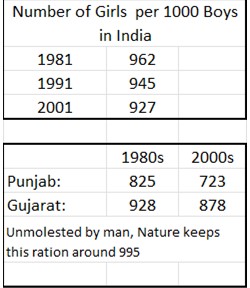
These skewed gender ratios are not because Indians have perfected the technique for conceiving male fetuses. No, it is only because of an unholy alliance between technology (ultrasound and amniocentesis) and the unscrupulous, unethical, and irresponsible radiologists and gynecologists in India-some of them women themselves.
This alliance has given a diabolical option to Indians to eliminate girls in families. “Spend Rs. 5000 now [for tests/abortions] and save a bundle later [in dowry],” says an ad hanging from trees in Punjab.
Adding to this disgrace, girls in poorer rural families go undernourished in their early years giving them problems in their child-bearing years. Girls’ literacy levels are low compared with boys’.
. This is the state of affairs in Gujarat and Punjab, the most industrialized states in India, where the literacy rates are low in spite of industrialization.
By comparison, in the less industrialized, but almost fully-literate Kerala, this gender-based disgrace is a lot less severe. So, education, not industrialization, is the key to address gender-related issues.
A cording to Hindustan Times, in India 430 mothers die during delivery per 100,000 live births. Even in low-income countries, this number is around 350. The statistic stands in sharp relief, given India’s accomplishments in missiles, nuclear weapons, satellite technologies and in the IT sector. Among the Indian middle class (~25% of the population), the mortality of mothers during childbirths is very low because of better medical care. So, death of uneducated, and poor mothers during delivery would be dreadfully high.
NRIs living outside India may not relate to these numbers. But beneath the surface, “Old World” values persist even among the educated NRIs with reference to gender preference.
Jagtar Singh, a machine operator in Punjab, summed it up with rural panache to the New York Times reporter: “Now it’s the girl’s family who pays the dowry,” he said. “In 20 or 25 years, you’ll see, it will be the boy’s family paying the dowry.” END